
Clinical picture. M., a man in his late forties, was referred after losing a senior position he had held for sixteen years; six months on, he remained preoccupied with the injustice of the dismissal, ruminating nightly and declining social contact while waiting for what he described as "the situation to be corrected." His sleep was fragmented, and he reported a persistent low-grade anger that left little room for adaptive grieving. During a session focused on the radical acceptance psychoeducation sheet, the clinician invited him to distinguish between the factual reality of the loss and his ongoing protest against that reality, noting that both could coexist with a legitimate sense of injustice. M. was initially resistant, interpreting acceptance as conceding that the dismissal had been fair; the clinician clarified that naming a fact does not endorse it. Over the following two weeks he reported a modest but noticeable reduction in ruminative loops at night, and he re-engaged with one social activity, which he framed as "deciding to live in the actual present rather than the one I wanted."
Radical Acceptance: PDF Worksheet, Tools and Exercises for DBT Practice
A printable DBT fiche PDF covering the resisting/accepting split, the 'turning the mind' practice, and clinical examples, for use as a visual psychoeducation support in session.
Clinical vignettes
Grief Looping After Unexpected Job Loss
Chronic Illness Resistance in a Young Adult
Clinical picture. K., a woman in her mid-twenties, had received a diagnosis of a chronic autoimmune condition eight months before the referral; she adhered to her medical regimen but spent considerable cognitive energy on "why me" questioning and on researching whether the diagnosis could be reversed or disputed. Her treating physician noted that the emotional burden appeared to be compounding her physical fatigue. The clinician introduced the radical acceptance framework using the two-path comparison from the information sheet, asking K. to observe what the resistance column cost her on an average day in terms of attention and energy. K. identified that the looping changed nothing about the diagnosis and was consuming resources she needed for rehabilitation. She did not report feeling at peace with her situation, but described the shift as "stopping the fight with the fact itself" while retaining the right to feel angry about it, a distinction she found clinically workable.
Explaining radical acceptance verbally tends to collapse almost immediately: patients hear the word "acceptance" and read surrender, betrayal, or complicity. This fiche PDF gives clinicians a structured visual tool to make the core DBT concept land correctly in session, before the patient has time to misread it.
Use this resource with your patients
Handout, exercises and materials ready to use, right inside SessionFuel.
Why Radical Acceptance Resists Verbal Explanation in Session
The semantic interference is rapid and predictable. A patient in active grief, freshly diagnosed with a chronic illness, or carrying unresolved perceived injustice will map "acceptance" onto resignation. Correcting that misreading requires more than a redefinition; it requires a side-by-side structural comparison that shows exactly what changes and what does not. That comparison is difficult to hold in working memory from a spoken explanation alone.
A second difficulty: the skill sits at the intersection of distress tolerance (Linehan's original framing in DBT) and the defusion work more familiar from ACT. Patients already juggling DBT distress tolerance skills or DBT emotion regulation skills can have a crowded working vocabulary. A concrete visual anchor cuts through that load, builds a shared clinical language, and saves time.
What the Fiche Contains: A Visual Map of the Concept
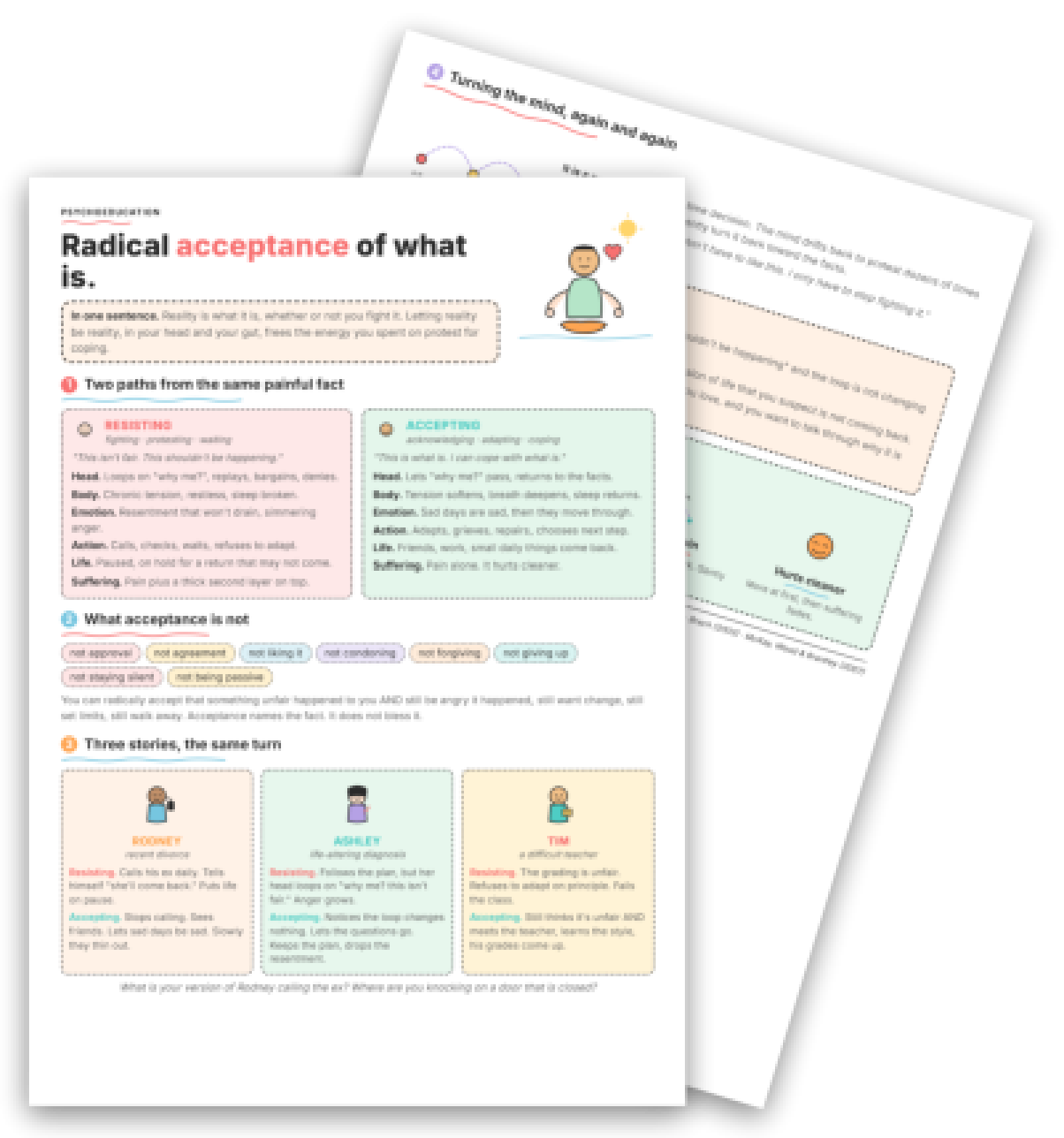
The fiche PDF is organized into four numbered panels, each serving a distinct psychoeducational function.
Panel 1 presents the decisive split in two parallel columns: RESISTING versus ACCEPTING, each traced across six dimensions: cognition, body sensations, emotion, action, life trajectory, and the nature of suffering. The contrast is precise. Under RESISTING, suffering is framed as "pain plus a thick second layer on top"; under ACCEPTING, as "pain alone. It hurts cleaner." That formulation tends to land faster in session than several minutes of oral explanation, because the patient can see both columns simultaneously rather than holding an abstract contrast in memory.
Panel 2 lists, in plain brief statements, everything acceptance is not: not approval, not agreement, not condoning, not forgiving, not giving up. The fiche states it directly: "Acceptance names the fact. It does not bless it." This panel preempts the most common resistance before the patient voices it, which changes the conversational dynamic considerably.
Panel 3 offers three short narrative vignettes, Rodney navigating a divorce, Ashley facing a life-altering diagnosis (a context where grief work and radical acceptance often converge), and Tim dealing with an unfair teacher, each showing the same clinical turning point across different life contexts. The section closes with a direct reflective prompt you can read aloud or leave with the patient.
Panel 4 introduces the "turning the mind" practice: a drift/notice/return cycle, with the rehearsal sentence "I don't have to like this. I only have to stop fighting it." A "To discuss in session" checklist and a compact "Remember" summary close the sheet.
The visual layout is where the fiche PDF earns its clinical value. The two-column structure in Panel 1 externalizes a comparison that a verbal explanation expects the patient to construct mentally. This is not a questionnaire to complete between sessions; it is a visual support the clinician uses in session to build vocabulary, contain misreading, and leave the patient with something concrete to return to.
> Key takeaway: The fiche's parallel-column structure makes the distinction between resisting and accepting visible on paper, which is precisely what an oral explanation cannot do on its own.
750+ clinical tools
A library built with and for clinicians, ready to use in session and extend between appointments.
Access all the toolsWhen and How to Introduce the Fiche
This resource is most useful from the third or fourth session onward, once the case formulation has identified a specific unresolved reality the patient continues to fight. Natural indications include active grief without forward movement, coping in crisis, chronic illness adjustment, or recurring anger fixed on an unchangeable fact. It integrates cleanly alongside tools like IMPROVE the Moment, ACCEPTS distress tolerance, DBT TIPP skills, and active acceptance work drawn from ACT. The Control, Influence, Accept framework can serve as a useful pre-step if the patient first needs to map what is and is not within their reach.
When introducing the fiche, avoid labelling the patient's current stance as "resistance." A workable opening: "There's a distinction in DBT between fighting a reality and facing it. This sheet lays it out visually in a way that tends to be clearer than anything I can describe verbally. I'd like to go through it with you." Work Panel 1 together; most patients locate themselves spontaneously in the left column, which opens the clinical conversation without confrontation.
One limit worth naming: with patients whose trauma history involved acceptance being weaponized against them or equated with submission, Panel 2 warrants additional clinical attention. The fiche's framing is solid, but the relational context of introduction matters more than the content for this subgroup. In those cases, pairing it with a discussion of adaptive versus maladaptive coping provides useful grounding before engaging the acceptance column directly.
The fiche does not replace the therapeutic relationship, but it makes a genuinely contested concept concrete, discussable, and portable between sessions.
Use it with your patients
Share this tool in the mobile app and follow the work between sessions.
Sources
- Linehan, M. M. (1993). Cognitive-Behavioral Treatment of Borderline Personality Disorder. Guilford Press.
- Linehan, M. M. (2015). DBT Skills Training Manual, Second Edition. Guilford Press.
- Linehan, M. M. (2015). DBT Skills Training Handouts and Worksheets, Second Edition. Guilford Press.
- Segal, O., Bronshtein, K., & Weinbach, N. (2025). The benefits of radical acceptance of reality as a standalone strategy for emotion regulation. Current Psychology.
Your session continues in your patients' pocket
Use with a patientYour resources, available everywhere
The handouts, exercises, programs and audios above: you choose which ones to make available to your patients, in the mobile app dedicated to them.
And far more than a library
The app goes well beyond resources, to support your patients every day:
Related categories
Explore other clinical resources by category.

Mood
Evidence-based worksheets and clinical tools for mood disorders: CBT, ACT, and positive psychology resources for psychologists and therapists.

Emotions
Clinical resources on emotion regulation: worksheets, coping tools, CBT, REBT, and ACT exercises for therapists working across diagnoses and age groups.

Transitions
Clinical hub for life transitions: tools, worksheets and exercises to support psychosocial adjustment, role change and identity work in practice.

Understand
Clinical hub for the therapeutic aim 'Understand': worksheets and tools to build patient insight across CBT, ACT, schema therapy and more.

Regulate
Clinical resources for emotion regulation: worksheets, ACT exercises, and psychoeducation tools for affect regulation across diagnoses. For clinicians.

DBT
DBT worksheets and exercises for clinicians: distress tolerance, emotion regulation, and interpersonal skills tools for dialectical behavior therapy practice.