
Clinical picture. M., a woman in her late forties, was referred eight months after the death of her mother following a prolonged illness. She described several weeks of relative functioning, then a sudden return of intense grief triggered by a familiar piece of music, and she arrived to the session convinced she had "gone backwards." The clinician introduced the Grief Fact Sheet, walking through the wave model and the explicit note that a resurgence does not undo calmer days. M. read the line about anniversaries and sensory triggers aloud, paused, and said it described her week precisely. By the end of the session she had reframed the episode as a wave rather than a failure, and her sense of alarm had visibly reduced.
Grief: PDF Fact Sheet, Tools and Exercises for Clinical Practice
A printable grief fact sheet, clinical tools, and exercises to explain bereavement's non-linear course, normalize its full emotional range, and support patients through loss.
Clinical vignettes
Normalising a Resurgence After Apparent Stability
Addressing Relief and Guilt After Complicated Loss
Clinical picture. T., a man in his early sixties, presented three months after his brother's death following years of addiction-related conflict. Alongside sadness, he reported persistent guilt about feeling relief, which he interpreted as evidence that he had not truly loved his brother. The clinician offered the Grief Fact Sheet as a reading task between sessions, highlighting the section listing relief and resilience as common responses, particularly after a complicated bond. At the next appointment T. brought the sheet back annotated; he had circled several items from the emotion palette and written "me" beside relief and exhaustion. The psychoeducational framing opened space to explore the ambivalence without the session being dominated by self-reproach.
The Kübler-Ross stage model is so culturally embedded that most patients arrive at bereavement sessions already grading themselves against it. When their grief doesn't move in a straight line, the self-criticism that follows can become clinically significant in its own right. This grief fact sheet (printable PDF) was built to replace that implicit benchmark with a more accurate, and more workable, frame, directly in session, with the patient, using a visual support they can keep.
Use this resource with your patients
Handout, exercises and materials ready to use, right inside SessionFuel.
Why Grief Resists Explanation Without a Visual Scaffold
Oral psychoeducation on bereavement has a retention problem. You describe the wave model; the patient understands in the room; then the next session they report "going backwards" after a difficult weekend. The conceptual content didn't stick as a usable reference point, because there was nothing concrete to return to when the next wave arrived.
There is also the breadth problem. Grief's affective range includes relief, laughter, irritability, and brain fog alongside the expected sadness and yearning. Normalizing fifteen states verbally, without a fixed visual representation, is inefficient at best. Patients frequently read relief or functional resilience as evidence they didn't love the person sufficiently, and that misreading feeds guilt in bereavement and chronic self-monitoring that has its own maintenance cycle.
The fiche PDF addresses both problems by turning a complex, diffuse phenomenology into a single, scannable visual object.
What the Fiche Contains: Four Panels, One Clear Frame
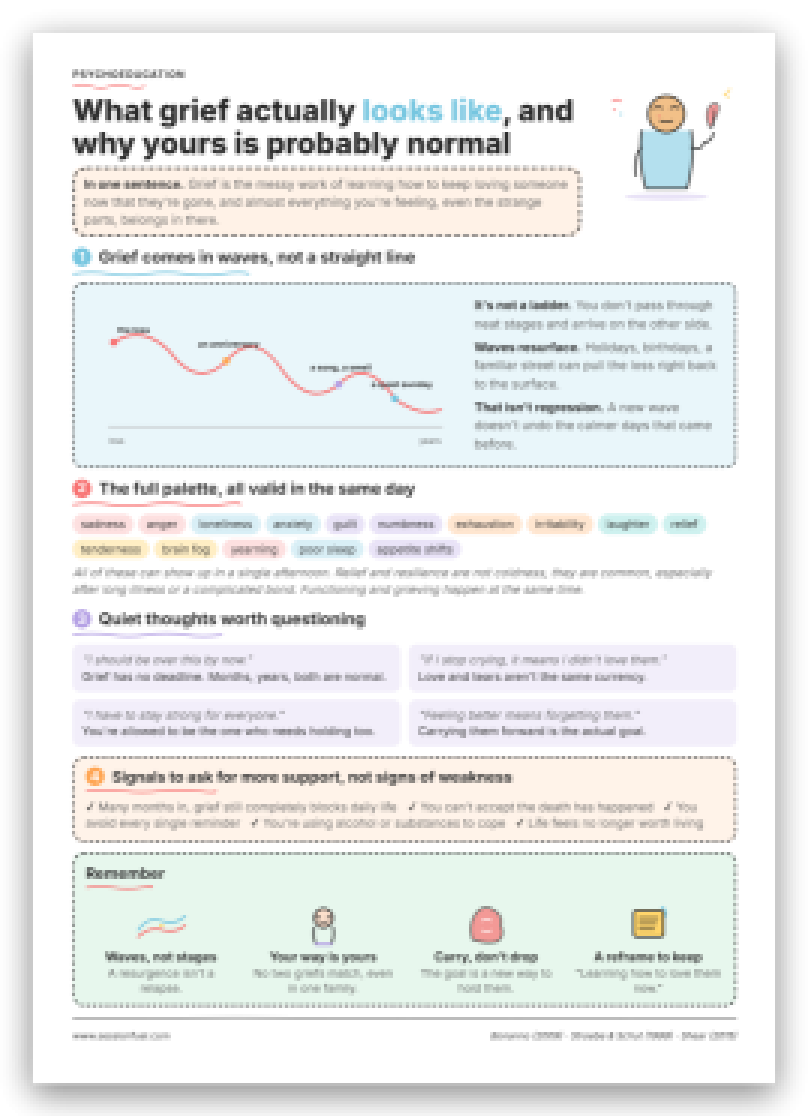
The fiche opens with a precise orienting sentence: "Grief is the messy work of learning how to keep loving someone now that they're gone." That framing sets the clinical register for everything that follows.
Panel 1 renders the wave model as a graphic, showing a loss point and its recurring resurgences over time, with concrete triggers named: an anniversary, a song, a familiar smell, a quiet Sunday. The explicit statement "That isn't regression" accomplishes in three words what often requires several minutes of oral explanation, especially with patients who have been applying a linear progress framework and quietly penalizing themselves for each recurrence. This pairs naturally with adaptive versus maladaptive coping work you may already be running in parallel.
Panel 2 presents fifteen affective states arranged together in a single visual field: sadness, anger, loneliness, anxiety, guilt, numbness, exhaustion, irritability, laughter, relief, tenderness, brain fog, yearning, poor sleep, appetite shifts. Showing this range visually, all at once, makes normalization more credible and faster than a spoken list. It also directly addresses the belief that functioning and grieving are mutually exclusive, which is relevant both to common trauma reactions and to presentations where emotion regulation is compromised.
Panel 3 identifies four grief-specific cognitive distortions verbatim and pairs each with its reframe. "If I stop crying, it means I didn't love them" maps directly onto the automatic thought restructuring work you may already be using. The panel also addresses the caregiver freeze ("I have to stay strong for everyone"), which is frequently the patient's entry-point for guilt-driven suppression. The distortions here are grief-specific enough that standard cognitive distortions frameworks don't always reach them efficiently.
Panel 4 lists five signals warranting stepped-up support, framed explicitly as "not signs of weakness." This is the section to reference when you are considering a complicated grief or prolonged grief disorder presentation, or when you want to open a conversation about PTSD following traumatic bereavement. The framing reduces the shame barrier around help-seeking at a critical moment.
> À retenir: This fiche is a visual support that facilitates the psychoeducation conversation in session. The clinician works through it with the patient; it is not a self-report form to fill in alone. It leaves the patient a concrete visual anchor to return to when the next wave arrives.
Clinical library
750+ clinical tools
A library built with and for clinicians, ready to use in session and extend between appointments.
Access all the toolsSeveral resource types
Psychoeducation handouts
Understand at a glance
Interactive exercises
To do and fill in
Interactive programs
A structured path
Audios
Meditation and relaxation
Psychometric tests
Automatic scoring
When and How to Propose It
The fiche fits best in the early-to-mid phase of bereavement work, once the initial alliance is established and the patient has enough reflective capacity to engage rather than simply absorb. The clearest indicator is when sessions keep re-covering the same normalizing ground without gaining traction, or when the patient is actively benchmarking their grief against an imagined timeline.
A low-friction introduction: "I have a one-page visual summary of what grief actually tends to look like in practice. I'd like to go through it with you." No labeling, no diagnostic framing, just a shared reading. Panel 2 tends to produce the strongest recognition responses; Panels 3 and 4 often open direct disclosures that didn't surface earlier.
The fiche pairs well with later-phase work around continuing bonds and what it means to carry the person forward, or with sessions where death anxiety surfaces as the patient begins processing their own mortality. For patients where rumination is a dominant maintenance process, Panel 1's explicit statement that resurgence is not relapse becomes a useful anchor between appointments. When sadness persists at clinical intensity, the fiche can precede more structured psychoeducation work without duplicating it. And when maintaining hope becomes part of the treatment focus, the closing reframe on the fiche ("learning how to love them now") offers a starting point for values-based discussion.
One genuine contraindication: acute crisis or shock presentation. Structured psychoeducation requires a minimum window of reflective functioning. If the patient is not yet in that window, set the fiche aside and return to it when they are.
The fiche PDF does not replace case formulation, alliance work, or the clinical judgment you bring to each session. It compresses a dense piece of psychoeducation into a visual object, saves session time, and gives the patient something durable to hold between appointments.
Use it with your patients
Share this tool in the mobile app and follow the work between sessions.
Sources
- Bonanno, G. A. (2009). The Other Side of Sadness: What the New Science of Bereavement Tells Us About Life After Loss. Basic Books.
- Worden, J. W. (2009). Grief Counseling and Grief Therapy: A Handbook for the Mental Health Practitioner (4th ed.). Springer Publishing Company.
Patient mobile app
Your session continues in your patients' pocket
Use with a patientYour resources, available everywhere
The handouts, exercises, programs and audios above: you choose which ones to make available to your patients, in the mobile app dedicated to them.
Psychoeducation handoutsInteractive exercisesInteractive programsAudiosPsychometric tests
And far more than a library
The app goes well beyond resources, to support your patients every day:
Standardized tests
Therapy journal
Gamification
Wellbeing challenges
Introspection prompts
Therapist homework
Related categories
Explore other clinical resources by category.

Mood
Evidence-based worksheets and clinical tools for mood disorders: CBT, ACT, and positive psychology resources for psychologists and therapists.

Understand
Clinical hub for the therapeutic aim 'Understand': worksheets and tools to build patient insight across CBT, ACT, schema therapy and more.
Repair & soothe
Clinical resources for the repair and soothe therapeutic aim: worksheets, exercises and tools to build self-compassion, reduce shame and restore emotional safety.

CBT
CBT worksheets, cognitive restructuring exercises & behavioral tools for clinicians. Evidence-based resources for every phase of cognitive behavioral therapy.

Humanistic
Printable clinical resources for humanistic therapy: worksheets, exercises, and psychoeducation programs for practitioners using person-centered and experiential approaches.

Integrative
Integrative therapy clinical resources: worksheets, psychoeducation programs, and exercises for eclectic, multimodal practice across orientations.