
A., a woman in her mid-forties, presented following the involuntary end of a fifteen-year career after organisational restructuring. She minimised her distress in session, repeating that she had no right to grieve because 'nobody died.' The clinician introduced the psychoeducation sheet on grief myths, drawing her attention to the reality that job loss, role loss, and an imagined future all constitute genuine losses. A. read the sheet between sessions and returned noting, with some surprise, that she had been stacking shame on top of pain by holding herself to a standard she would never apply to a friend. This shift in attribution allowed the work to move toward processing the loss itself rather than defending its legitimacy.
Grief Myths: PDF Worksheet, Tools and Exercises for Clinical Practice
A visual psychoeducation sheet helping clinicians dismantle the beliefs that compound bereavement with shame, and make space for each patient's own grief process in session.
Clinical vignettes
Shame Around a Non-Death Loss
Pressure to Reach Closure on Schedule
T., a man in his early sixties, sought consultation approximately eighteen months after the death of his adult son, reporting that family members had begun signalling that he should be 'moving on.' He described his ongoing waves of grief as evidence that something was wrong with him clinically. The clinician shared the informational sheet, focusing on the myth that grief has a deadline and the corresponding reality that intensity shifts over time without grief disappearing on a fixed schedule. T. did not immediately accept this framing, but in the following session he said that reading it had given him language to use with his family. Ongoing work focused on tolerating grief's non-linear course rather than treating recurrence as pathology.
When a bereaved patient says "I should be over this by now," they are not describing their inner experience, they are applying a rule someone handed them. Correcting that verbally, mid-session, is possible, but rarely efficient and almost never lasting. This fiche PDF gives you a structured visual to do it clearly, quickly, and in a format the patient can take home.
Use this resource with your patients
Handout, exercises and materials ready to use, right inside SessionFuel.
Why Grief Myths Resist Verbal Correction
The problem with normative grief beliefs is that they arrive from trusted sources: family members, cultural scripts, even previous clinicians. By the time a patient reaches your practice, the myth has been rehearsed so many times it feels factual. When you challenge it orally, you are competing against years of reinforcement.
What makes this particularly difficult is that grief myths generate secondary suffering on top of primary pain. The fiche names this precisely: "When you believe grief should look a certain way, you stack guilt, shame and anxiety on top of pain." That secondary layer, the self-judgment, the comparison to imagined norms, is what guilt psychoeducation and shame-focused work target downstream. The myths are the upstream driver.
There is also a specific interpretive bias at play: patients whose grief does not match the expected template (no visible sadness, no linear "stages," relief mixed with longing) often pathologize themselves before you have had the chance to assess. A purely verbal reframe in session can feel transient. A visual reference that names their experience explicitly changes the dynamic.
What the Fiche Contains: A Visual Support for the Explanation
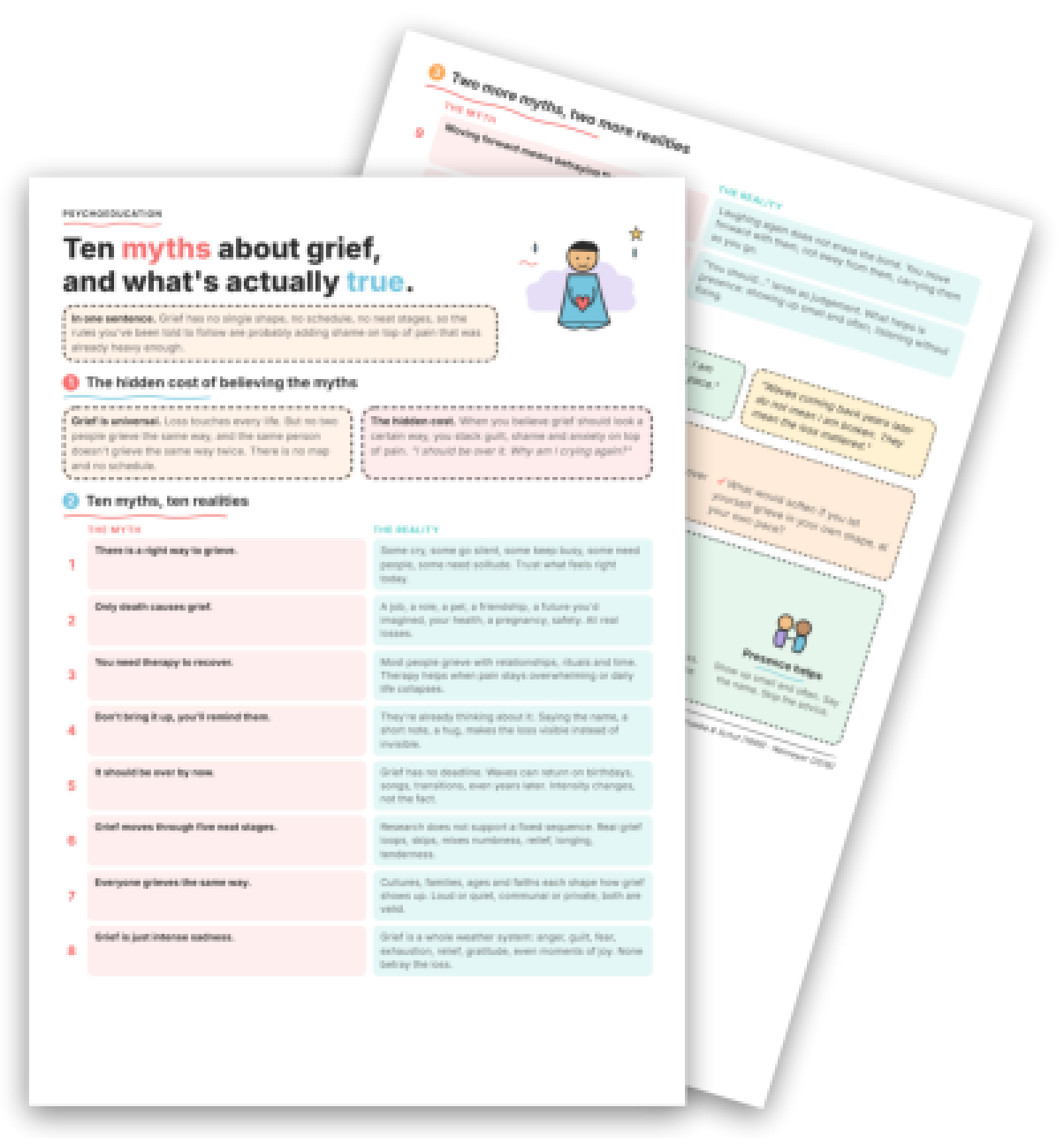
The fiche is built around a clean myth-versus-reality table covering ten common beliefs, covering the full range of what patients most frequently internalize: that grief has a correct form, a fixed timeline, a five-stage sequence, and that it applies only to death. Each row pairs the distorted belief with a concrete corrective. For example, myth 6 ("Grief moves through five neat stages") is met with: "Research does not support a fixed sequence. Real grief loops, skips, mixes numbness, relief, longing, tenderness." That single sentence does more work in session than a paragraph of verbal explanation, because it normalizes clinical complexity without minimizing the loss.
Beyond the table, the fiche includes three reframes framed in first-person language ("There is no map for this. I am allowed to follow my own pace.") and three guided session questions that you can work through together: which myth has the patient been carrying, whose voice is the "I should be over it" thought, and what would soften if they grieved at their own pace. There is also a compact "Remember" panel, four short entries covering non-linearity, returning waves, the full emotional spectrum of grief, and how presence helps more than advice.
> Key point: The fiche is a visual support that facilitates the explanation in session, not a self-administered questionnaire. You use it to walk through the myths together, name what applies, and hand the patient a concrete reference that validates their specific experience of loss.
This is especially useful when grief co-occurs with rumination, death anxiety, or trauma reactions, where the patient's already limited attentional bandwidth makes dense verbal explanations hard to retain.
Clinical library
750+ clinical tools
A library built with and for clinicians, ready to use in session and extend between appointments.
Access all the toolsSeveral resource types
Psychoeducation handouts
Understand at a glance
Interactive exercises
To do and fill in
Interactive programs
A structured path
Audios
Meditation and relaxation
Psychometric tests
Automatic scoring
When and How to Use the Fiche in Practice
This fiche PDF fits naturally in the first two to three sessions of a bereavement follow-up, once you have completed an initial anamnèse and established sufficient alliance. It is also well-suited for any moment during longer work when a patient presents with self-judgment about the form or duration of their grief.
Useful profiles: patients who minimize their loss because it was "not a death" (a relationship, a role, a pregnancy), patients who are confused by ambivalent or delayed reactions, and those in whom you observe the secondary suffering pattern described above. It pairs well with work on maintaining the bond differently and with sadness psychoeducation later in the follow-up.
To introduce it without labeling the patient, you might say: "I'd like to look at something with you, a list of ideas about grief that most people absorb without realizing it. Tell me which ones feel familiar." That framing keeps it collaborative and keeps you out of the role of correcting. Debrief by asking which row landed hardest, and which myth has cost the patient the most. For patients where resilience work is part of the longer plan, or where hope is genuinely fragile, the three reframes on the fiche can serve as an early anchor before more structured work begins.
The fiche does not substitute for emotion regulation skills or for processing the loss itself. Its role is narrower and more upstream: it clears the shame that was never warranted, and opens the space for everything else to follow.
Use it with your patients
Share this tool in the mobile app and follow the work between sessions.
Sources
- Kubler-Ross, E. (1969). On Death and Dying. Simon & Schuster.
- Worden, J. W. (2018). Grief Counseling and Grief Therapy: A Handbook for the Mental Health Practitioner (5th ed.). Springer Publishing Company.
- Elisabeth Kubler-Ross Foundation. 5 Stages of Grief. Elisabeth Kubler-Ross Foundation.
Patient mobile app
Your session continues in your patients' pocket
Use with a patientYour resources, available everywhere
The handouts, exercises, programs and audios above: you choose which ones to make available to your patients, in the mobile app dedicated to them.
Psychoeducation handoutsInteractive exercisesInteractive programsAudiosPsychometric tests
And far more than a library
The app goes well beyond resources, to support your patients every day:
Standardized tests
Therapy journal
Gamification
Wellbeing challenges
Introspection prompts
Therapist homework
Related categories
Explore other clinical resources by category.

Mood
Evidence-based worksheets and clinical tools for mood disorders: CBT, ACT, and positive psychology resources for psychologists and therapists.

Understand
Clinical hub for the therapeutic aim 'Understand': worksheets and tools to build patient insight across CBT, ACT, schema therapy and more.

Repair & soothe
Clinical resources for the repair and soothe therapeutic aim: worksheets, exercises and tools to build self-compassion, reduce shame and restore emotional safety.

Humanistic
Printable clinical resources for humanistic therapy: worksheets, exercises, and psychoeducation programs for practitioners using person-centered and experiential approaches.

Integrative
Integrative therapy clinical resources: worksheets, psychoeducation programs, and exercises for eclectic, multimodal practice across orientations.

Anxiety
Clinical hub for anxiety disorders: CBT and ACT worksheets, psychoeducation sheets, and exercises for assessment and treatment across the anxiety spectrum.