
Clinical picture. M., a woman in her early forties, presented with persistent low mood and a pattern of self-blame following her mother's decline into dementia; she described feeling responsible for every setback in her mother's care, whether or not she had any control over it. Her clinician introduced the psychoeducation program on guilt, starting with Lesson 1, which distinguishes healthy guilt from its disproportionate, chronic form and separates guilt from shame. Between sessions, M. completed the reflective prompts and identified that her guilt was largely irrational and disconnected from actual wrongdoing. At the following session she was able to articulate, with some hesitation, that she had been conflating guilt with shame, a distinction that opened a more productive conversation about self-compassion and realistic limits of responsibility.
Guilt Psychoeducation: A Structured 6-Lesson Clinical Program
Help patients distinguish healthy from toxic guilt, recognize manipulation, and move from self-punishment toward self-forgiveness, step by step.
Clinical vignettes
Chronic Guilt in a Caregiver Role
Guilt After a Difficult Professional Decision
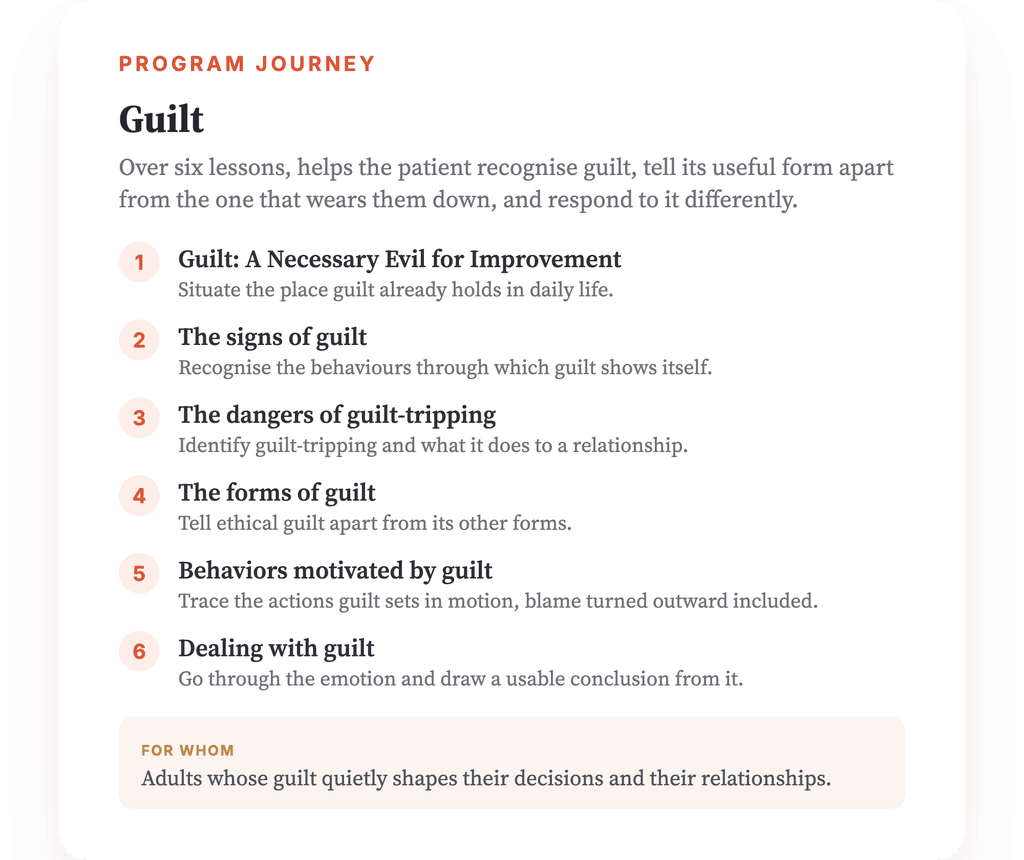
Clinical picture. T., a man in his mid-thirties, sought support after having to dismiss a colleague and reported ruminating nightly over the decision, convinced he had caused lasting harm despite having followed a fair process. His clinician assigned the first lesson of the guilt psychoeducation program, which frames guilt as a potential guide to moral reflection rather than proof of wrongdoing, and includes a multiple-choice prompt asking patients to identify the specific situations that trigger the emotion. T. returned having selected responses describing guilt proportional to an outcome but disproportionate to his actual responsibility, which gave the session a concrete starting point. Progress was modest but the exercise helped him begin separating an understandable moral discomfort from a distorted sense of personal culpability.
Use this resource with your patients
Handout, exercises and materials ready to use, right inside SessionFuel.
Why guilt is harder to work with than it looks
Guilt sits at the intersection of moral development, relational dynamics, and self-worth, and that is precisely what makes it clinically slippery. Patients rarely arrive with a clear picture of what they are actually feeling. They confuse guilt with shame, collapse it into remorse, or deny it entirely while displaying every somatic and behavioral sign. Explaining these distinctions verbally in a consultation is possible, but the concepts rarely settle: without a structured framework to return to, patients tend to revert to their habitual labels, and to their habitual responses.
The clinical challenge compounds when guilt-tripping is part of the picture. Whether it originates in family systems, professional contexts, or the patient's own inner critic, externally induced guilt is particularly difficult to name without a map. Patients need time, guided reflection, and language they can own before they can begin to separate what genuinely belongs to them from what has been placed there by others. That kind of work does not fit neatly into a single consultation.
750+ clinical tools
A library built with and for clinicians, ready to use in session and extend between appointments.
Access all the toolsWhat the program contains
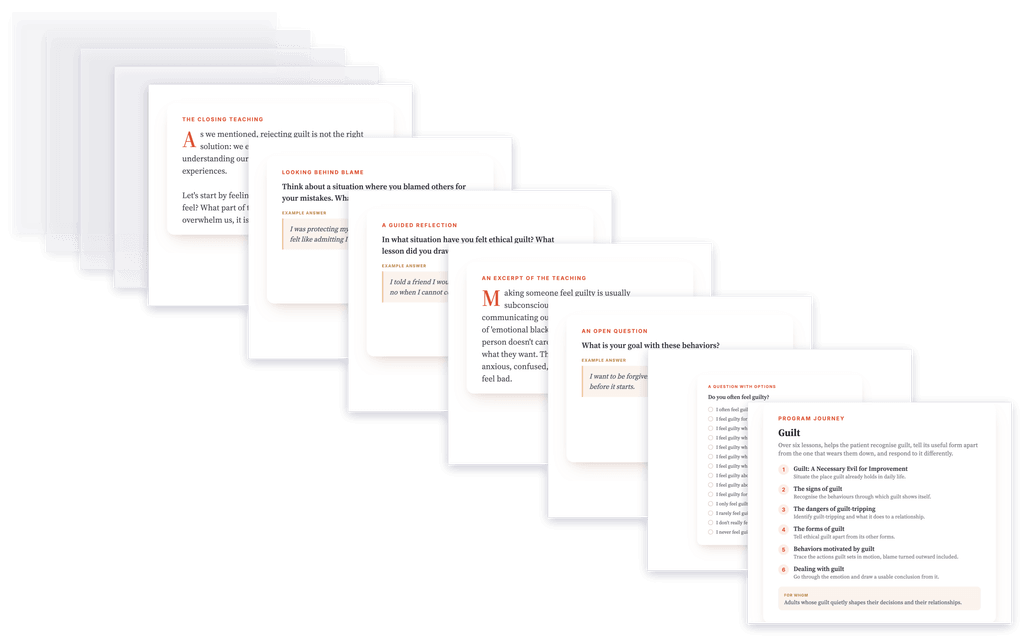
This structured 6-lesson curriculum moves patients through the full emotional and cognitive territory of guilt, one step at a time.
Lesson 1 establishes the conceptual foundation: what guilt actually is, how it differs from shame and remorse, and the critical distinction between healthy and unhealthy guilt, including the clinical significance of feeling no guilt at all. Lesson 2 maps guilt's physical, emotional, psychological, and social signs, giving patients concrete vocabulary to recognize the emotion across its many presentations. Lesson 3 introduces guilt-tripping as a relational mechanism, with guided prompts exploring family, social, and professional contexts, as well as self-induced guilt.
Lesson 4 differentiates four sources of guilt: deontological (values violated), empathic (another person harmed), existential (life goals unmet), and inequality guilt, a typology that makes attribution work far more precise. Lesson 5 examines guilt-driven behaviors: denial, repression, projection, self-punishment, overcompensation, and the one constructive path, which is expression. Lesson 6 closes the arc with a structured three-step process: welcoming and listening to the emotion, considering apology or repair, and practicing self-forgiveness through reflection and chosen affirmations.
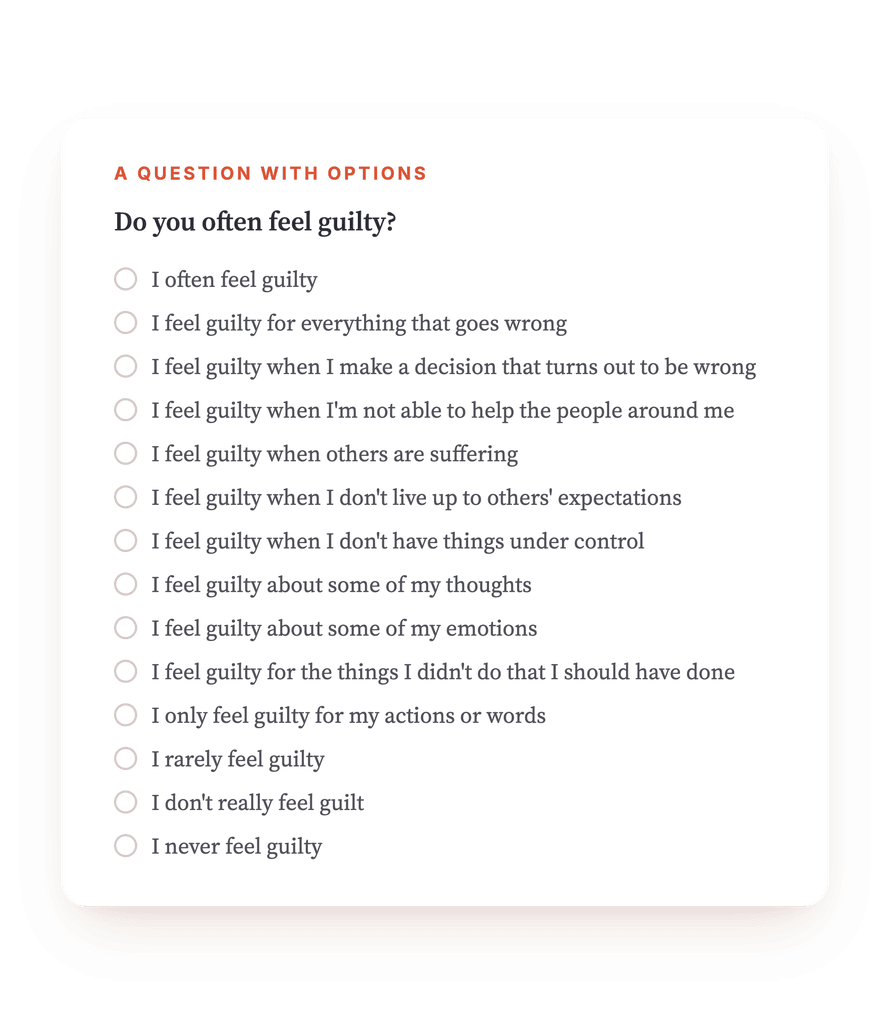
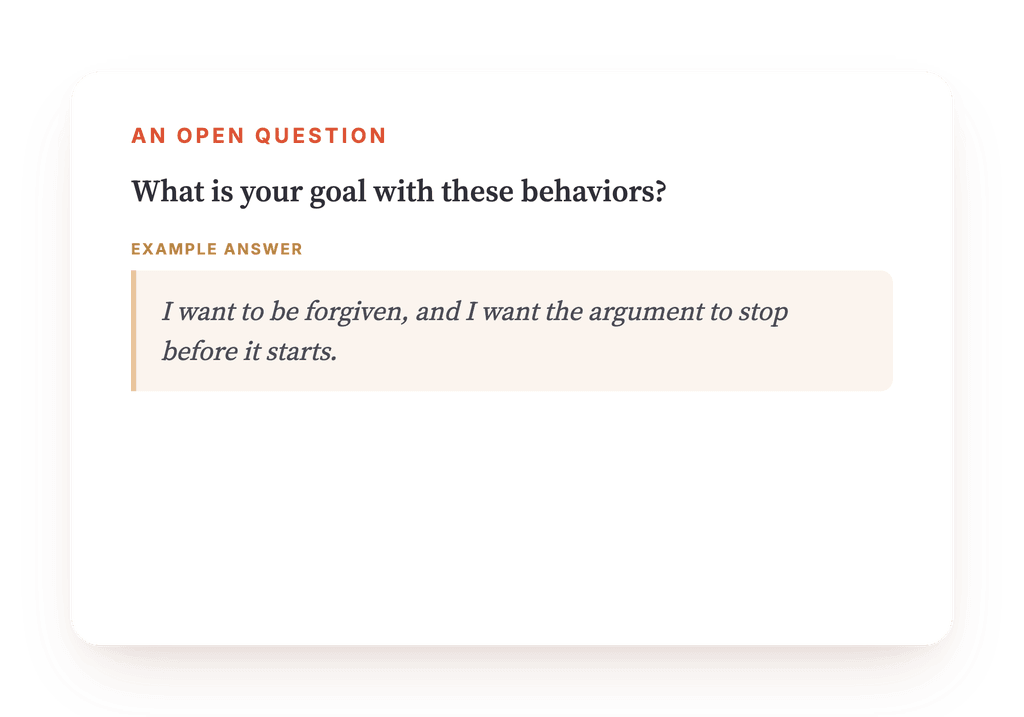
Each lesson combines psychoeducation text with multiple-choice questions and open guided prompts, so the patient does not just read, they respond, reflect, and produce material that becomes clinically usable.
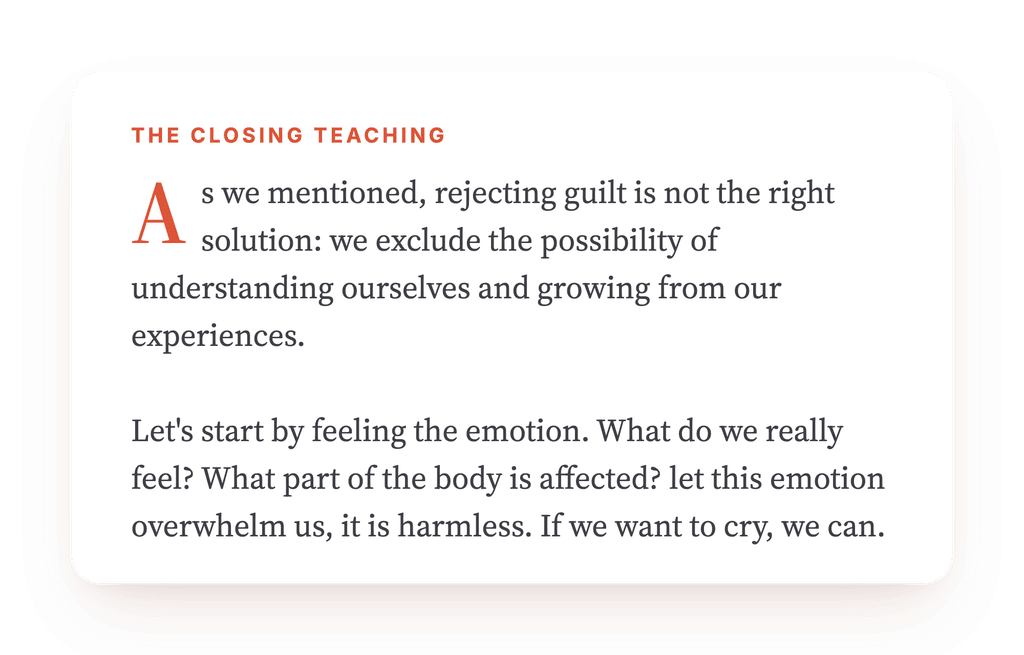
The preview illustrations embedded here (an overview map and a sample of cards) show only a small fraction of the program. The complete curriculum contains many more lessons, steps, guided prompts, and reflection questions than what these aperçus reveal.
This program is available to patients through the mobile application that is the dedicated patient-side interface of SessionFuel: once you assign it, your patient works through each lesson directly on their phone, on their own, between appointments.
Use it with your patients
Share this tool in the mobile app and follow the work between sessions.
How to integrate it as between-session homework
This curriculum is assigned as autonomous homework for patients to complete between consultations, at their own pace. It suits a broad range of profiles: patients with chronic self-blame, those prone to self-sacrifice patterns, individuals caught in approval-seeking dynamics, or anyone whose guilt appears disproportionate, diffuse, or poorly differentiated from shame.
It also fits naturally alongside work on the punitiveness schema, self-forgiveness, or nonviolent communication when the patient's guilt is entangled with relational resentment or boundary difficulties.
Key insight: The richest clinical use of this program is not the psychoeducation itself, it is what the patient brings back. Their answers to the guided prompts (when did they feel guilt-tripped, what behaviors do they use to overcompensate, what self-forgiveness affirmations feel true) give you direct access to material that verbal questioning rarely surfaces.
When introducing the program, a single sentence is usually enough: "Between now and our next meeting, I'm going to assign you a structured reflection on guilt, you'll work through it step by step on your phone, and we'll pick up what comes up when we meet." At the next consultation, the patient's written responses become a concrete starting point. You might focus on where they located themselves on the healthy-unhealthy guilt axis, which guilt-driven behaviors they recognized, or which of the four guilt sources resonated most.
Pair it, if relevant, with the Feeling Guilty: A Structured Responsibility Exercise or the Self-Compassion After Mistakes exercise for patients who need a more targeted single reflection before or after working through the full program. For patients whose guilt is intertwined with broader emotional avoidance, the Managing Emotions or Inner Dialogue Psychoeducation programs make natural companions.
Your session continues in your patients' pocket
Use with a patientYour resources, available everywhere
The handouts, exercises, programs and audios above: you choose which ones to make available to your patients, in the mobile app dedicated to them.
And far more than a library
The app goes well beyond resources, to support your patients every day:
Related categories
Explore other clinical resources by category.

Identity
Clinical resources for self-identity work in therapy: CBT, ACT, schema tools for clinicians addressing self-concept, core beliefs, and identity disruption.

Emotions
Clinical resources on emotion regulation: worksheets, coping tools, CBT, REBT, and ACT exercises for therapists working across diagnoses and age groups.

Understand
Clinical hub for the therapeutic aim 'Understand': worksheets and tools to build patient insight across CBT, ACT, schema therapy and more.

CBT
CBT worksheets, cognitive restructuring exercises & behavioral tools for clinicians. Evidence-based resources for every phase of cognitive behavioral therapy.

Compassion-focused
CFT clinical tools for practioners: exercises, programs and guided audio on shame, self-criticism, guilt and self-compassion. Ready to use in session.
Anxiety
Clinical hub for anxiety disorders: CBT and ACT worksheets, psychoeducation sheets, and exercises for assessment and treatment across the anxiety spectrum.