
Clinical picture. M., a woman in her late thirties presenting with persistent low mood and rumination, described feeling wholly responsible for an argument that had led her adult sister to disengage from family contact. Between sessions, the clinician assigned the structured guilt exercise, asking M. to walk through each question in writing. She returned having articulated, for the first time, that several factors outside her control had contributed to the rupture, including longstanding relational patterns that predated her involvement. When the clinician reviewed her responses, M. acknowledged that fully assuming blame had kept her from noticing her sister's own role, and she began to express a more proportionate sense of accountability. No resolution of the family situation was reached, but the exercise reduced the intensity of her self-directed hostility enough to allow more productive session work.
Feeling Guilty: A Structured Responsibility Exercise
Help patients examine self-attributed responsibility, name the emotional weight of guilt, and build proportionate accountability between sessions.
Clinical vignettes
Disproportionate Blame After a Family Conflict
Guilt Following a Workplace Incident
Clinical picture. T., a man in his mid-forties referred for adjustment difficulties after being placed on administrative leave, reported intrusive guilt centred on a procedural error that had affected a colleague. The clinician introduced the responsibility exercise as homework, guiding T. to describe the incident, examine why he held himself solely accountable, and name the emotional texture of that responsibility. His written responses revealed that he had been operating under chronic understaffing, a systemic factor he had not previously weighed against his personal conduct. At the following session, he reported that articulating his emotional reaction in question three had felt uncomfortable but clarifying, and that imagining a fuller, more balanced accountability in question four had slightly loosened the rigidity of his self-blame. The exercise did not eliminate guilt, yet it introduced enough cognitive flexibility to begin discussing proportionate responsibility in a sustained way.
Why guilt resists verbal explanation alone
Guilt is rarely a clean signal. In your consulting room, patients arrive carrying a diffuse sense of moral wrongness that they struggle to locate, describe, or calibrate. Some collapse their entire role in a complex interpersonal event into a single crushing verdict; others oscillate between full self-blame and defensive dismissal. Either way, oral exploration alone tends to loop: the clinician asks, the patient restates the same conviction, and the session ends without movement.
The clinical difficulty is not that patients refuse to think about guilt, it is that their thinking stays stuck at the surface level of the verdict ("I ruined everything," "I should have known better") without ever reaching the actual causal chain, the emotional texture beneath it, or the question of whether genuine accountability could open a path forward. This is precisely where personalization as a cognitive distortion operates silently, and where a structured written prompt can do what a spoken question cannot. The Self-Blame PDF worksheet and the Responsibility Pie Chart address the attribution side; this exercise adds the emotional and adaptive layer that those tools leave open.
Use this resource with your patients
Handout, exercises and materials ready to use, right inside SessionFuel.
What the exercise contains
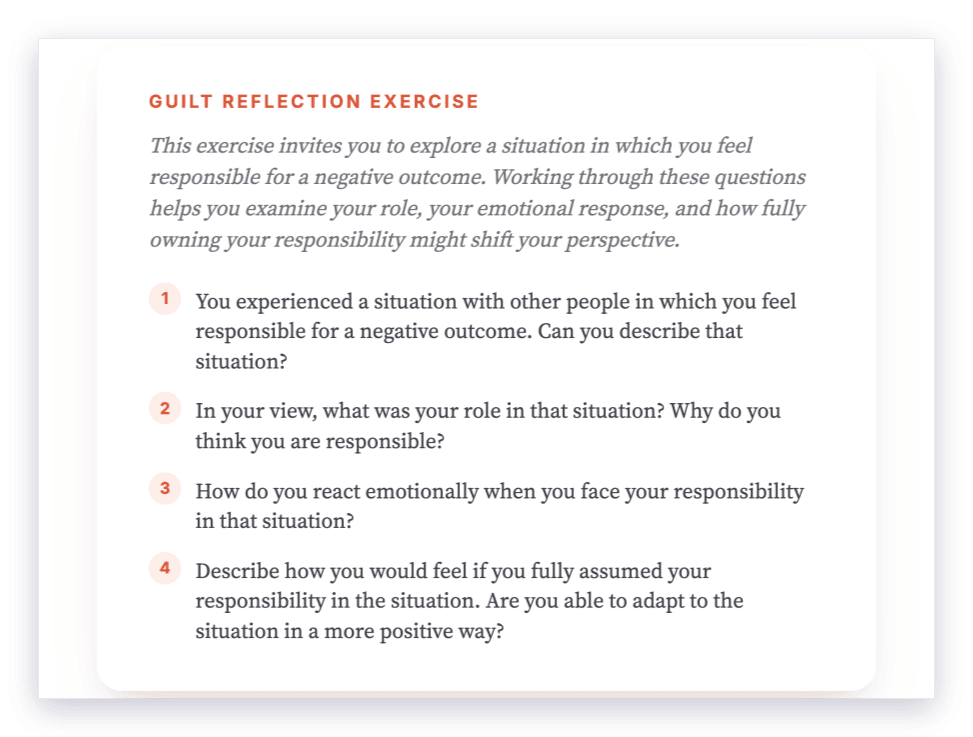
The tool is built around four sequential questions that move the patient progressively from situational description to emotional reckoning to adaptive reappraisal. The image above lists those questions in order with a brief introductory framing.
This image is a static preview of the question list only. The full guided experience, with patient-facing instructions, pacing, and space to write responses, happens autonomously in the app, not in this image.
The first question asks the patient to describe a concrete situation involving others in which they feel responsible for a negative outcome. This grounds the work in a specific event rather than in an abstract self-concept. The second question invites explicit reasoning: what was their role, and why do they believe themselves responsible? This surfaces the attribution logic the clinician will later want to examine, often revealing personalizing thinking or the signature loops documented in the Guilt Psychoeducation program. The third question shifts register entirely, asking for the emotional reaction to that perceived responsibility, naming the affective weight sitting underneath the cognitive verdict, a step that connects naturally to shame-adjacent material and punitiveness schema dynamics. The fourth question is the reappraisal pivot: how would the patient feel if they fully assumed that responsibility, and can they imagine adapting more positively to the situation? This moves toward genuine moral repair rather than endless self-condemnation, the same movement at the heart of self-forgiveness work.
This exercise is available to patients through the SessionFuel patient app, the mobile application reserved for the patients of clinicians who use SessionFuel. You assign the exercise directly from your SessionFuel account, and your patient completes it on their own phone, between two of your consultations.
Key takeaway: Guilt that stays verbal stays circular. These four questions move patients from a fixed verdict to a reasoned causal account, an emotional reckoning, and an opening toward adaptive responsibility, exactly the sequence that makes the next session productive.
750+ clinical tools
A library built with and for clinicians, ready to use in session and extend between appointments.
Access all the toolsUse it with your patients
Share this tool in the mobile app and follow the work between sessions.
How to integrate this as between-session work
Assign this exercise as homework between consultations for patients who present with disproportionate self-blame after interpersonal conflict, those working through acceptance of their own mistakes, or those whose guilt connects to a broader self-criticism pattern. It suits patients who are cognitively ready to reflect in writing but not yet able to challenge their own reasoning in real time.
When introducing it, keep the framing simple: explain that writing forces a level of precision that thinking alone rarely reaches, and that you will be looking at it together at the next appointment. Avoid presenting it as a test of whether the guilt is "valid."
When the patient returns their answers, the richest clinical material usually sits in the gap between questions two and four: what they believe explains their role versus whether assuming that role fully actually opens or closes psychological space. A patient who writes that full responsibility would feel "like finally being honest" is giving you a very different entry point than one who writes that it would feel "unbearable." Pair this exercise with the Hindsight Bias worksheet when retrospective distortion is prominent, or with the Self-Compassion for Emotions audio when the emotional weight in question three is intense. For patients where guilt connects to shame schema work, the fourth question becomes a first step toward the broader repair process rather than a standalone endpoint.
Your session continues in your patients' pocket
Use with a patientYour resources, available everywhere
The handouts, exercises, programs and audios above: you choose which ones to make available to your patients, in the mobile app dedicated to them.
And far more than a library
The app goes well beyond resources, to support your patients every day:
Related categories
Explore other clinical resources by category.

Identity
Clinical resources for self-identity work in therapy: CBT, ACT, schema tools for clinicians addressing self-concept, core beliefs, and identity disruption.

Emotions
Clinical resources on emotion regulation: worksheets, coping tools, CBT, REBT, and ACT exercises for therapists working across diagnoses and age groups.

Behaviours
Clinical hub for behaviors in therapy: worksheets and tools for coping, eating disorders, CBT formulation, and maladaptive behavioral patterns.

Cognition
Printable cognitive therapy worksheets and clinical tools for therapists: CBT, ACT, schema work, defusion, distortions, and belief restructuring.
Repair & soothe
Clinical resources for the repair and soothe therapeutic aim: worksheets, exercises and tools to build self-compassion, reduce shame and restore emotional safety.

CBT
CBT worksheets, cognitive restructuring exercises & behavioral tools for clinicians. Evidence-based resources for every phase of cognitive behavioral therapy.