
Clinical picture. M., a man in his early forties, presented with alcohol use disorder in sustained remission. He disclosed a brief relapse three months prior and had avoided discussing it in sessions, describing a pervasive sense of shame that was interfering with his engagement in treatment. The clinician introduced the four-question exercise as written homework, asking M. to describe the episode in his own words before examining the thoughts generating his shame. At the following session, M. brought a completed worksheet; he had written that he would tell a close friend the relapse reflected exhaustion and a difficult life period, not a permanent character flaw. This shift in framing did not resolve the shame entirely, yet M. reported feeling able to raise the subject again and identified continued sobriety as a concrete reason to work through the discomfort rather than avoid it.
Shame: A Guided Cognitive Reappraisal Exercise
A four-question structured homework exercise helping patients name a shame-laden situation, challenge the thoughts sustaining it, and reconnect with their motivation to move forward.
Clinical vignettes
Shame After a Relapse Disclosure
Occupational Shame in Burnout Recovery
Clinical picture. T., a woman in her mid-thirties, was seen during outpatient follow-up for a depressive episode triggered by professional burnout. She had left her post abruptly and described persistent shame about what she called 'abandoning her team,' a belief she rarely examined directly. The clinician assigned the structured exercise between sessions, guiding T. to articulate the specific situation and then to list the thoughts sustaining her sense of fault. In question three, T. wrote that she would never hold a friend responsible for collapsing under an objectively unsustainable workload, a perspective she acknowledged she had not applied to herself. Her response to the final question was brief but clinically notable: she noted that carrying unexamined shame was preventing her from considering a return to work on her own terms.
Why Shame Is Particularly Hard to Work With Clinically
Shame sits apart from most other painful emotions. Unlike guilt, which targets a behaviour, shame targets the self, and that distinction is easy to say aloud but remarkably hard for patients to genuinely metabolise. They nod when you explain it, then leave the consultation still convinced they are the thing they did.
What makes the clinical work additionally difficult is that shame thrives in concealment. Many patients have never narrated the situation at the center of their shame to anyone. The cognitive content feeding it, the silent verdicts, the global self-labels, has never been externalised or examined. Words in session help, but shame-prone patients often respond to therapist-led challenges with compliance rather than genuine belief revision. The Defectiveness / Shame Schema: PDF Worksheet, Tools and Exercises captures this self-reinforcing structure well, and the Shame Psychoeducation: A 5-Lesson Clinical Program maps its sources and types in depth. What is often missing is the patient's own written engagement with their specific shame episode, the kind that only happens in private, between sessions.
That is precisely the gap this exercise addresses.
Use this resource with your patients
Handout, exercises and materials ready to use, right inside SessionFuel.
What the Exercise Contains
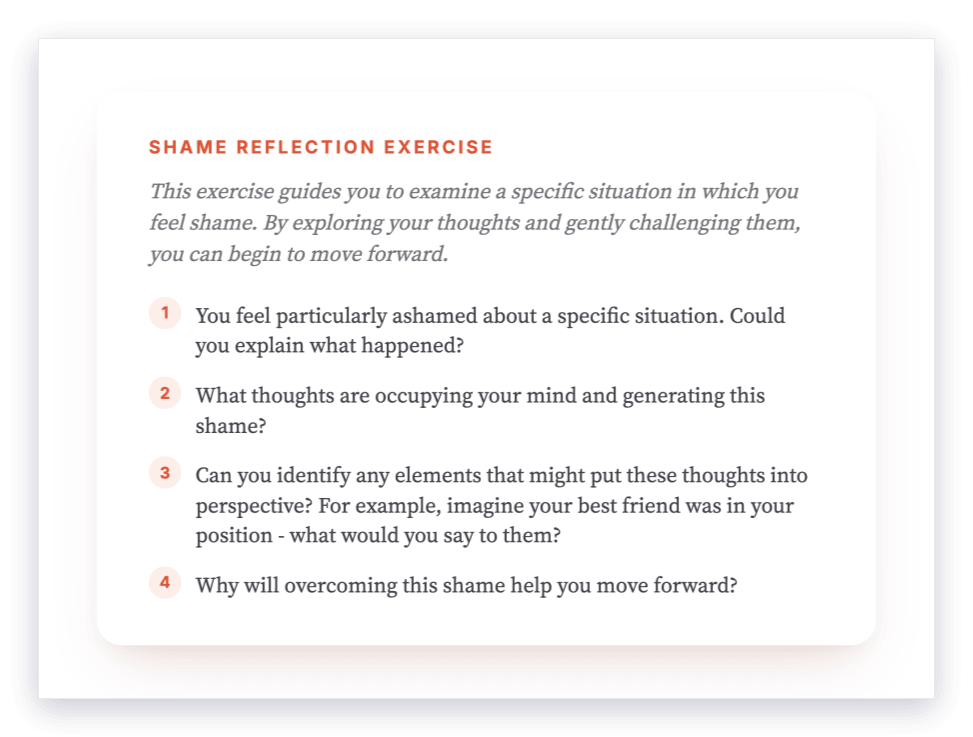
The exercise "I am ashamed..." is built around four sequenced questions that guide the patient from raw narration through cognitive examination to motivational reconnection.
This image is a static preview listing the questions in order. The full guided exercise, including patient-facing instructions and space to write responses, is experienced by the patient autonomously in the app, not in this image.
The first question asks the patient to narrate the situation that is generating shame. This act of structured narration is itself clinically significant: it moves the episode from a diffuse somatic-affective experience into language, which is the first condition for cognitive work. The second question surfaces the automatic thoughts driving the shame, the kind of global, self-condemning cognitions that tools like the Challenging Negative Thoughts: PDF Worksheet, Tools and Exercises and the Cognitive Distortions: PDF Worksheet, Tools and Exercises for Clinical Practice are designed to address.
The third question introduces the best-friend perspective, a classic compassionate reframing device that gently activates self-compassion without requiring the patient to abandon their experience. This is the pivot of the exercise: the patient must formulate, in their own words, an alternative reading of the situation. Research on cognitive restructuring consistently shows that patient-generated alternatives carry more weight than therapist-provided ones. The final question shifts from cognitive restructuring to motivational anchoring: naming why moving through shame matters, which reconnects the exercise to the patient's genuine values and therapeutic goals.
This exercise is available to patients through the mobile application that is the dedicated patient-side interface of SessionFuel: the clinician assigns it to their patient, who then completes it directly on their phone, on their own, between two appointments.
Taken together, the four questions form a compact but coherent arc, narration, examination, reframing, motivation, that mirrors the logic of structured cognitive work without requiring the clinician to be present.
750+ clinical tools
A library built with and for clinicians, ready to use in session and extend between appointments.
Access all the toolsHow to Integrate It as Between-Session Homework
Which patients benefit most. This exercise suits patients who present with shame-laden material they struggle to speak about directly, those who deflect, minimise, or show visible discomfort when the topic surfaces. It also works well alongside self-compassion work, in schema therapy with a defectiveness or punitiveness schema, and in trauma-adjacent work where self-blame is prominent. The Accepting Mistakes: A Guided Self-Compassion Exercise pairs naturally with it for patients whose shame is tied to a specific error or failure.
How to introduce it. Assign the exercise at the end of a session where a shame episode has been named, even briefly. Frame it plainly: "Between now and our next appointment, I'd like you to take some time on your own to work through a few guided questions about the situation you mentioned. There is no right answer. What matters is your honest reaction." Avoid over-preparing the patient with interpretations; the point is that they arrive at their own formulations.
What to do with what the patient brings back. The written responses become the clinical material for the following session. Pay particular attention to the third question: the gap between what the patient would say to a friend and what they say to themselves is often a direct measure of self-compassion deficit, and naming that gap aloud with the patient can be more powerful than any therapist-formulated reframe. The fourth question sometimes reveals values or fears the patient had not previously articulated. Use it to connect shame work to the broader therapeutic formulation.
For patients who need extended support, the Self-Image and Self-Esteem: A 4-Lesson Clinical Program and the Guilt and Responsibility: A Structured Clinical Exercise offer complementary pathways that deepen and consolidate the work begun here.
Key insight: The best-friend reframe in question three is not a rhetorical flourish, it is the structural mechanism that temporarily bypasses the patient's habitual self-referential processing and allows a genuinely different perspective to emerge in writing.
Use it with your patients
Share this tool in the mobile app and follow the work between sessions.
Articulations Worth Considering
When shame is entangled with a sense of global defectiveness, combining this exercise with Feeling Not Good Enough: A Guided Self-Criticism Exercise or Constant Social Comparison: A Guided Self-Criticism Exercise reinforces the same core restructuring move across different triggers. For patients whose shame leads to persistent concealment and social withdrawal, the Loneliness: PDF Worksheet, Tools and Exercises for Clinical Practice offers a clear psychoeducation frame for the relational cost. And where shame is tied to past actions and the patient is not yet ready to move toward repair, the Self-Forgiveness: PDF Worksheet, Tools and Exercises for Clinicians and Responsibility Pie Chart: PDF Worksheet, Tools and Exercises provide structured stepping stones toward genuine resolution.
Your session continues in your patients' pocket
Use with a patientYour resources, available everywhere
The handouts, exercises, programs and audios above: you choose which ones to make available to your patients, in the mobile app dedicated to them.
And far more than a library
The app goes well beyond resources, to support your patients every day:
Related categories
Explore other clinical resources by category.

Anxiety
Clinical hub for anxiety disorders: CBT and ACT worksheets, psychoeducation sheets, and exercises for assessment and treatment across the anxiety spectrum.

Mood
Evidence-based worksheets and clinical tools for mood disorders: CBT, ACT, and positive psychology resources for psychologists and therapists.

Identity
Clinical resources for self-identity work in therapy: CBT, ACT, schema tools for clinicians addressing self-concept, core beliefs, and identity disruption.

Emotions
Clinical resources on emotion regulation: worksheets, coping tools, CBT, REBT, and ACT exercises for therapists working across diagnoses and age groups.

Behaviours
Clinical hub for behaviors in therapy: worksheets and tools for coping, eating disorders, CBT formulation, and maladaptive behavioral patterns.

Cognition
Printable cognitive therapy worksheets and clinical tools for therapists: CBT, ACT, schema work, defusion, distortions, and belief restructuring.