
Clinical picture. P., a woman in her late thirties, presented with persistent low mood and work-related anxiety following a series of minor errors she had made during a period of high demand. In session, she described a recurrent internal monologue centred on the phrase "I'm incompetent and everyone can see it." The clinician introduced the worksheet's friend test, asking her to read the sentence aloud and then consider whether she would use that wording with a close friend in the same situation. She paused, said she would never speak that way to anyone she cared about, and was able to produce a normalising reframe: "Making errors when I'm stretched is human, not a character flaw." Over the following fortnight she reported using the N register independently after two further incidents, noting reduced rumination rather than an absence of self-critical thoughts.
Transforming Self-Critical Thoughts: PDF Worksheet, Tools and Exercises
A printable PDF worksheet, clinical tools, and concrete exercises to help patients recognize the inner critic and practise five registers of self-compassionate response in session.
Clinical vignettes
Reframing Shame After a Workplace Error
Addressing Catastrophic Self-Talk in Anxiety
Clinical picture. T., a man in his mid-forties with generalised anxiety disorder, habitually responded to uncertainty about health and finances with the self-directed phrase "I won't cope, I never do." The clinician used the worksheet's five-register framework to explore which register matched the feeling underneath; together they identified anxiety and fear of the future, pointing toward the R (reassure) register. T. drafted the rewrite "Whatever happens, I have managed before and I will find a way" in session, noting it felt less dismissive of his distress than blanket positive statements had in the past. He was given the sheet to keep as a between-session reference. At the next appointment he reported using the written prompt on two occasions, describing a modest but noticeable reduction in the spiral that usually followed the initial anxious thought.
Most patients who present with a harsh inner critic understand, intellectually, that they would never speak to a friend the way they speak to themselves. And yet the self-attack continues. Telling them to "be kinder to themselves" in session rarely produces lasting change, and the concept of self-compassion tends to generate either resistance ("that's just letting myself off the hook") or vague agreement that goes nowhere between sessions. This fiche PDF on transforming self-critical thoughts gives the notion a precise, visual structure you can use as a shared reference point during psychoeducation, shortening the gap between understanding the principle and actually applying it.
Use this resource with your patients
Handout, exercises and materials ready to use, right inside SessionFuel.
Why the Inner Critic Resists Oral Explanation
The core difficulty is not conceptual, it is affective. Patients with low self-esteem, entrenched perfectionism, or a punitiveness schema have spent years fusing with the critic's voice. When you describe the distinction between harsh self-talk and compassionate self-talk verbally, the critic itself filters the explanation: "Trying to be kind to myself is another thing I'll probably fail at."
What patients frequently miss in oral delivery is the differentiation between registers. Self-compassion is not a single tone; it has at least five distinct functional forms, each matched to a different emotional state. Without a visual map, patients conflate them, apply the wrong register to the wrong moment, or produce what the fiche aptly calls "the kind-should": the critic wearing a softer mask.
What the Fiche Contains: a Visual Map of the Five Registers
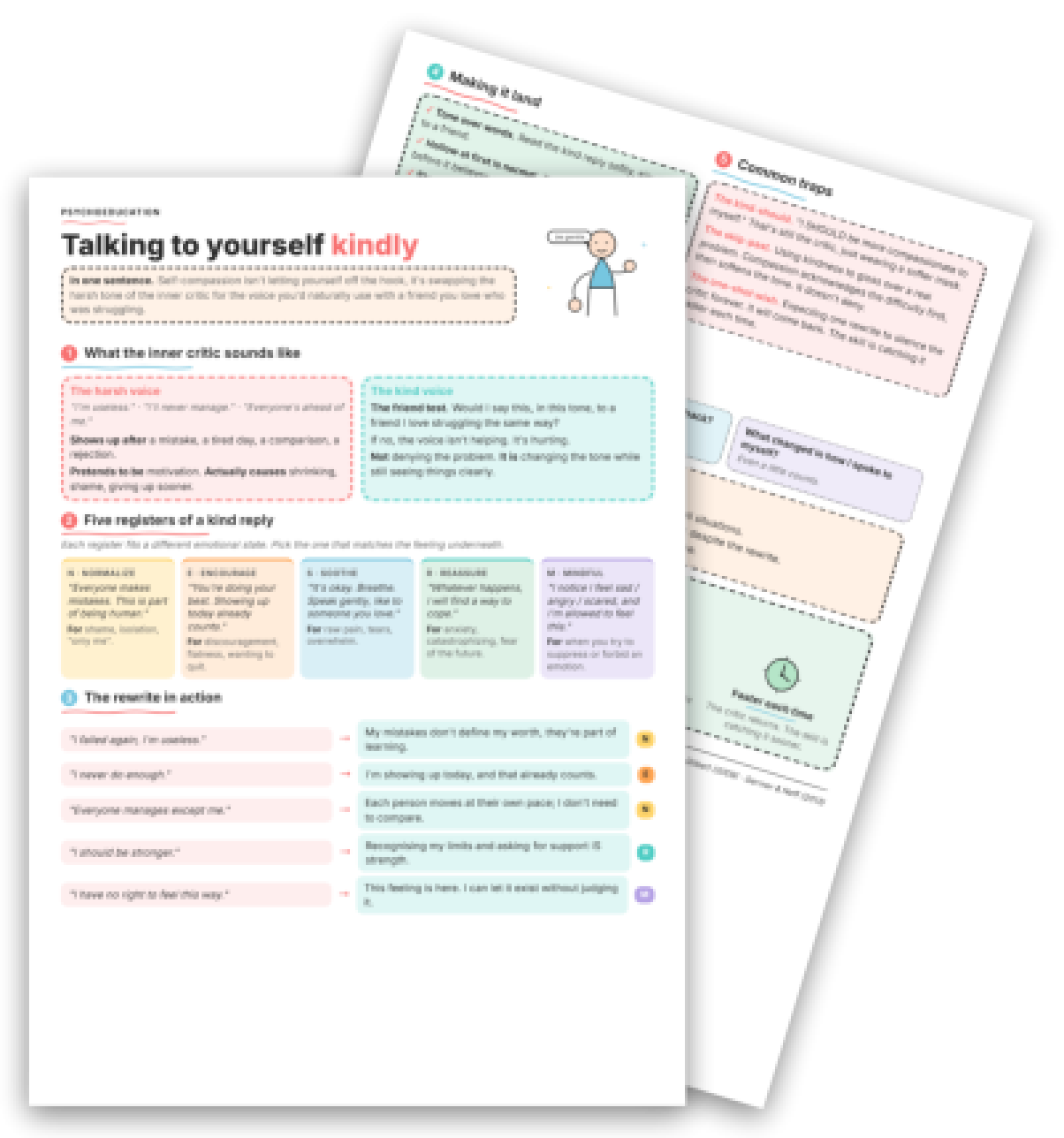
The fiche PDF is organised into six numbered panels. The first anchors the concept through the friend test: "Would I say this, in this tone, to a friend I love struggling the same way?" Placing that question visually on the page makes it a quick self-monitoring probe patients can return to outside the session.
The second panel, and the clinical spine of the support, presents the NESRM framework: five registers of a kind reply, each labelled, each tied to a specific emotional state.
- N, Normalize: "Everyone makes mistakes. This is part of being human." For shame and isolation.
- E, Encourage: for discouragement and flatness.
- S, Soothe: for raw pain and overwhelm.
- R, Reassure: for catastrophizing and anxiety about the future.
- M, Mindful: "I notice I feel sad / angry / scared, and I'm allowed to feel this." For suppression of emotion.
Panel 3 shows the rewrite in action with five paired examples (automatic thought, then kind reply, labelled by register). Seeing the register letter next to each rewrite makes the logic visible in a way that oral modelling alone does not. Panels 4 and 5 address common implementation failures, tone over word choice, the "hollow at first is normal" normalisation, and three named traps including the skip-past (using kindness to gloss over a real problem). Panel 6 provides a brief end-of-week reflection with a "To discuss in session" section, listing signals that warrant clinical attention: when the kind voice feels completely inaccessible, when the same critical thought persists despite rewrites, or when compassion starts blurring into problem avoidance.
> Key point: this fiche is a visual support that facilitates the explanation of self-compassion in session, not a self-help exercise the patient completes alone. The NESRM grid, the paired rewrites, and the named traps are tools for the clinician to work through with the patient, then leave as a concrete reference between sessions.
750+ clinical tools
A library built with and for clinicians, ready to use in session and extend between appointments.
Access all the toolsWhen and How to Introduce the Fiche
The fiche fits naturally from the second or third session onward, once you have identified self-critical automatic thoughts as a maintaining process. It is particularly indicated with patients presenting shame-based self-image, perfectionism, chronic self-comparison, or post-mistake spirals (where the companion self-compassion after mistakes exercise pairs well).
A workable introduction: "I want to show you something that makes this distinction more concrete, there are actually five different ways to respond to the critic, and each one fits a different feeling. Let's look at which register fits what you were describing earlier." This framing positions the fiche as a precision tool rather than generic encouragement, which is important for patients who are already suspicious of the concept.
Walk through the NESRM panel together. Ask which register the patient would have needed in the situation they brought to session. Note any register they find unbelievable or inaccessible, the inner dialogue psychoeducation program and the self-acceptance exercise can extend that work. For patients with more entrenched patterns, the not-good-enough self-criticism exercise and the shame psychoeducation program address the deeper schema-level maintenance.
One contraindication: with patients in active crisis or early traumatic processing, the Soothe register in particular can feel destabilising. Start with Normalize and Mindful, the fiche itself flags this, noting that most patients find these "gentler entry points."
The fiche does not replace the therapeutic framework; it gives the patient a named vocabulary and a portable reference so the work begun in session continues with more precision between appointments.
Use it with your patients
Share this tool in the mobile app and follow the work between sessions.
Sources
- Neff, K. D. (2011). Self-Compassion: The Proven Power of Being Kind to Yourself. William Morrow.
- Gilbert, P. (2009). The Compassionate Mind: A New Approach to Life's Challenges. Constable and Robinson.
- Neff, K. D., Germer, C. (2018). The Mindful Self-Compassion Workbook: A Proven Way to Accept Yourself, Build Inner Strength, and Thrive. Guilford Press.
Your session continues in your patients' pocket
Use with a patientYour resources, available everywhere
The handouts, exercises, programs and audios above: you choose which ones to make available to your patients, in the mobile app dedicated to them.
And far more than a library
The app goes well beyond resources, to support your patients every day:
Related categories
Explore other clinical resources by category.

Mood
Evidence-based worksheets and clinical tools for mood disorders: CBT, ACT, and positive psychology resources for psychologists and therapists.

Identity
Clinical resources for self-identity work in therapy: CBT, ACT, schema tools for clinicians addressing self-concept, core beliefs, and identity disruption.

Cognition
Printable cognitive therapy worksheets and clinical tools for therapists: CBT, ACT, schema work, defusion, distortions, and belief restructuring.

Build awareness
Clinical worksheets and tools to build awareness in therapy: cognitive distortions, schemas, emotions, ACT and CBT resources for practitioners.

Restructure
Clinical hub for cognitive restructuring worksheets: distortion identification, belief disputation, ABC model, and schema work for evidence-based practice.

Repair & soothe
Clinical resources for the repair and soothe therapeutic aim: worksheets, exercises and tools to build self-compassion, reduce shame and restore emotional safety.