
Clinical picture. A., a woman in her early forties, presented with residual low mood and persistent self-reproach following a work-related burnout. She described a long-standing difficulty tolerating what she called her "emotional fragility," which she linked to recurrent avoidance of professional and social situations. The clinician introduced the five-question exercise as a between-session task, asking A. to write her responses before the next appointment. At the following session, A. reported that questions two and five had been the most useful: naming the behavioural costs of non-acceptance and articulating the concrete relief that acceptance might bring had shifted the exercise from abstract to tangible. She expressed less global self-blame by the end of the session, though she identified anticipated guilt as a likely obstacle requiring further work.
Self-Acceptance and Self-Compassion: A Guided Exercise
A structured five-question homework exercise helping patients name what they cannot accept, map its costs, and build genuine self-compassion.
Clinical vignettes
Chronic Self-Criticism After Burnout
Body Image Avoidance in Adolescence
Clinical picture. T., a seventeen-year-old referred for mild depressive symptoms, described strong aversion to his physical appearance, particularly his height, which he perceived as a source of social humiliation. The clinician offered the structured exercise verbally during the session, working through each question together rather than assigning it as written homework, given T.'s reported difficulty with writing tasks. Responses to question three, concerning what would make acceptance logical and justified, produced an unexpected shift: T. acknowledged unprompted that his self-comparison targets were narrowly selected peers rather than a realistic reference group. Outcome at that session was modest, a slight reduction in avoidance-related shame, with the obstacle of anticipated peer ridicule noted as a focus for the following contact.
Why Self-Acceptance Is So Hard to Reach Through Words Alone
Self-acceptance is one of those concepts that patients nod at in conversation and then quietly shelve. Most people entering therapy with self-critical patterns already know, on some intellectual level, that they "should" be kinder to themselves. What they struggle with is the gap between knowing and actually moving. Verbal psychoeducation fills that gap only partially.
The problem is structural. Non-acceptance of a body feature, a personality trait, or a cognitive tendency tends to remain abstract until the patient is asked to name the specific element and sit with it in writing. Without that concreteness, the work stays at the level of generality, which is precisely where the avoidance lives. Clinicians familiar with Active Acceptance: PDF Worksheet, Tools and Exercises for ACT Practice or the Practicing Self-Compassion: PDF Worksheet, Tools and Exercises know how much resistance even a well-framed psychoeducation tool can meet when the patient leaves the office without a structured task to carry forward.
This exercise answers that clinical need directly. It gives the patient a concrete written task they complete on their own, at their own pace, turning a vague therapeutic intention into five grounded reflection steps.
Use this resource with your patients
Handout, exercises and materials ready to use, right inside SessionFuel.
What the Exercise Contains
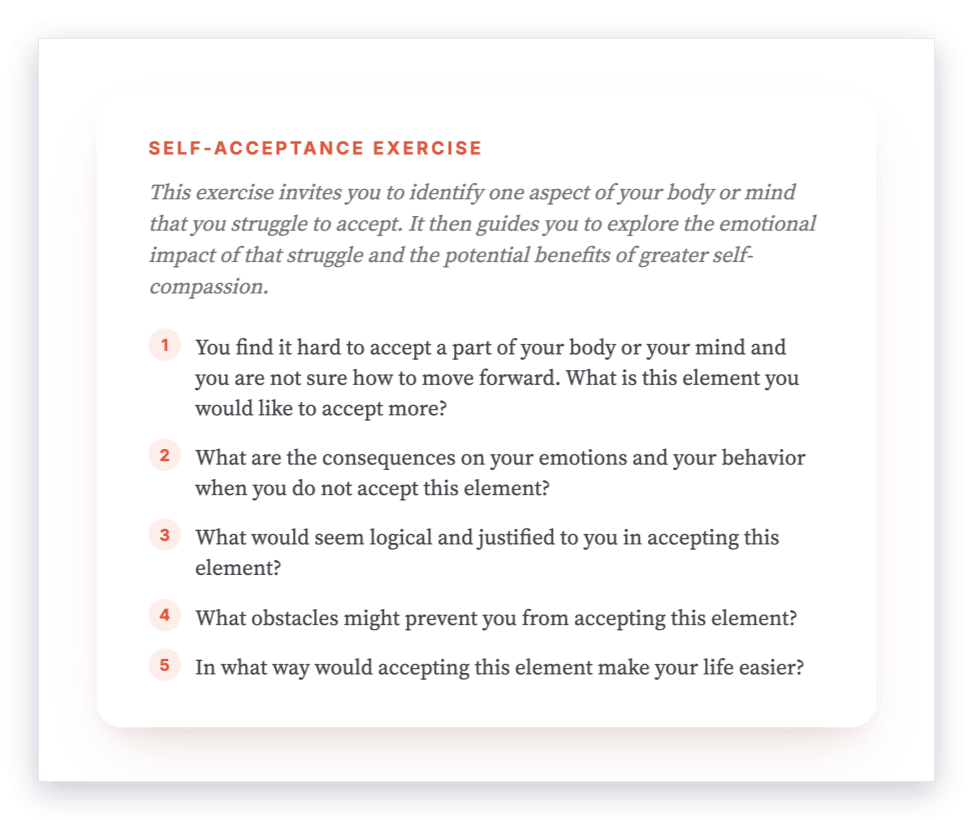
The five questions move in a deliberate sequence. The patient begins by naming the specific element they struggle to accept, whether physical or psychological. That act of naming alone often carries significant weight. Question two asks what actually happens, emotionally and behaviorally, when non-acceptance is active: this is where the real cost becomes visible rather than assumed. The third question invites the patient to build a rational case for acceptance, identifying what would make it logical and justified for them personally. Question four surfaces the anticipated obstacles, which prevents the exercise from producing hollow optimism. The fifth question asks how acceptance would simplify their life, grounding the work in concrete personal benefit rather than abstract virtue.
The image above lists all five questions in sequence with a brief introductory framing. This is a static preview only: the full guided exercise, with patient-facing instructions and dedicated space to write each answer, is experienced by the patient on their own inside the app, not in this image.
This exercise is available to your patients through the patient mobile application of SessionFuel: once you assign it as homework, your patient receives it directly on their phone and completes it autonomously between your sessions, on their own schedule.
Key takeaway: The sequence from naming the element, through costs and rational justification, to obstacle mapping and envisioned benefit is what makes this exercise clinically useful. It does not ask the patient to simply "be kinder." It walks them through the reasoning.
750+ clinical tools
A library built with and for clinicians, ready to use in session and extend between appointments.
Access all the toolsIntegrating It as Between-Session Homework
This exercise suits a broad range of presentations: body image distress, low self-esteem, perfectionism, shame-based profiles, and any patient working on the Defectiveness / Shame Schema: PDF Worksheet, Tools and Exercises or the Punitiveness Schema: PDF Worksheet, Tools and Exercises. It also pairs naturally with the Accepting Mistakes: A Guided Self-Compassion Exercise and the Constant Social Comparison: A Guided Self-Criticism Exercise for patients whose non-acceptance is fed by relentless comparison.
Introduce it at a moment when the patient has already identified, at least loosely, the area causing friction. A simple framing works: "Before our next session, I would like you to reflect on something you find it genuinely hard to accept about yourself, using these five questions. Take your time and write what actually comes to you." Avoid over-explaining the therapeutic rationale beforehand, which can prime intellectualized answers.
When the patient brings their responses back, the most clinically productive entry points are usually question three and question four together. What they identify as logically justifying acceptance often reveals an implicit standard they have never examined; what they name as obstacles frequently maps directly onto early maladaptive schemas visible in tools like Early Maladaptive Schemas: PDF Worksheet, Tools and Exercises or the Core Beliefs About Self, Others, and World: PDF Worksheet, Tools and Exercises. Question five, about simplification, can open a values-based conversation that connects naturally to Exploring Values: PDF Worksheet, Tools and Exercises for ACT Practice.
Use it with your patients
Share this tool in the mobile app and follow the work between sessions.
Articulating It With Related Tools
For patients working on a broader self-image trajectory, this exercise fits well inside the Self-Image and Self-Esteem: A 4-Lesson Psychoeducation Program. It can follow the RAIN Mindfulness Technique: PDF Worksheet, Tools and Exercises when a patient needs embodied contact with the non-accepted element before they can write about it. For those whose self-criticism takes a more relational form, pairing it with the Self-Deprecation in Social Interactions: A Clinical Exercise or Feeling Not Good Enough: A Guided Self-Criticism Exercise builds a coherent arc from private self-judgment to its interpersonal expression.
Your session continues in your patients' pocket
Use with a patientYour resources, available everywhere
The handouts, exercises, programs and audios above: you choose which ones to make available to your patients, in the mobile app dedicated to them.
And far more than a library
The app goes well beyond resources, to support your patients every day:
Related categories
Explore other clinical resources by category.

Identity
Clinical resources for self-identity work in therapy: CBT, ACT, schema tools for clinicians addressing self-concept, core beliefs, and identity disruption.

Cognition
Printable cognitive therapy worksheets and clinical tools for therapists: CBT, ACT, schema work, defusion, distortions, and belief restructuring.

Repair & soothe
Clinical resources for the repair and soothe therapeutic aim: worksheets, exercises and tools to build self-compassion, reduce shame and restore emotional safety.

ACT
Clinical hub for Acceptance and Commitment Therapy (ACT): worksheets, exercises, programs and audio resources for practitioners using the ACT model.

Compassion-focused
CFT clinical tools for practioners: exercises, programs and guided audio on shame, self-criticism, guilt and self-compassion. Ready to use in session.

Anxiety
Clinical hub for anxiety disorders: CBT and ACT worksheets, psychoeducation sheets, and exercises for assessment and treatment across the anxiety spectrum.