
Clinical picture. M., a 34-year-old project manager, presented with persistent low mood and chronic self-criticism, frequently describing herself as incompetent after minor professional missteps. The clinician introduced the structured exercise between sessions, asking her to identify a recent error and rate both its objective consequences and the severity of her inner verdict. M. returned having noted a scheduling oversight that had caused a brief meeting delay; she had rated the impact at 2 out of 10 yet her self-blame at 9. Sitting with that gap prompted her to articulate, unprompted, that she would not judge a colleague so harshly for the same lapse. Over the following two weeks she reported a modest but noticeable reduction in ruminative self-criticism after comparable events.
Self-Compassion After Mistakes: A Structured Clinical Exercise
A guided homework tool helping patients calibrate self-blame, close the gap between objective impact and inner verdict, and build genuine self-compassion.
Clinical vignettes
Recalibrating Self-Blame After a Work Slip
Perfectionism and the Compassionate-Friend Reframe
Clinical picture. T., a 27-year-old graduate student with a long history of perfectionism, sought help after a period of avoidance he linked to fear of making mistakes in his thesis work. The clinician assigned the exercise following a session on self-compassion, specifically drawing his attention to question four's invitation to imagine a close friend offering comfort. T. had rated a methodological error in his data collection at 4 for actual impact but at 10 for personal blame, and he struggled initially to generate a kinder internal voice. He eventually wrote a short paragraph in the first person as if addressing a friend, which he read aloud in the next session; the clinician used that text as a basis for exploring what conditions would allow him to extend the same stance to himself. Avoidance behavior around drafting did not resolve fully, though T. reported that the exercise gave him a concrete reference point when self-critical thoughts escalated.
The clinical knot: when self-blame outweighs the mistake
Patients rarely struggle to recall their errors. What they struggle with is holding them in proportion. A minor slip becomes evidence of fundamental inadequacy; a momentary lapse triggers days of self-flagellation. The difficulty is not cognitive laziness, it is that the gap between the objective severity of a mistake and the subjective weight of self-blame is largely invisible to the person living inside it.
Explaining that gap out loud, session after session, rarely moves the needle on its own. The notion of fallibility as a universal human condition is easy to nod at and hard to truly inhabit. Patients with a punitiveness schema or a defectiveness/shame schema will often acknowledge the idea intellectually while emotionally maintaining a verdict far harsher than any court would deliver. What is needed is not more explanation, but a structured moment of autonomous self-examination that makes the disproportion visible in concrete numbers and words.
Use this resource with your patients
Handout, exercises and materials ready to use, right inside SessionFuel.
What the exercise contains
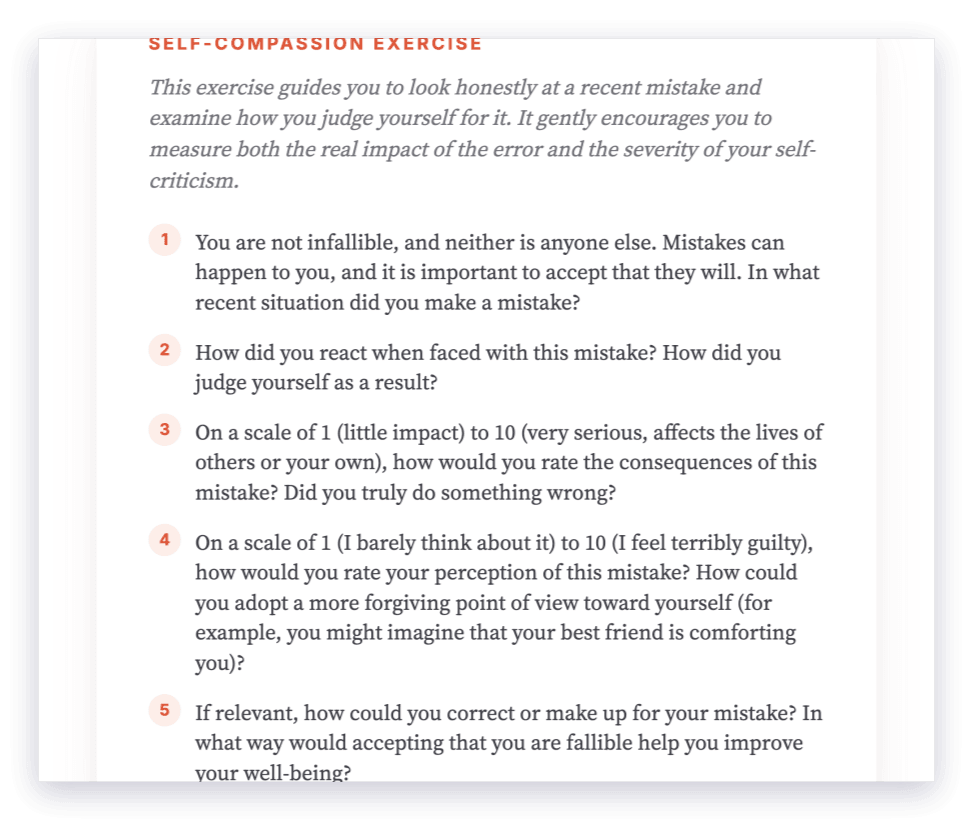
"I Made a Mistake..." is a five-question structured reflection that walks the patient through the full arc of a recent error: naming the situation, examining their immediate self-judgment, rating objective consequences, rating subjective self-perception, and exploring repair.
The dual-scale design is the clinical core. Question 3 asks the patient to rate the real-world consequences of the mistake from 1 (minimal impact) to 10 (genuinely serious, affecting other people's lives or their own). Question 4 then asks them to rate how harshly they have been perceiving that same mistake, again from 1 to 10. The juxtaposition of those two numbers, objective impact versus inner verdict, is a concrete, portable representation of cognitive distortion that no oral explanation fully replaces. It gives the patient something to see, not just think about.
Question 4 also invites a perspective-taking move: the patient is prompted to imagine how their closest friend would comfort them, a technique that activates self-compassion without demanding it abstractly. This connects naturally to self-compassion practice and the RAIN mindfulness technique. Question 5 closes the loop by asking whether repair is possible and what accepting fallibility would concretely change in the patient's wellbeing, nudging toward growth rather than rumination. That last step echoes the work of self-forgiveness and opens space for a growth mindset.
The image above lists the five questions in order with their brief framing texts. This is a static preview only, the full guided exercise, with patient-facing instructions and space to write, is experienced by the patient on their own inside the app, and that interactive dimension is not visible here.
This exercise is available to patients through the SessionFuel patient app, the mobile companion reserved for patients of clinicians who use SessionFuel. You assign it directly from your clinician interface, and your patient completes it autonomously on their phone between two appointments.
750+ clinical tools
A library built with and for clinicians, ready to use in session and extend between appointments.
Access all the toolsUse it with your patients
Share this tool in the mobile app and follow the work between sessions.
Integrating it as between-session homework
This exercise is well-suited to patients who present with chronic self-criticism, perfectionist patterns, or a tendency to personalize and absorb responsibility beyond their actual share. It sits naturally alongside work on self-blame, the responsibility pie chart, or the feeling guilty exercise. It is equally relevant for patients working through shame or impostor syndrome, where errors are routinely read as exposure of a deeper defect.
Key insight: The exercise does not ask the patient to dismiss their mistake. It asks them to name it precisely, measure it honestly, and hold it in proportion, which is a meaningfully different request.
To introduce it, you might say something like: "Between now and our next meeting, I would like you to do a short reflection on a recent mistake, one that is still sitting with you. There are five questions that will guide you through it." Keep the framing simple. The structure does the rest.
When the patient returns, the two numerical ratings from questions 3 and 4 are an immediate clinical opening. A large gap between them points directly toward negativity bias, overgeneralization, or all-or-nothing thinking. The friend-perspective answer in question 4 often reveals the quality of the patient's inner dialogue more vividly than a direct question about self-talk ever does. And the repair step in question 5 can seed behavioral commitments that carry real momentum into the work on self-acceptance and inner dialogue.
Used consistently over several weeks, this exercise builds what perfectionist patients rarely develop on their own: the habit of distinguishing honest accountability from punitive self-verdict.
Your session continues in your patients' pocket
Use with a patientYour resources, available everywhere
The handouts, exercises, programs and audios above: you choose which ones to make available to your patients, in the mobile app dedicated to them.
And far more than a library
The app goes well beyond resources, to support your patients every day:
Related categories
Explore other clinical resources by category.

Identity
Clinical resources for self-identity work in therapy: CBT, ACT, schema tools for clinicians addressing self-concept, core beliefs, and identity disruption.

Restructure
Clinical hub for cognitive restructuring worksheets: distortion identification, belief disputation, ABC model, and schema work for evidence-based practice.
Repair & soothe
Clinical resources for the repair and soothe therapeutic aim: worksheets, exercises and tools to build self-compassion, reduce shame and restore emotional safety.

CBT
CBT worksheets, cognitive restructuring exercises & behavioral tools for clinicians. Evidence-based resources for every phase of cognitive behavioral therapy.

Compassion-focused
CFT clinical tools for practioners: exercises, programs and guided audio on shame, self-criticism, guilt and self-compassion. Ready to use in session.

Anxiety
Clinical hub for anxiety disorders: CBT and ACT worksheets, psychoeducation sheets, and exercises for assessment and treatment across the anxiety spectrum.