
Clinical picture. A, a woman in her early thirties, presents with persistent low self-esteem tied to constant upward comparisons with colleagues she perceives as more competent and socially at ease. Her therapist introduces the structured self-comparison exercise as autonomous between-session work, guiding her to name her self-perceived flaws in writing before considering whether those same traits are visible in peers around her. On question three, A rates her inner dialogue at two out of ten, which she finds striking when she reads it back aloud in session. The subsequent prompt asking what she would say to a close friend with identical insecurities produces a noticeably warmer and more measured response than the language she had used about herself. Over the following two weeks she returns with a partially reformulated self-narrative, still tentative but less globally devaluing.
Constant Self-Comparison: A Guided Self-Criticism Exercise
Help patients challenge chronic self-comparison, rate their inner dialogue, and rebuild genuine self-worth through structured autonomous reflection.
Clinical vignettes
Reframing Chronic Social Comparison at Work
Self-Worth and Body Image in a Young Adult
Clinical picture. M, a man in his mid-twenties, reports spending significant time each day comparing his physical appearance to images encountered on social media, feeding a cycle of rumination and social withdrawal. His clinician proposes the guided exercise as a structured way to slow that automatic process down and introduce some distance from it. Working through the questions, M notes for the first time that the perceived flaws he listed are, on reflection, features he has noticed in friends he holds in high regard, without it diminishing his view of them. He scores his self-talk at three out of ten and, unprompted, comments that the score felt worse written down than it does inside his head. The reformulation attempt at the final question remains effortful, but M identifies it as a useful reference point to return to when comparison-driven thoughts escalate.
The Clinical Need: When Comparison Becomes a Distorting Lens
Social comparison is a normal cognitive process. The difficulty arises when it becomes automatic, systematic, and invariably unfavorable to the patient. In that pattern, the inner critic runs on a loop: "They're more successful," "She's more attractive," "He seems so much more confident." What makes this hard to address through conversation alone is that patients often cannot see the distortion from inside it. They experience comparison as accurate observation, not as a skewed filter, which makes purely verbal challenges feel dismissive.
The Social Comparison: PDF Worksheet can name the mechanism in session, but patients also need structured practice to examine their own comparison patterns concretely, from the inside, in their own time. That is precisely what this exercise provides. It sits alongside work on the Defectiveness / Shame Schema and Fennell's model, explored through the Fennell's CBT Model of Low Self-Esteem fiche, as a patient-side complement to the clinical work already underway.
Use this resource with your patients
Handout, exercises and materials ready to use, right inside SessionFuel.
What the Tool Contains
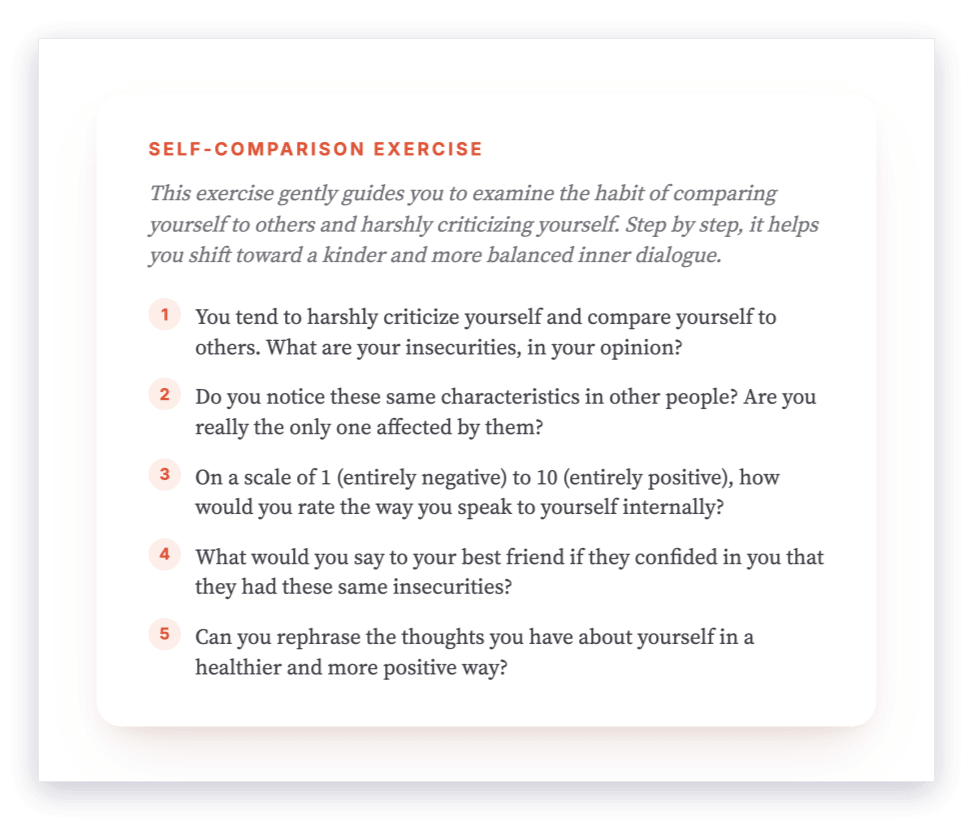
The exercise opens by inviting patients to name their specific insecurities as they experience them (question 1). This first step does something that oral questioning often misses: it asks the patient to put the content into words, in writing, without the relational pressure of the session.
Question 2 immediately introduces a perspective shift: do you notice these same characteristics in other people? Are you truly the only one affected? This mirrors the Socratic movement you might use with a Challenging Negative Thoughts worksheet, but here the patient arrives at the disconfirmation autonomously, which tends to carry more weight.
Question 3 uses a simple self-rating scale (1 to 10) to make the quality of inner dialogue visible and measurable. It gives you a concrete baseline and opens space for tracking change over time, compatible with work you may already be doing with Scaling Beliefs About Yourself.
Question 4 is the pivot of the exercise: what would you say to your best friend if they admitted to the same insecurities? This is a well-established self-compassion lever. Seeing it written out in the patient's own words often lands differently than hearing it proposed in the consulting room. It connects naturally to the Accepting Mistakes: A Guided Self-Compassion Exercise and the Practicing Self-Compassion fiche.
Question 5 closes with an explicit reframing task: the patient is asked to rephrase the thoughts they hold about themselves in a healthier, more positive way. This is cognitive restructuring in practice, close in spirit to the Feeling Not Good Enough: A Guided Self-Criticism Exercise and grounded in the same restructuring logic as Challenging Negative Thinking.
The image above lists all five questions in order, with a brief introduction framing the exercise. This image is a static preview of the questions only: the full guided exercise, with patient-facing instructions, space to write, and the complete interactive experience, is what the patient encounters on their own in the app, not in this preview.
This exercise is available to patients directly through the patient app of SessionFuel, the mobile application reserved for patients of clinicians who use SessionFuel: you assign it as homework, and your patient completes it on their phone, on their own, between two sessions.
750+ clinical tools
A library built with and for clinicians, ready to use in session and extend between appointments.
Access all the toolsHow to Integrate It Into Your Practice
This exercise suits a broad range of patients: those presenting with low self-esteem, chronic self-criticism, perfectionistic patterns (see Perfectionism: A Guided Self-Reflection Exercise), or social anxiety in which upward comparison fuels avoidance. It also fits patients working on impostor syndrome or those whose self-image is entangled with body perception, where pairing it with the Self-Acceptance: A Guided Exercise on Body and Mind extends the work naturally.
Introduce it simply between sessions: "Before our next appointment, I'd like you to work through a few questions on your own about the way you compare yourself to others." The questions guide themselves; lengthy framing is rarely needed.
When the patient returns, the material they have produced gives you several entry points. The scale score from question 3 offers an immediate and low-stakes opening. Question 4 almost always generates rich clinical content: the gap between the compassion patients readily extend to a friend and the harshness they apply to themselves becomes visible in their own handwriting, not your words. Question 5 can seed a restructured belief that you then reinforce with the Inner Dialogue Psychoeducation: A 4-Lesson Clinical Program or the Self-Image and Self-Esteem: A 4-Lesson Psychoeducation Program.
Key insight: Question 4, the "best friend" prompt, frequently makes the double standard visible in the patient's own words, not yours, which is what makes it clinically useful as a starting point for genuine self-compassion work.
Use it with your patients
Share this tool in the mobile app and follow the work between sessions.
Articulations Worth Considering
Patients who deflect positive feedback alongside their comparison patterns benefit from following this exercise with the Accepting Compliments: A Guided Self-Worth Exercise. Those whose self-comparison is driven by rigid internal standards may need the added lens of Rigid Rules and Demandingness: A Guided Clinical Exercise. For patients whose self-criticism is more pervasive, the I Am Unique: A Guided Clinical Exercise for Holistic Self-Worth offers a complementary between-session step that broadens the self-view beyond the comparison frame.
Your session continues in your patients' pocket
Use with a patientYour resources, available everywhere
The handouts, exercises, programs and audios above: you choose which ones to make available to your patients, in the mobile app dedicated to them.
And far more than a library
The app goes well beyond resources, to support your patients every day:
Related categories
Explore other clinical resources by category.

Identity
Clinical resources for self-identity work in therapy: CBT, ACT, schema tools for clinicians addressing self-concept, core beliefs, and identity disruption.

Relationships
Clinical worksheets and tools on relational functioning: attachment, schemas, assertiveness, and communication skills for therapists. Printable PDF resources.

Build awareness
Clinical worksheets and tools to build awareness in therapy: cognitive distortions, schemas, emotions, ACT and CBT resources for practitioners.

Restructure
Clinical hub for cognitive restructuring worksheets: distortion identification, belief disputation, ABC model, and schema work for evidence-based practice.
CBT
CBT worksheets, cognitive restructuring exercises & behavioral tools for clinicians. Evidence-based resources for every phase of cognitive behavioral therapy.

Compassion-focused
CFT clinical tools for practioners: exercises, programs and guided audio on shame, self-criticism, guilt and self-compassion. Ready to use in session.