
Clinical picture. M., a woman in her early thirties, presented with persistent low mood and body-image distress linked to daily Instagram use. She reported spending up to two hours each evening scrolling fitness accounts, after which she described feeling "behind" and ashamed of her own body. The clinician introduced the social comparison worksheet, drawing her attention to the insides-versus-outsides asymmetry: M. was measuring her felt bodily experience against a curated visual output. She identified the pattern as upward comparison with selective sampling, noting she scrolled past neutral posts and paused on the ones that stung most. Over the following week she began labelling the move aloud as it happened, which she described as creating a small but useful pause before the shame response consolidated.
Social Comparison: PDF Worksheet, Tools and Exercises for Clinical Practice
A structured PDF worksheet with visual tools and exercises to make the social comparison mechanism visible in session, build a shared vocabulary, and give patients a concrete reference to use between appointments.
Clinical vignettes
Upward Comparison Feeding Shame Spiral
Lateral Comparison at a Family Gathering
Clinical picture. T., a man in his mid-forties, reported a marked dip in mood after a family reunion, which he struggled to account for given that the event had been objectively uneventful. In session, the clinician used the worksheet's lateral comparison section to map what had happened: T. had spent much of the evening tallying his relationship status, career position, and finances against same-age cousins, each time concluding he was deficient. He recognised the inner voice pattern described in the fiche, namely the idea that "everyone his age" had already achieved the markers he had not. The psychoeducation reframed the process as a normal but biased cognitive habit rather than accurate self-assessment. T. left with the three-step catch-and-label sequence to practise at the next comparable social event.
Explaining social comparison in session rarely lands at first. Patients recognise the behaviour in the abstract, but the mechanism keeping them stuck, particularly the asymmetry between their own insides and everyone else's curated outsides, stays out of reach until it becomes visible. This PDF worksheet offers that visibility: a structured, printable support you work through with your patient to make the psychoeducation concrete, and leave them with a reference they can consult between sessions.
Use this resource with your patients
Handout, exercises and materials ready to use, right inside SessionFuel.
Why Social Comparison Resists Verbal Explanation
The clinical difficulty is less about theory and more about helping the patient see the distortion in real time. When you describe upward comparison orally, most patients respond with variants of "but their life really is better than mine." The stacked deck is invisible to them precisely because it is automatic.
Three resistances tend to appear in consultation. First, patients conflate comparing with evaluating reality: they do not yet perceive the asymmetric sampling, where they systematically select the person who stings most on the feature they feel worst about. Second, downward comparison confuses the clinical picture: patients feel brief relief, then guilt, which they rarely volunteer without prompting. Third, the lateral comparison variant, quietly competitive and strongly tied to approval-seeking schemas, is the most socially normalised and therefore the least scrutinised.
These dynamics feed directly into low self-esteem maintenance cycles, perfectionism ratchet patterns, and body-checking behaviours prominent in body dysmorphic disorder presentations. A visual support breaks through where oral explanation stalls.
What the Worksheet Contains
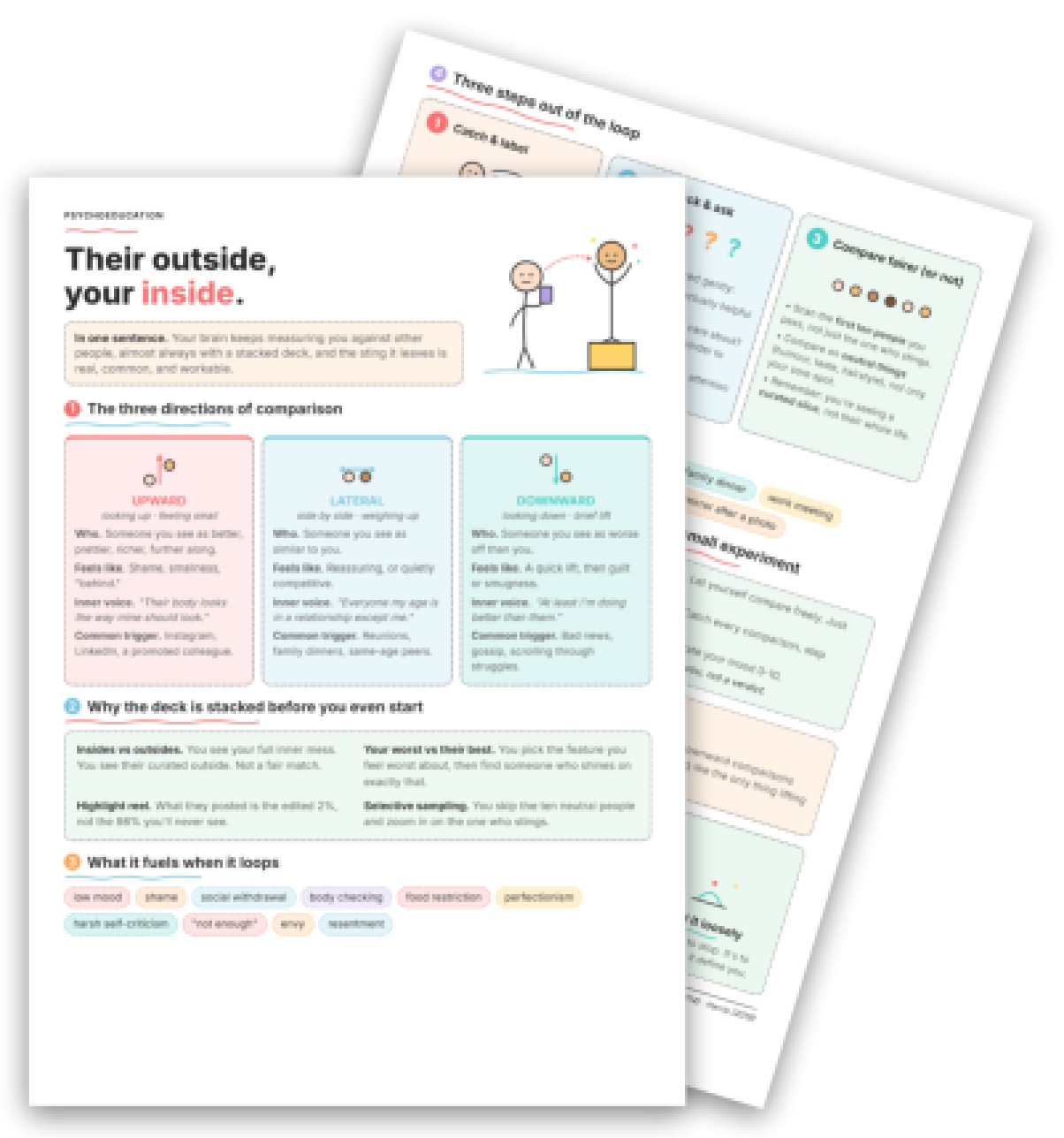
The fiche is organized into seven content panels, all oriented toward psychoeducation rather than self-report. The opening frame sets a non-pathologising tone in one sentence: "Your brain keeps measuring you against other people, almost always with a stacked deck, and the sting it leaves is real, common, and workable."
Panel 1 maps the three directions of comparison: upward (shame, feeling small, the inner voice "their body looks the way mine should look"), lateral (side-by-side, quietly competitive, often anchored to same-age peers), and downward (brief lift, then guilt or smugness). Displaying the three directions simultaneously makes visible what patients rarely articulate: that downward and lateral comparison are also active, not just the upward comparisons dominating their reported distress.
Panel 2 names four structural biases that stack the deck before any comparison begins: insides vs. outsides, worst-self vs. their best feature, the highlight reel against the unseen 98%, and selective sampling of the one person who stings most. This is the panel that most reliably produces a clinical shift, because it gives patients precise language for a process they already half-suspected but could not name.
Panel 3 catalogues what comparison fuels when it loops: low mood, shame, social withdrawal, body checking, food restriction, perfectionism, harsh self-criticism, envy, and resentment. Seeing this list often helps patients connect isolated symptoms to a single maintaining process, reinforcing cognitive case formulation work and making self-compassion exercises a logical next step in the care plan.
Panel 4 presents the three-step exit sequence: catch and label ("There I go comparing again"), step back and ask (four questions, including "Is this comparison actually helpful right now?" and "What else could I put my attention on?"), and compare fairer, with behavioural alternatives such as scanning the first ten people you pass rather than fixing on the one who stings. This sequence maps neatly onto ACT defusion work and cognitive restructuring. The remaining panels cover typical ambush contexts (Instagram, LinkedIn, gym entry, family dinners), a set of pocket phrases, and a six-day behavioural experiment with nightly mood tracking.
> Key point: The worksheet is a visual support that facilitates the explanation of social comparison in session, not a questionnaire the patient fills out alone. The three-directional layout and the stacked-deck panel carry the psychoeducation; you guide the patient through them, and they leave with a concrete reference.
750+ clinical tools
A library built with and for clinicians, ready to use in session and extend between appointments.
Access all the toolsWhen and How to Introduce the Worksheet
The worksheet fits naturally from session two onwards, once you have an initial formulation and have identified comparison as a maintaining process. It is particularly indicated for patients presenting with low self-esteem, social anxiety, perfectionism, eating difficulties, or social withdrawal feeding depressive cycles. It also pairs well early in schema work with patients showing defectiveness or shame schemas.
Introduce it with a neutral, non-labelling frame: "I'd like to show you something that maps a pattern most brains do automatically, and that many people find surprisingly recognisable." Work through panels 1 and 2 together in session before handing over the printed copy. The "To discuss in session" prompts embedded in the fiche (when the same person keeps appearing in comparisons week after week; when avoidance of specific contexts begins to structure daily life; when downward comparisons become the only reliable mood lift) give you a natural debrief structure for the next appointment.
One contraindication worth noting: with patients in an acute depressive episode, or with active body dysmorphic disorder, panel 3's symptom list can feel overwhelming rather than normalising. Cover panels 1 and 2 first in those cases, and return to the rest as the alliance strengthens. The Constant Social Comparison guided exercise offers a structured between-session complement when you want to go deeper on the self-criticism dimension.
The worksheet does not replace formulation or the therapeutic relationship; it makes one core maintaining mechanism visible enough to work on together.
Use it with your patients
Share this tool in the mobile app and follow the work between sessions.
Sources
- Le Blanc-Brillon, J., Fortin, J.-S., Lafrance, L., Hetu, S. (2025). The Associations Between Social Comparison on Social Media and Young Adults' Mental Health. Frontiers in Psychology, 16, 1597241.
Your session continues in your patients' pocket
Use with a patientYour resources, available everywhere
The handouts, exercises, programs and audios above: you choose which ones to make available to your patients, in the mobile app dedicated to them.
And far more than a library
The app goes well beyond resources, to support your patients every day:
Related categories
Explore other clinical resources by category.

Anxiety
Clinical hub for anxiety disorders: CBT and ACT worksheets, psychoeducation sheets, and exercises for assessment and treatment across the anxiety spectrum.

Mood
Evidence-based worksheets and clinical tools for mood disorders: CBT, ACT, and positive psychology resources for psychologists and therapists.

Identity
Clinical resources for self-identity work in therapy: CBT, ACT, schema tools for clinicians addressing self-concept, core beliefs, and identity disruption.

Behaviours
Clinical hub for behaviors in therapy: worksheets and tools for coping, eating disorders, CBT formulation, and maladaptive behavioral patterns.

Cognition
Printable cognitive therapy worksheets and clinical tools for therapists: CBT, ACT, schema work, defusion, distortions, and belief restructuring.

Understand
Clinical hub for the therapeutic aim 'Understand': worksheets and tools to build patient insight across CBT, ACT, schema therapy and more.