
Clinical picture. A, a 34-year-old software engineer, presented with persistent low-grade exhaustion and a vague sense of failure despite repeated promotions. He described finishing each project with a brief moment of relief followed immediately by the conviction that the result had been too straightforward to count. During a session focused on psychoeducation, the clinician introduced the five-step ratchet loop and asked A to map his last three months onto it; he identified the discount step as automatic and nearly invisible to him. He left with the informational sheet and, the following week, returned able to name two instances mid-week where he had caught the discounting thought before the bar shifted. No broader change in pattern was claimed, but the naming gave him a small foothold for observation.
The Perfectionism Ratchet Effect: PDF Worksheet, Tools and Exercises
A visual PDF worksheet for clinicians to explain why achievements never land and the bar keeps climbing, used as an in-session psychoeducation tool for perfectionism.
Clinical vignettes
The Bar That Keeps Moving
Compliments That Slide Off
Clinical picture. M, a 28-year-old doctoral student, sought consultation after her supervisor noted she seemed unable to receive positive feedback without immediately redirecting to what remained undone. She reported that praise felt suspicious and that rest felt undeserved until the next milestone was secured. The clinician used the ratchet psychoeducation sheet to externalise the mechanism, framing the discounting not as modesty but as a structural loop that made satisfaction structurally unavailable. M recognized the phrase "it only counts if nobody helped" as something she repeated to herself after her most successful chapter. Subsequent sessions focused on distinguishing healthy high standards from the ratchet dynamic, using the sheet's contrast table as a shared reference point.
Patients presenting with clinical perfectionism often describe meeting goal after goal while feeling perpetually behind. The core problem is rarely the height of their standards; it is the discounting mechanism that erases each success before it can register. Explaining this orally tends to produce polite nodding and limited transfer. This fiche PDF works as a visual support you use in session to make the loop concrete, nameable, and recognisable, not an assignment the patient completes alone at home.
Use this resource with your patients
Handout, exercises and materials ready to use, right inside SessionFuel.
Why the discounting mechanism resists verbal explanation
In the CBT model of perfectionism, success-discounting is the engine that keeps the system running: without it, raising the bar would at least feel like a choice. The difficulty in session is that the mechanism is pre-reflective. Patients do not experience themselves as discounting; they experience themselves as simply being realistic. Phrases like "that was too easy, it doesn't count" or "anyone in my position would manage" feel like neutral appraisals, not distortions.
This makes oral psychoeducation fragile. The concept sounds plausible in the room, then dissolves before the next session because the patient never saw the loop from the outside. A cognitive distortions framework helps name specific errors, but it does not show the cyclical structure that gives perfectionism its self-perpetuating quality. That structural view is exactly what a visual fiche can provide.
The ratchet metaphor is also worth noting clinically: it names directionality. A ratchet cannot turn back. That single image often lands faster than a paragraph of explanation, and it gives patient and clinician a shared shorthand for the rest of the treatment.
What the fiche contains: a visual map of the ratchet loop
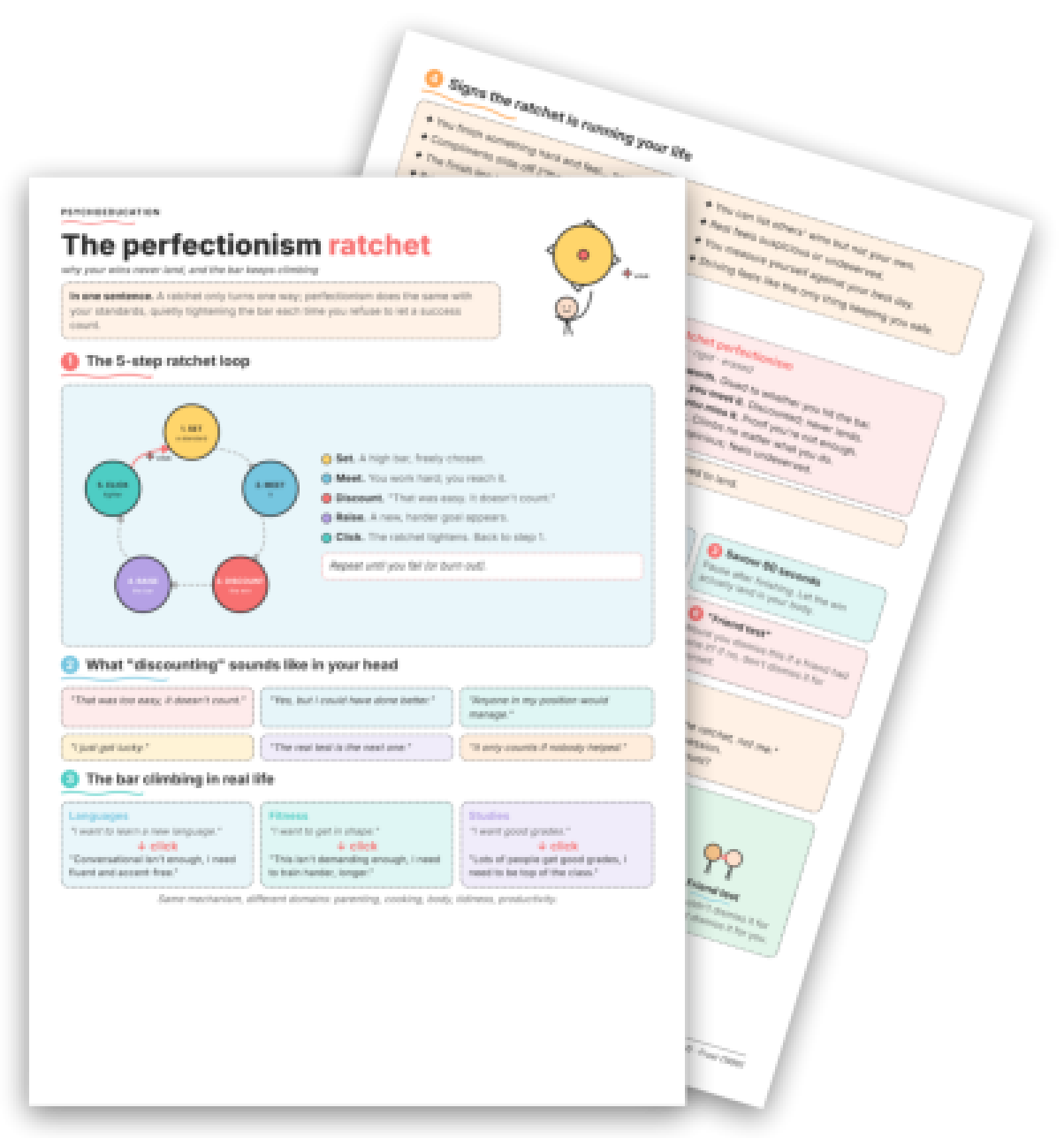
The fiche is organised into six clearly labelled panels, all grounded in the Shafran, Egan, and Frost research tradition.
- Panel 1 displays the 5-step ratchet loop as a sequential diagram: Set, Meet, Discount, Raise, Click. The visual circuit makes the automatic nature of the loop visible in a way that prose cannot; patients can point to exactly where their system tends to jam.
- Panel 2 lists six verbatim discounting statements ("yes, but I could have done better", "I just got lucky") that patients recognise without prompting, often mid-sentence.
- Panel 3 illustrates the bar climbing across real-life domains: languages, fitness, academic performance, with the repeated "↓ click" arrow showing the mechanism is domain-general.
- Panel 4 offers eight behavioural signs that the ratchet is running the patient's life, from "the finish line keeps moving as you near it" to "striving feels like the only thing keeping you safe." This section is particularly useful for differential work with burnout presentations and low self-esteem.
- Panel 5 provides a side-by-side comparison of healthy high standards versus ratchet perfectionism across five dimensions (self-worth, response to meeting the bar, response to missing it, bar movement, and rest). The table format does what a spoken comparison rarely achieves: it holds both columns in view simultaneously.
- Panel 6 details six concrete practices for interrupting the ratchet, including "Name it out loud before your brain edits: I did X. That was hard. It counts," the "friend test," and a 60-second savouring pause. A dedicated "To discuss in session" block provides three ready-made debrief prompts.
> Key takeaway: the fiche is a visual support that facilitates the in-session explanation of the ratchet effect; you use it to walk through the mechanism together, then leave it with the patient as a concrete reference, not a questionnaire to fill out alone.
750+ clinical tools
A library built with and for clinicians, ready to use in session and extend between appointments.
Access all the toolsWhen and how to introduce the fiche in session
This fiche PDF fits naturally once the therapeutic alliance is established and you have an initial formulation. For patients already working with the cognitive behavioural model of perfectionism, it can slot into a second or third session as a consolidation tool. For those who arrive describing impostor syndrome or a persistent sense that their wins do not count, it is often the first psychoeducation piece that makes the pattern feel recognisable rather than shameful.
A low-inference introduction: "I want to show you something that might map onto what you've been describing." Walk through Panel 1 together, then ask which step feels most familiar. Most patients identify the Discount step immediately; the visual gives them language for something they had not been able to name.
Panel 4's checklist functions well as a shared inventory rather than a diagnostic checklist. After the session, the perfectionism self-reflection exercise pairs well as between-session homework, while the celebrating personal successes exercise directly targets the discounting habit the fiche has named. For patients whose all-or-nothing thinking underpins the bar-raising, the fiche creates a useful bridge to that subsequent cognitive work. If self-criticism is prominent alongside the perfectionism, the growth mindset worksheet and the making mistakes self-compassion exercise extend the work naturally.
The fiche does not replace formulation or exposure work; it gives patient and clinician a shared vocabulary for the mechanism, which is often the prerequisite for everything that follows.
Use it with your patients
Share this tool in the mobile app and follow the work between sessions.
Sources
- Shafran, R., Egan, S., & Wade, T. (2018). Overcoming Perfectionism: A self-help guide using scientifically supported cognitive behavioural techniques (2nd ed.). Little, Brown Book Group.
- Egan, S. J., Wade, T. D., Shafran, R., & Antony, M. M. (2014). Cognitive-Behavioral Treatment of Perfectionism. Guilford Press.
Your session continues in your patients' pocket
Use with a patientYour resources, available everywhere
The handouts, exercises, programs and audios above: you choose which ones to make available to your patients, in the mobile app dedicated to them.
And far more than a library
The app goes well beyond resources, to support your patients every day:
Related categories
Explore other clinical resources by category.

Identity
Clinical resources for self-identity work in therapy: CBT, ACT, schema tools for clinicians addressing self-concept, core beliefs, and identity disruption.

Behaviours
Clinical hub for behaviors in therapy: worksheets and tools for coping, eating disorders, CBT formulation, and maladaptive behavioral patterns.

Cognition
Printable cognitive therapy worksheets and clinical tools for therapists: CBT, ACT, schema work, defusion, distortions, and belief restructuring.

Understand
Clinical hub for the therapeutic aim 'Understand': worksheets and tools to build patient insight across CBT, ACT, schema therapy and more.

Build awareness
Clinical worksheets and tools to build awareness in therapy: cognitive distortions, schemas, emotions, ACT and CBT resources for practitioners.
CBT
CBT worksheets, cognitive restructuring exercises & behavioral tools for clinicians. Evidence-based resources for every phase of cognitive behavioral therapy.