
Clinical picture. A., a 34-year-old teacher referred for persistent low mood, opens the session describing three sleepless nights spent replaying a difficult conversation with her department head. She reports feeling worse after each cycle of thinking, with no clearer sense of what to do next. The clinician introduces the why/how distinction from the psychoeducation sheet, asking her to name the question her mind kept returning to; she identifies it immediately as "Why does he never take me seriously?" Together they rewrite it as "How do I want to raise this with him, and when?" A. noted, with some surprise, that the rewritten question felt answerable, and she left the session with one concrete step rather than the same abstract grievance.
HandoutThoughts & cognitionMood & depressionAnxietyTrauma & PTSDUnderstandBuild awarenessCBTMetacognitive
Rumination: PDF Worksheet, Tools and Exercises for Clinical Practice
A printable PDF fiche, clinical tools and exercises to explain ruminative thinking in session and help patients distinguish stuck 'why' loops from actionable problem-solving.
Clinical vignettes
Recognising the Why Loop in Session
Distinguishing Rumination from Problem-Solving
Clinical picture. M., a 47-year-old manager presenting with generalised anxiety, described spending his weekends "working through" a project setback but arriving at Monday no closer to a decision. When the clinician used the sheet to map his mental activity against the three comparisons (worry, problem-solving, self-reflection), M. recognised that his thinking was abstract, repetitive, and produced no action steps, fitting the rumination pattern rather than genuine problem-solving. The clinician invited him to force specificity: "What exactly happened on which afternoon, and what is one thing you could do by Thursday?" Anchoring the question this way shifted M. from a broad narrative about professional failure to a single, manageable next action. He returned the following week reporting a modest but noticeable reduction in weekend distress.
Explaining rumination in session often produces the same frustrating moment: the patient follows your reasoning, agrees it sounds exactly like what they do, and then spends the next four evenings in exactly the same loop. The concept lands cognitively but doesn't produce traction. This fiche PDF is a visual support designed to be used during the session itself, not sent home as reading, and it targets the specific thing patients misunderstand most: the belief that ruminating is problem-solving.
Use this resource with your patients
Handout, exercises and materials ready to use, right inside SessionFuel.
Why Rumination Resists Explanation in Session
The core difficulty isn't definitional. It's that ruminative thinking mimics purposeful cognition from the inside. A patient grinding on "why did they react that way?" genuinely experiences themselves as working on the problem. The évitement expérientiel is well concealed: the loop feels active, even virtuous.
Without a clear visual contrast, your oral explanation competes with this felt sense. Patients conflate rumination with three neighbouring processes: worry about future outcomes, self-reflection that leads to usable insight, and genuine problem-solving. Each of these distinctions matters clinically, and each is genuinely difficult to hold in mind from a verbal description alone. The fiche addresses this by making the distinctions concrete and side-by-side rather than sequential.
What the Fiche Contains: A Visual Fork in the Road
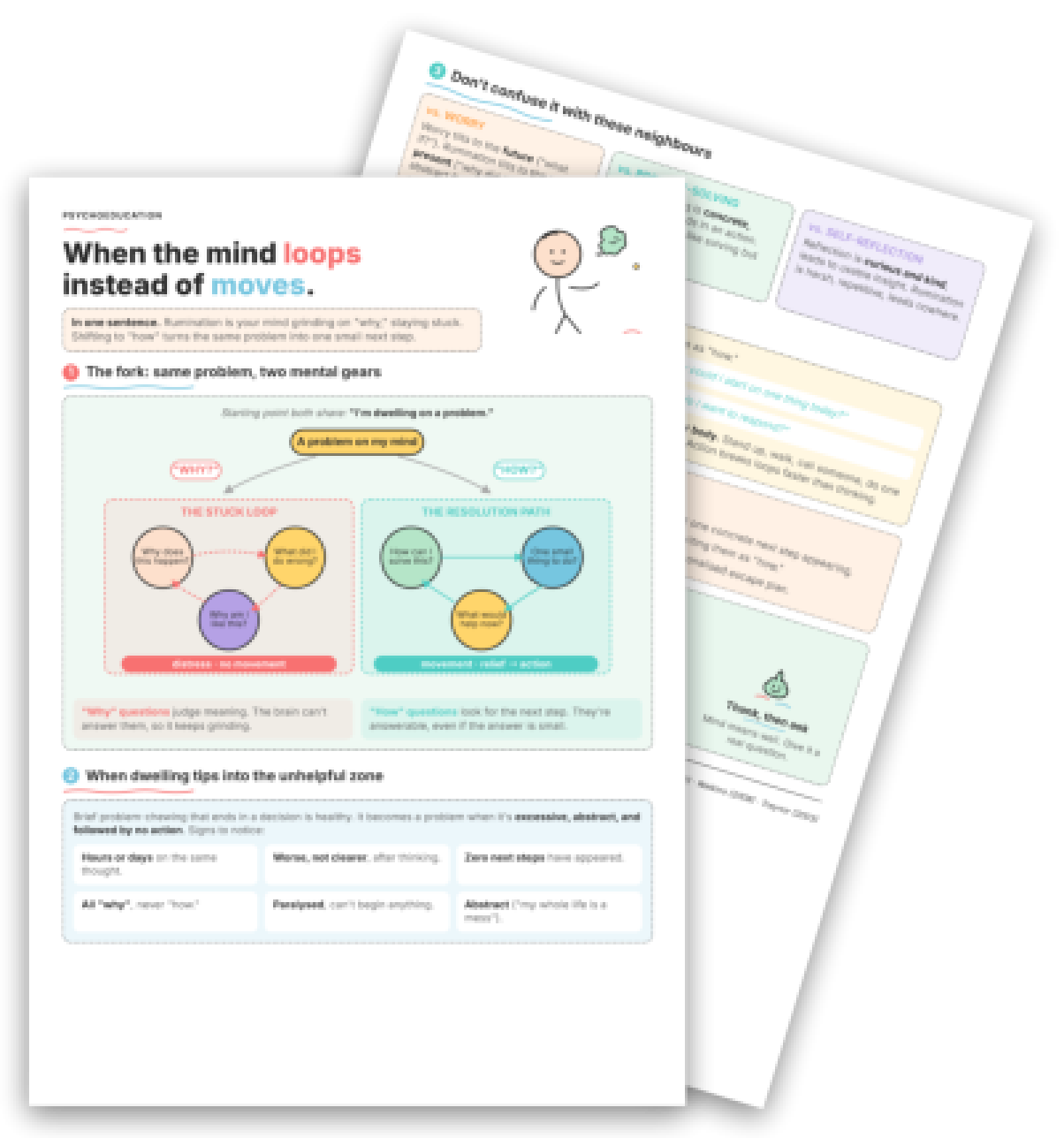
The structural spine of the fiche is a two-path diagram labelled The fork: same problem, two mental gears. Both paths begin at the same starting point, "A problem on my mind," then branch: the "WHY?" path (stuck loop: "Why does this happen? What did I do wrong? Why am I like this?") leads to distress and no movement; the "HOW?" path (resolution path: "How can I solve this? One small thing to do? What would help now?") leads to movement and relief toward action. Presented visually, this fork does something your explanation alone cannot: it shows that the content of the question, not the amount of thinking, determines whether the loop moves or stalls.
The fiche then gives clinicians three further panels to work through. Panel 2 lists six observable signs that brief "problem-chewing" has tipped into the unhelpful zone: hours or days on the same thought, feeling worse rather than clearer, zero next steps, all "why" and never "how," paralysis, and abstraction ("my whole life is a mess"). This is useful to display alongside automatic thought monitoring tools when you need patients to self-identify the pattern. Panel 3 draws explicit contrasts with worry, genuine problem-solving, and self-reflection, directly addressing the three most common confusions. Panel 4 offers three concrete loop-breaking techniques: the catch and rewrite technique (spot the "why" question, write it, rewrite as "how"), a concreteness prompt ("what exactly happened on Tuesday afternoon?"), and a behavioural interrupt (stand up, walk, call someone, do one small task).
> Key takeaway: the fiche is a visual support that facilitates the explanation of rumination in session; the fork diagram and the side-by-side comparisons show patients, in one glance, what an oral explanation takes several minutes to approximate.
Clinical library
750+ clinical tools
A library built with and for clinicians, ready to use in session and extend between appointments.
Access all the toolsSeveral resource types
Psychoeducation handouts
Understand at a glance
Interactive exercises
To do and fill in
Interactive programs
A structured path
Audios
Meditation and relaxation
Psychometric tests
Automatic scoring
When and How to Propose It in Session
The fiche fits naturally from the second or third session onward, once you have established alliance and the patient has spontaneously described repetitive thinking. You can introduce it without pathologising: "I'd like to show you something that describes what you just told me. Tell me if this looks familiar." The fork diagram typically produces immediate recognition; patients often point to the "WHY?" column unprompted.
It is particularly well-suited to presentations where rumination maintains depression (a classic finding in Nolen-Hoeksema's response styles model), or where intolerance of uncertainty feeds abstract self-questioning. It also pairs directly with the structured self-monitoring exercise on ruminative patterns as a between-session assignment once the psychoeducation has landed. For patients who need the next step scaffolded, the full rumination psychoeducation program extends the fiche across four structured lessons.
The debrief question is straightforward: ask the patient which "why" questions they recognise from the left-hand column, then collaboratively draft two or three "how" rewrites. The rumination eraser guided meditation can then be assigned as an autonomous between-session tool once the conceptual frame is established. If the clinical picture includes perceived injustice loops or overthinking driven by anxiety, note that the fiche's framework applies equally to those presentations; the "why vs. how" gear-shift is transdiagnostic.
One limit worth keeping in mind: for patients with significant depressive slowing, the behavioural interrupt suggestions (movement, calling someone) may read as dismissive before sufficient psychoeducation on behavioural activation has been established. In those cases, work through panels 1 through 3 first, and return to panel 4 once the patient has some momentum.
The fiche doesn't replace the formulation. It makes one part of it visible, shareable, and concrete enough to refer back to in every subsequent session.
Use it with your patients
Share this tool in the mobile app and follow the work between sessions.
Sources
- Watkins, E. R. (2016). Rumination-Focused Cognitive-Behavioral Therapy for Depression. Guilford Press.
- Watkins, E. R., Mullan, E., Wingrove, J., Rimes, K., Steiner, H., Bathurst, N., Eastman, R., Scott, J. (2011). Rumination-Focused Cognitive-Behavioural Therapy for Residual Depression: Phase II Randomised Controlled Trial. British Journal of Psychiatry, 199(4), 317-322.
Patient mobile app
Your session continues in your patients' pocket
Use with a patientYour resources, available everywhere
The handouts, exercises, programs and audios above: you choose which ones to make available to your patients, in the mobile app dedicated to them.
Psychoeducation handoutsInteractive exercisesInteractive programsAudiosPsychometric tests
And far more than a library
The app goes well beyond resources, to support your patients every day:
Standardized tests
Therapy journal
Gamification
Wellbeing challenges
Introspection prompts
Therapist homework
Related categories
Explore other clinical resources by category.

Anxiety
Clinical hub for anxiety disorders: CBT and ACT worksheets, psychoeducation sheets, and exercises for assessment and treatment across the anxiety spectrum.

Trauma
Clinical hub on trauma and PTSD: assessment, differential diagnosis, treatment phases, and printable resources for practitioners. 155 chars.

Mood
Evidence-based worksheets and clinical tools for mood disorders: CBT, ACT, and positive psychology resources for psychologists and therapists.

Cognition
Printable cognitive therapy worksheets and clinical tools for therapists: CBT, ACT, schema work, defusion, distortions, and belief restructuring.

Understand
Clinical hub for the therapeutic aim 'Understand': worksheets and tools to build patient insight across CBT, ACT, schema therapy and more.

Build awareness
Clinical worksheets and tools to build awareness in therapy: cognitive distortions, schemas, emotions, ACT and CBT resources for practitioners.