
Clinical picture. M., a woman in her mid-thirties, presented with recurrent low mood linked to perceived underperformance at work. She reported feeling deflated most afternoons but struggled to identify why. The clinician introduced the Automatic Thoughts Worksheet and asked her to complete a row each time her mood dropped sharply during the following week. She returned with an entry describing a routine email from her manager asking for a file revision; the thought she had recorded was: "He thinks I don't know what I'm doing." Working through the evidence column together, M. acknowledged she had no prior feedback suggesting incompetence, and she generated an alternative reading that she rated as moderately believable. Her affect during that review session was noticeably less flat than at intake, though she remained cautious about generalising the gain.
Automatic Thoughts: PDF Worksheet, Tools and Exercises
A printable PDF worksheet, visual tools, and exercises to explain automatic thoughts clearly in session and give patients a concrete between-session reference.
Clinical vignettes
Worksheet Surfaces a Hidden Assumption
Externalising a Thought Reduces Rumination
Clinical picture. T., a man in his early forties with a longstanding pattern of social withdrawal, described lying awake after a dinner with colleagues, replaying a moment when he had been briefly interrupted mid-sentence. He had not written the thought down at the time, relying instead on mental rehearsal, which amplified rather than resolved it. The clinician used the worksheet structure in session to reconstruct the sequence: the trigger, the automatic thought ("they find me boring"), and the cognitive distortions at play, here mind-reading and personalising. T. found the act of writing the raw thought on paper, rather than cycling through a tidied version of it internally, created enough distance for him to question it. He agreed to use a brief paper log on his phone's notes app for one week, with the explicit goal of externalising rather than resolving, and reported at the next session that the rumination cycles had been shorter.
Explaining automatic thoughts to a patient rarely lands on the first attempt. The concept carries a built-in paradox: the very thing you're asking them to observe feels, from the inside, like a self-evident fact rather than a thought. This fiche PDF bridges that gap, providing a visual structure you can walk through together in session rather than relying on verbal explanation alone.
Use this resource with your patients
Handout, exercises and materials ready to use, right inside SessionFuel.
Why Automatic Thoughts Resist Oral Explanation
The core difficulty is epistemic. When a patient hears "your thought colours your mood," they typically agree at the surface and miss the mechanism entirely. What they struggle to do is identify the micro-sentence their mind produced between a neutral trigger and a feeling that seems to arrive fully formed. The thought-feeling link is so compressed, so automatic, that the thought itself becomes invisible.
A second obstacle: interpretive bias. The automatic thought feels true, feels like a perception rather than an inference. Patients with depression or social anxiety, in particular, report "they're done with me" with the same certainty they'd report a weather fact. No amount of orally delivered psychoeducation fully dissolves that certainty. What helps is making the structure visible on paper, so the patient can look at the thought rather than from inside it. That shift in perspective is the prerequisite for any sustained cognitive restructuring work.
What the Fiche Contains
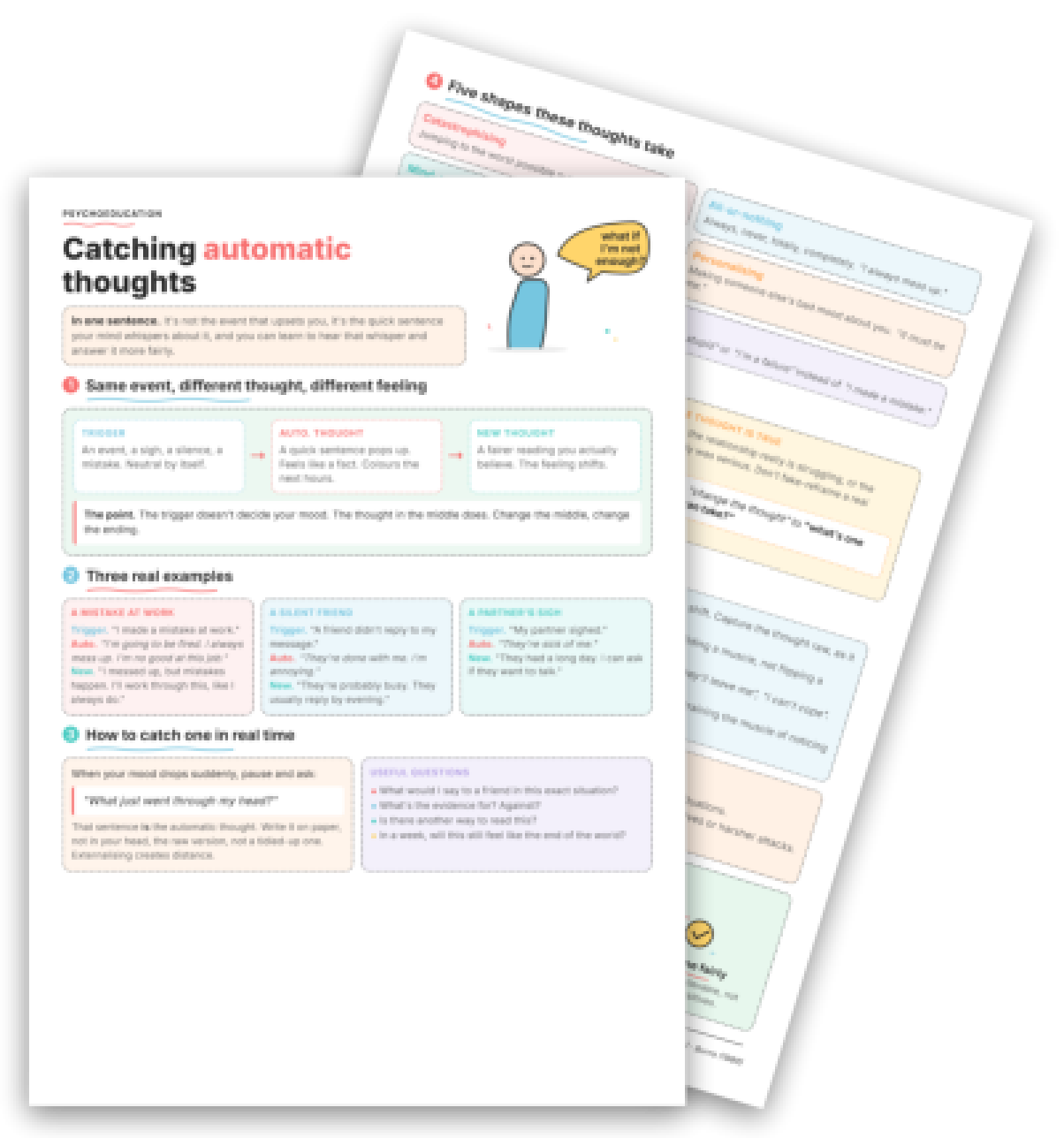
The fiche is organised across six numbered panels, each addressing a distinct clinical moment in working with automatic thoughts.
- Panel 1 maps the core mechanism explicitly: "The trigger doesn't decide your mood. The thought in the middle does." Having this printed lets you point at the middle column when a patient conflates situation and emotional reaction.
- Panel 2 offers three grounded examples: a work mistake, an unanswered message, a partner's sigh. These normalise the kinds of mind-reading distortions and all-or-nothing thinking that appear most often in your consultations, without requiring the patient to generate their own example before they've understood the concept.
- Panel 3 addresses real-time catching, anchored on the question "What just went through my head?" and paired with four follow-up prompts: weighing evidence for and against, considering an alternative reading, and checking whether the thought will still feel catastrophic in a week.
- Panel 4 names five cognitive distortion types: catastrophising, all-or-nothing thinking, mind-reading, personalising, and labelling. This builds a shared vocabulary without requiring you to deliver a taxonomy lecture.
- Panel 5 addresses reframe quality, distinguishing a balanced and believable new thought from forced positivity, a distinction patients consistently fail to make without an explicit reference. It also flags the case where the thought is accurate, redirecting toward one concrete action rather than fake reframing.
- Panel 6 sets realistic expectations across weeks of practice, and closes with a direct session discussion prompt: "When you notice the same automatic thought keeps showing up across very different situations", which opens naturally onto core belief work.
> Key point: The fiche is a visual support that facilitates the explanation of automatic thoughts in session. It is not a self-administered questionnaire; it is a psychoeducation tool the clinician walks through with the patient, leaving them with a concrete printed reference for between-session use.
The ABC Model worksheet pairs naturally with this fiche. Where REBT's ABC foregrounds irrational beliefs explicitly, this fiche stays closer to Beck's original formulation, which tends to be a gentler entry point in early-phase CBT work and is often less activating for patients who are not yet ready to examine beliefs at the schema level.
750+ clinical tools
A library built with and for clinicians, ready to use in session and extend between appointments.
Access all the toolsWhen and How to Introduce It in Session
The fiche fits most naturally from session two or three, once the initial anamnesis is complete and the working alliance is established. It is broadly applicable across presentations: depression, generalised anxiety, panic disorder, low self-esteem, and any presentation where a pervasive self-critical internal dialogue is maintaining the clinical picture.
A straightforward introduction: "I'd like to show you a diagram that describes something most people experience but rarely have words for. Let's look at it together." Framing it as a shared exploration, not a homework assignment, lowers defensiveness in patients who are apprehensive about structured tasks.
During debrief, ask which of the three examples in panel 2 resonates most. That choice is diagnostically informative: a patient who immediately identifies with "they're done with me" may be signalling abandonment-schema dynamics or approval-seeking patterns that warrant more precise mapping. Patients who recognise their distortion type in panel 4 but cannot generate a believable new thought in panel 5 are good candidates for the guided cognitive restructuring exercise as explicit between-session work, or for the evaluating thought utility exercise if metacognitive flexibility is the working target.
One limit worth noting: in early work with patients presenting active psychosis or severe dissociation, the implicit demand for self-observation built into this model may be premature. Reserve it for when attentional stability is sufficient to hold the three-column structure without fragmenting.
The fiche does not replace the therapeutic frame; it makes the explanation more precise and leaves the patient with a reference they can actually use between sessions.
Use it with your patients
Share this tool in the mobile app and follow the work between sessions.
Sources
- Beck, A. T. (1976). Cognitive Therapy and the Emotional Disorders. Meridian / New American Library.
- Burns, D. D. (1989). The Feeling Good Handbook. Harper-Collins Publishers.
- Beck, J. S. (2021). Cognitive Behavior Therapy: Basics and Beyond (3rd ed.). The Guilford Press.
- Greenberger, D., & Padesky, C. A. (2016). Mind Over Mood: Change How You Feel by Changing the Way You Think (2nd ed.). The Guilford Press.
- Beck Institute for Cognitive Behavior Therapy. CBT Worksheet Packet: Thought Record and Automatic Thoughts.
Your session continues in your patients' pocket
Use with a patientYour resources, available everywhere
The handouts, exercises, programs and audios above: you choose which ones to make available to your patients, in the mobile app dedicated to them.
And far more than a library
The app goes well beyond resources, to support your patients every day:
Related categories
Explore other clinical resources by category.

Anxiety
Clinical hub for anxiety disorders: CBT and ACT worksheets, psychoeducation sheets, and exercises for assessment and treatment across the anxiety spectrum.

Mood
Evidence-based worksheets and clinical tools for mood disorders: CBT, ACT, and positive psychology resources for psychologists and therapists.

Cognition
Printable cognitive therapy worksheets and clinical tools for therapists: CBT, ACT, schema work, defusion, distortions, and belief restructuring.

Build awareness
Clinical worksheets and tools to build awareness in therapy: cognitive distortions, schemas, emotions, ACT and CBT resources for practitioners.

Restructure
Clinical hub for cognitive restructuring worksheets: distortion identification, belief disputation, ABC model, and schema work for evidence-based practice.

CBT
CBT worksheets, cognitive restructuring exercises & behavioral tools for clinicians. Evidence-based resources for every phase of cognitive behavioral therapy.