
Clinical picture. M., a 34-year-old man presenting with social anxiety, described leaving a team meeting early after his manager gave no visible reaction to his contribution. He had concluded within seconds that she found his input worthless, and spent the remainder of the afternoon avoiding her. In the following session, the clinician introduced the mind-reading psychoeducation sheet and walked M. through the five-step loop, asking him to map his experience onto each stage. He recognized, with some surprise, that he had skipped any question mark between the guess and the belief, and that his early exit had prevented any corrective information from reaching him. As a first step, M. agreed to practice labeling the thought aloud to himself using the phrase "I notice I am mind-reading" before acting on it.
Mind Reading: PDF Worksheet, Tools and Exercises for Clinical Practice
A visual PDF worksheet, practical tools, and structured exercises to help clinicians explain the mind-reading cognitive distortion clearly and efficiently in session.
Clinical vignettes
Silence Misread as Rejection
Unanswered Text, Tightening Loop
Clinical picture. T., a 28-year-old woman with a history of relational insecurity, reported a three-hour period of distress after a close friend did not reply to a message, during which she had ruminated that the friend was angry at her and withdrawing. The clinician used the informational sheet to distinguish mind reading from real empathy, drawing attention to the column contrasting a verdict-first posture with a hypothesis-held-lightly posture. T. noted that she had filtered out the friend's subsequent reply, which gave a benign explanation, because by then she had already partly acted on her story by sending a second, apologetic message. The clinician named the confirmation step in the loop and reflected that her withdrawal had briefly created the very distance she feared. They agreed to explore in coming sessions what conditions made the loop run fastest for her.
When you explain mind reading verbally, most patients agree immediately: "Yes, I do that." What they rarely grasp on the spot is how the distortion operates as a closed loop that runs in seconds, generates its own confirming evidence, and keeps them perpetually reacting to a private story rather than to the actual person in front of them. This fiche PDF makes that loop visible, which changes the conversation entirely.
Use this resource with your patients
Handout, exercises and materials ready to use, right inside SessionFuel.
Why Mind Reading Resists a Verbal Explanation
The clinical difficulty here is not conceptual, it is structural. Mind reading sits at the intersection of interpretive bias, automatic thoughts, and confirmatory reasoning. When you describe it in words, patients tend to hear a bad habit, something to correct with willpower. What they miss is the self-sealing mechanism: the withdrawal that follows the negative guess creates the very distance that "proves" the guess was right.
A second obstacle is the confusion with genuine empathy. Many patients, especially those high in social anxiety (see the Clark and Wells model), believe they are reading people accurately. Without a side-by-side comparison showing the structural differences between a verdict and a hypothesis, that belief is hard to dislodge in a single oral exchange. The fiche addresses both problems at once.
What the Fiche Contains: A Visual Support for In-Session Explanation
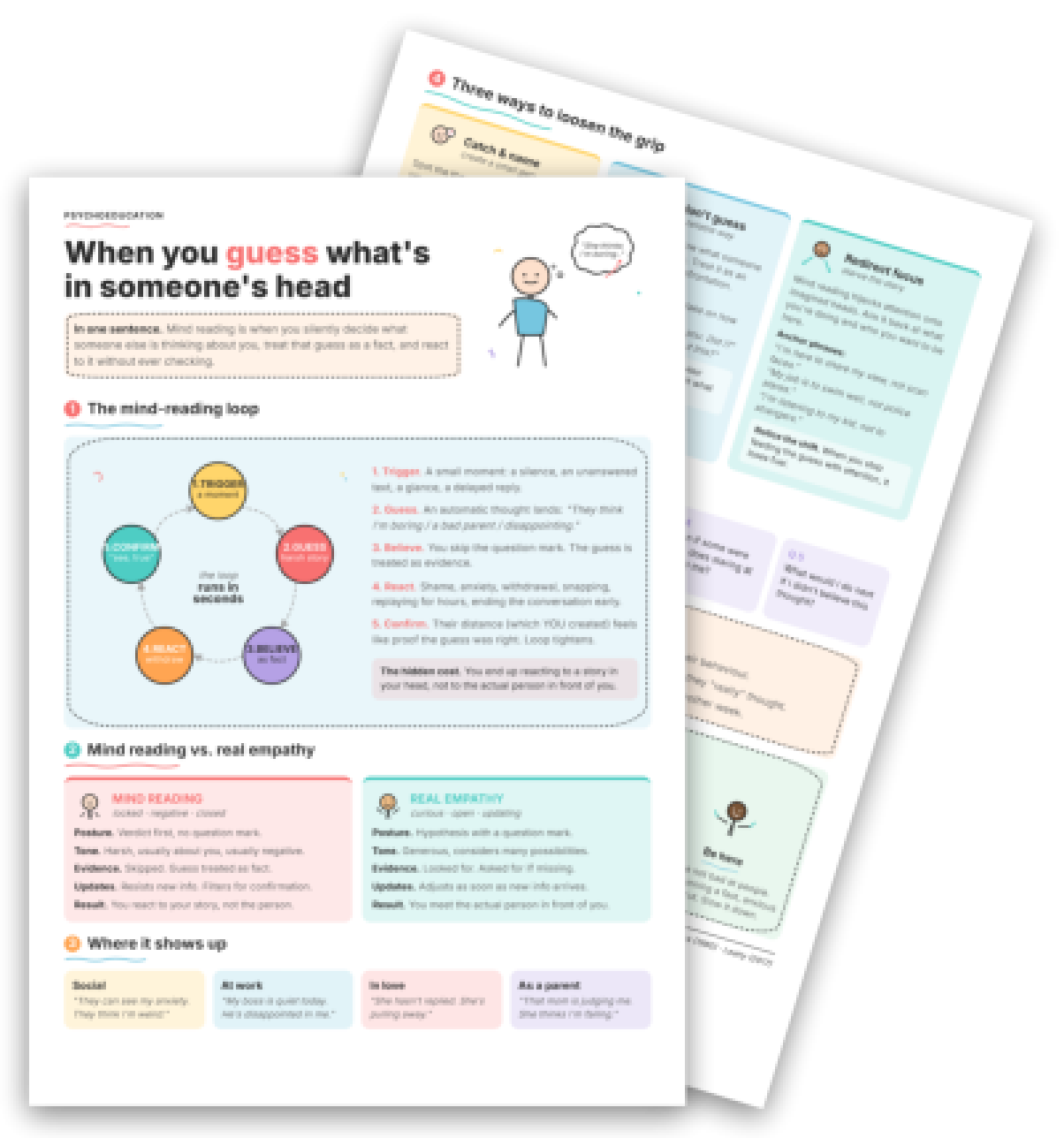
The fiche PDF is organized across five panels, each serving a distinct clinical function.
- The mind-reading loop maps the five-step sequence (Trigger, Guess, Believe, React, Confirm) as a circular diagram, making the self-reinforcing logic immediately visible. Patients can point to exactly where they enter the loop, which is far more precise than a verbal description.
- Mind reading vs. real empathy presents a two-column comparison contrasting the locked, verdict-first posture of mind reading with the curious, updating stance of real empathy. The contrast is built around five dimensions: posture, tone, evidence, updates, and result. This is what breaks the "I'm just perceptive" rationalization most efficiently.
- Where it shows up grounds the distortion in four concrete contexts (social, work, romantic, parenting) with one-line examples per domain, giving patients immediate recognition without requiring them to produce autobiographical material on the spot.
- Three ways to loosen the grip offers structured behavioral strategies: catch and name (with phrases like "Ah, mind-reading again" and "That's a guess, not a fact"), ask rather than assume (with ready-to-use scripts), and redirect focus using personal anchor phrases. Each strategy includes a micro-experiment or tracking prompt.
- Five questions to test the guess provides a cognitive restructuring scaffold the patient can use independently between sessions.
A dedicated "To discuss in session" section lists three clinical situations worth exploring together, which doubles as a debrief prompt you can use immediately after introducing the fiche.
> Key point: The fiche is a visual support that facilitates the explanation of mind reading during the session itself. It is not a self-directed questionnaire: the clinician uses it in session to make the loop tangible, then hands the patient a concrete reference to take away.
750+ clinical tools
A library built with and for clinicians, ready to use in session and extend between appointments.
Access all the toolsWhen and How to Introduce the Fiche
This fiche PDF fits naturally from the second or third session onward, once the cognitive model has been introduced and at least one interpersonal difficulty has emerged in the anamnesis. It is particularly useful with patients presenting social anxiety, abandonment schemas, or approval-seeking patterns, where mind reading is a central maintenance process. It also travels well into couples work alongside resources on relational beliefs.
A low-labeling introduction works well: "I want to show you something about how the mind fills in gaps, especially in social situations. Take a look at this diagram and tell me if any step looks familiar." The loop graphic usually does the work from there.
For debrief, the "To discuss in session" prompts on the fiche are enough to generate a 10-minute structured conversation. The five-question grid can then be assigned as between-session homework alongside the companion mind-reading exercise, which builds directly on the fiche's vocabulary.
One contraindication worth noting: with patients in an early paranoid episode or where the therapeutic alliance is fragile, introducing the distortion label prematurely can feel invalidating. In those cases, the fact or interpretation tool offers a softer entry point.
The fiche does not replace the formulation work or the broader cognitive distortions framework; it makes one specific mechanism clear enough that patients can actually catch it in real time.
Use it with your patients
Share this tool in the mobile app and follow the work between sessions.
Sources
- Beck, A. T., Rush, A. J., Shaw, B. F., & Emery, G. (1979). Cognitive Therapy of Depression. Guilford Press.
- Burns, D. D. (1980). Feeling Good: The New Mood Therapy. Signet Books.
- Burns, D. D. (1989). The Feeling Good Handbook. William Morrow.
Your session continues in your patients' pocket
Use with a patientYour resources, available everywhere
The handouts, exercises, programs and audios above: you choose which ones to make available to your patients, in the mobile app dedicated to them.
And far more than a library
The app goes well beyond resources, to support your patients every day:
Related categories
Explore other clinical resources by category.

Anxiety
Clinical hub for anxiety disorders: CBT and ACT worksheets, psychoeducation sheets, and exercises for assessment and treatment across the anxiety spectrum.

Identity
Clinical resources for self-identity work in therapy: CBT, ACT, schema tools for clinicians addressing self-concept, core beliefs, and identity disruption.

Cognition
Printable cognitive therapy worksheets and clinical tools for therapists: CBT, ACT, schema work, defusion, distortions, and belief restructuring.

Understand
Clinical hub for the therapeutic aim 'Understand': worksheets and tools to build patient insight across CBT, ACT, schema therapy and more.

Build awareness
Clinical worksheets and tools to build awareness in therapy: cognitive distortions, schemas, emotions, ACT and CBT resources for practitioners.

Restructure
Clinical hub for cognitive restructuring worksheets: distortion identification, belief disputation, ABC model, and schema work for evidence-based practice.