
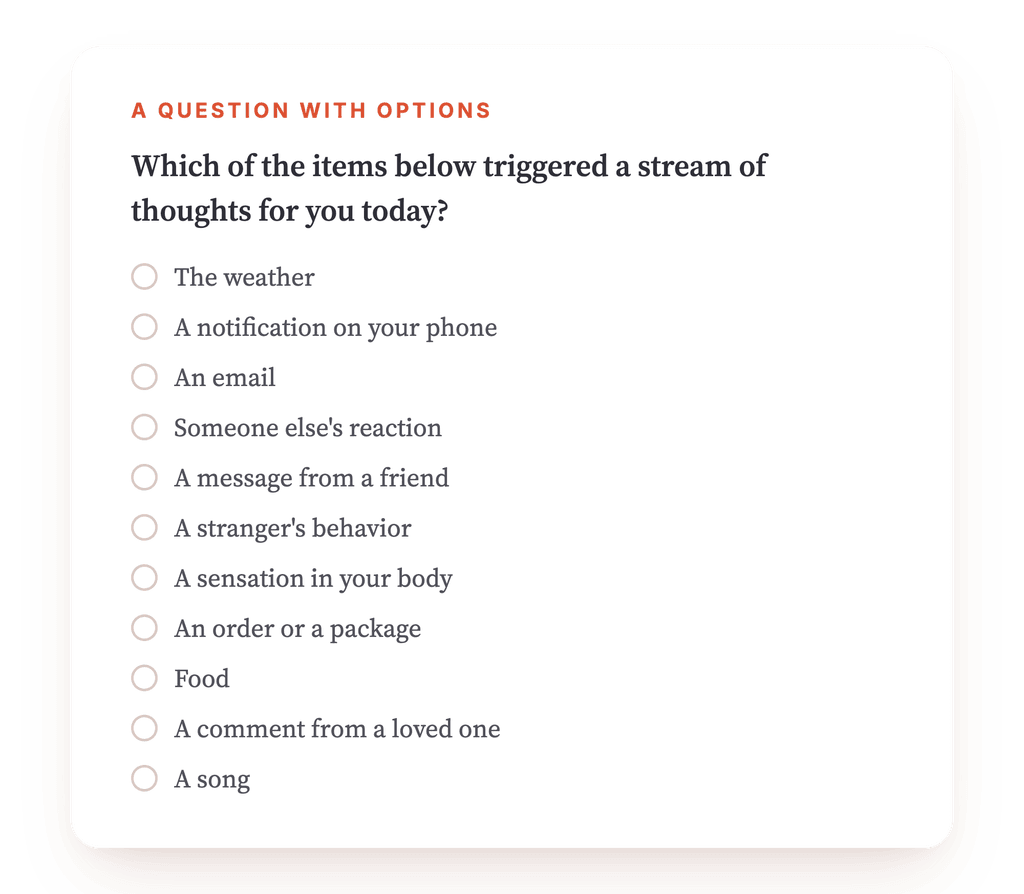
Clinical picture. M., a woman in her early forties, presents with generalised anxiety disorder characterised by pervasive anticipatory worry and difficulty disengaging from catastrophic interpretations of routine events. Her clinician introduces the first lesson of the Towards Calmer Self-Talk program as between-session work, asking her to complete the guided reflection on thought triggers before their next appointment. M. returns having identified, through the multiple-choice prompt, that body sensations and colleagues' reactions were her most frequent thought-triggers, and she had written out two thought-emotion pairs in her own words. This concrete mapping gave the subsequent session a shared, patient-generated starting point, reducing the time spent eliciting examples and allowing the clinician to move directly into functional analysis.
Toward a Calmer Inner Dialogue: A 4-Lesson Clinical Program
A structured psychoeducation program helping patients identify negative self-talk patterns and rebuild a healthier inner voice, step by step.
Clinical vignettes
Mapping Worry-Driven Self-Talk in GAD
Engaging a Reluctant Patient Through Self-Paced Lessons
Clinical picture. T., a man in his mid-thirties seen for recurrent depressive episodes, expresses scepticism toward structured psychological exercises, reporting that worksheets feel "like school." His psychologist frames the program's lessons as self-directed exploration rather than homework, emphasising that each step can be paused and revisited. After completing the second lesson on types of negative inner discourse, T. spontaneously noted that the "worry" category matched his pre-sleep rumination more precisely than the label "depression" had. This reframing modestly increased his engagement with subsequent lessons and provided clinically useful language he was willing to use within sessions.
Use this resource with your patients
Handout, exercises and materials ready to use, right inside SessionFuel.
Why inner self-talk is hard to shift with words alone
Most patients arrive with a vague sense that they are "too hard on themselves," yet they cannot locate exactly what is happening, or when. Negative self-talk is, by definition, automatic: it runs in the background, feels self-evidently true, and is rarely examined as a process in its own right. That is precisely what makes it clinically slippery. Explaining the concept verbally in a consultation can produce a moment of recognition, but recognition rarely outlasts the session. Without a structured vehicle to carry the work into daily life, the insight evaporates before the patient reaches the car park.
This program is designed to bridge that gap. It gives patients a guided path through the material that they can revisit, sit with, and respond to on their own, on their own schedule. It complements the work you would pair with resources such as Automatic Thoughts) or Cognitive Distortions: PDF Worksheet, Tools and Exercises by embedding the psychoeducation in a step-by-step reflective arc rather than a single handout.
750+ clinical tools
A library built with and for clinicians, ready to use in session and extend between appointments.
Access all the toolsWhat the program contains
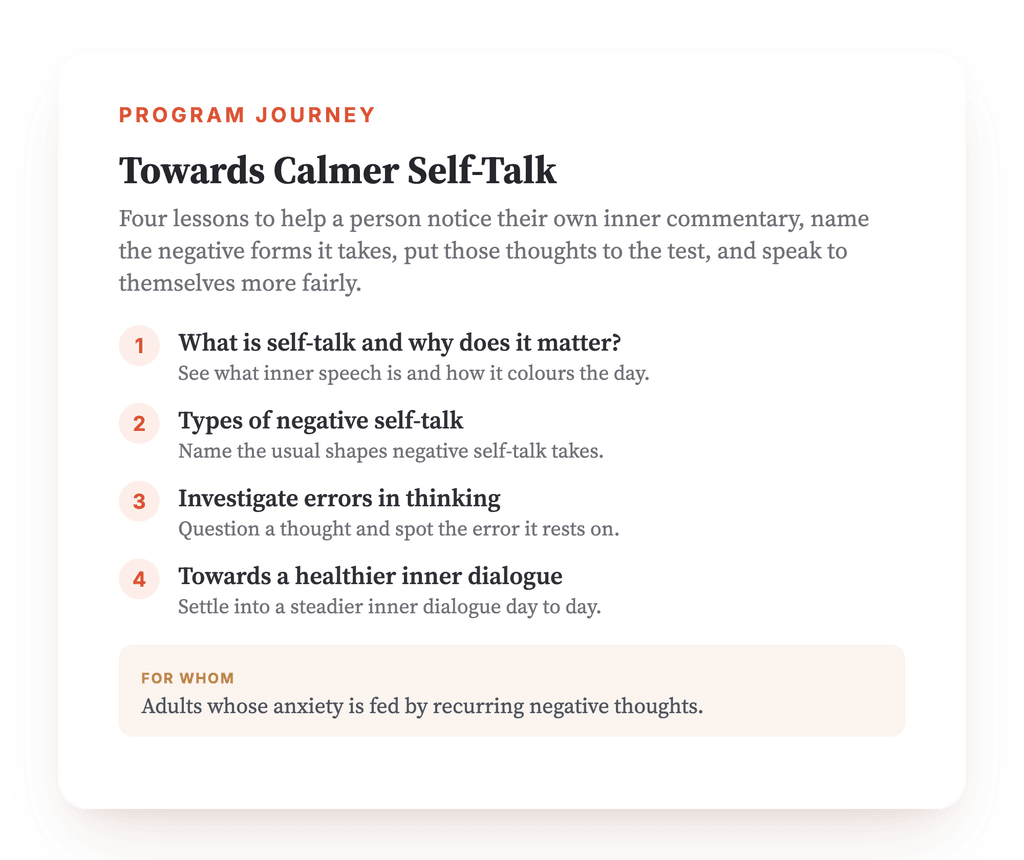
The program unfolds across four structured lessons, each building on the previous one.
Lesson 1 introduces the inner voice itself: where it comes from, how neutral events generate non-neutral interpretations, and the key distinction between a thought and an emotion. Patients are invited to observe their own stream of thoughts through multiple-choice prompts and written reflection, making the invisible visible. This is the foundation for everything that follows, and closely parallels the work supported by tools like Fact or Interpretation: CBT PDF Worksheet, Tools and Exercises.
Lesson 2 maps the four most harmful self-talk patterns: the worry voice, the critical voice, the perfectionist voice, and the helplessness voice. Guided prompts help patients identify which patterns dominate their own inner landscape. Clinicians who use Catastrophizing: PDF Worksheet, Tools and Exercises for Clinical Practice or the "Should" Statements: PDF Worksheet, Tools and Exercises will recognise immediately where these two resources slot naturally around this lesson.
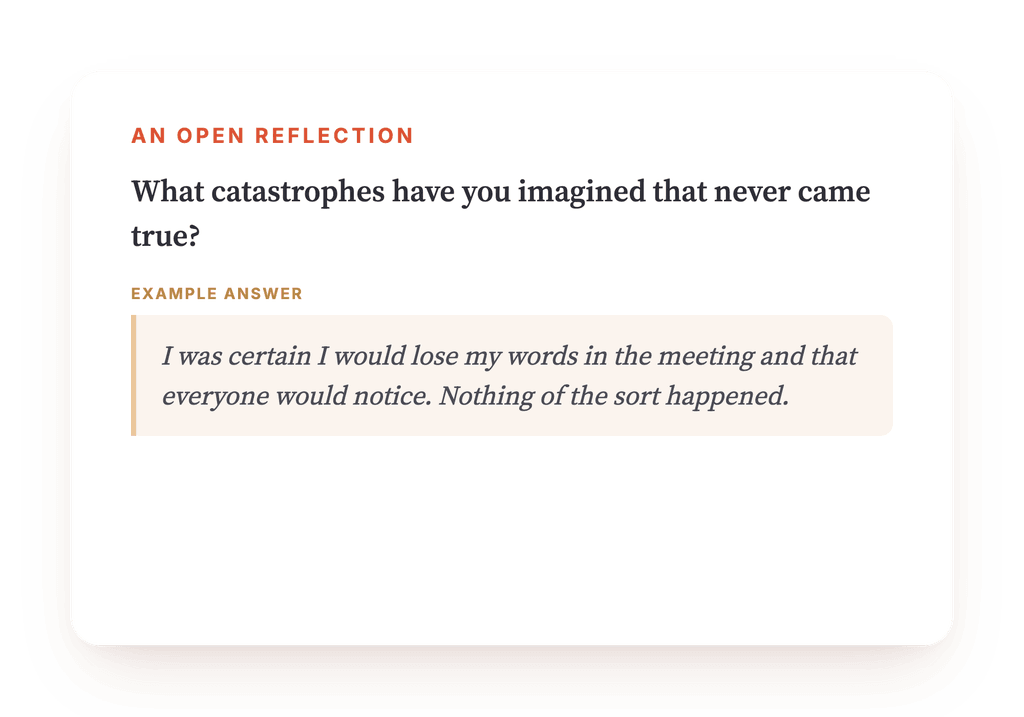
Lesson 3 shifts into cognitive investigation: returning to the facts, distinguishing evidence from interpretation, countering negativity bias, and challenging "I must / I should" rules. Patients practise on a worked example ("I will never have a normal life because of anxiety") before applying the same lens to their own recent thoughts. This mirrors the clinical logic of Countering Negative Thoughts: PDF Worksheet, Tools and Exercises and Challenging Negative Thoughts: PDF Worksheet, Tools and Exercises.
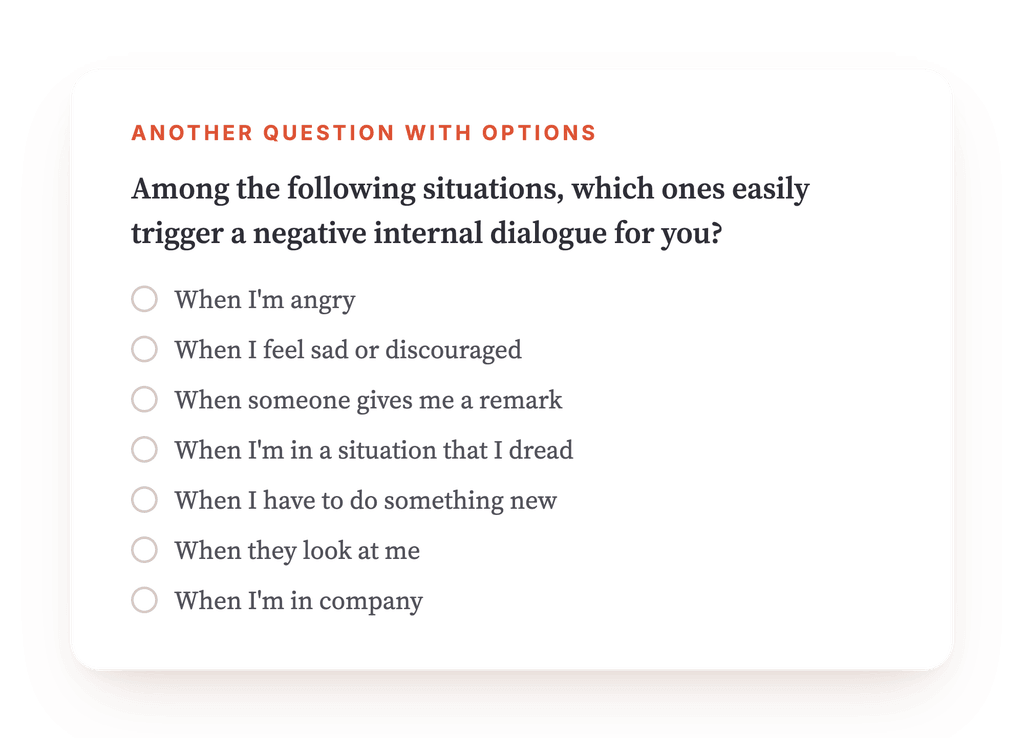
Lesson 4 anchors change in daily practice: identifying personal triggers for negative self-talk, finding adaptive emotional release strategies, practising a structured situation-thought-emotion-reflection log, and crafting a personal positive affirmation. It is a natural bridge toward maintenance work you might deepen with Constructive vs Harmful Rumination: PDF Worksheet, Tools and Exercises or Transforming Self-Critical Thoughts: PDF Worksheet, Tools and Exercises.
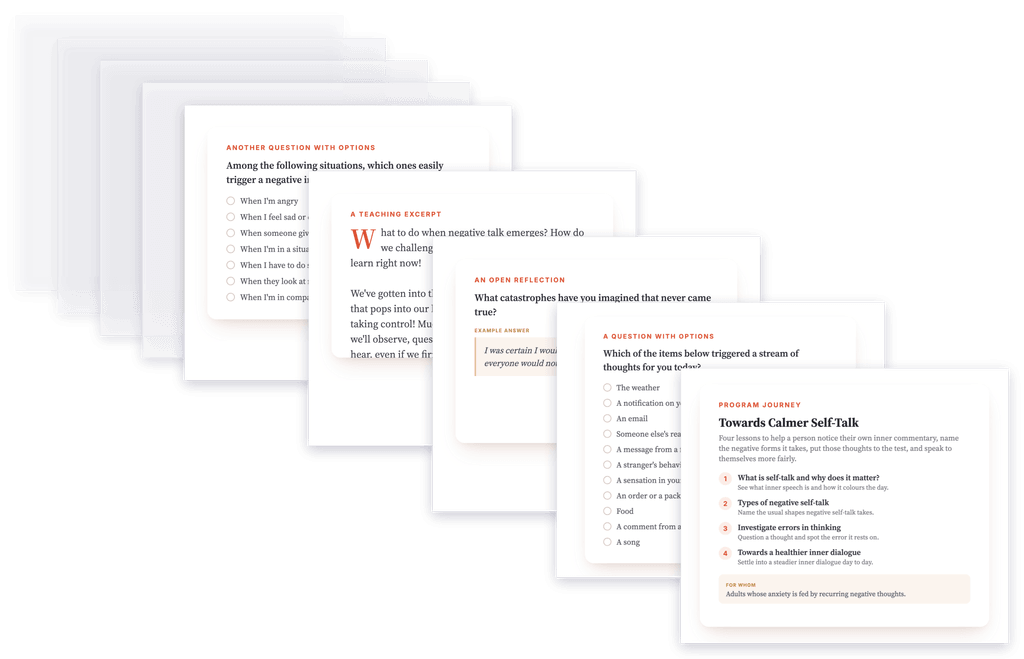
The preview images below show a program overview map and a handful of sample cards. These aperçus represent only a small fraction of the full program; the complete curriculum contains many more lessons, steps, guided prompts, and multiple-choice exercises than what is shown here.
This program is available to patients through the mobile application that is the dedicated patient-side interface of SessionFuel. Once you assign it through your SessionFuel account, your patient receives it directly on their phone and completes each lesson autonomously, between consultations, at their own pace.
Key insight: Inner self-talk work succeeds when patients can catch the pattern in real time, not just understand it conceptually; this program builds that capacity incrementally, lesson by lesson.
Use it with your patients
Share this tool in the mobile app and follow the work between sessions.
How to assign it and use what the patient brings back
This is homework, carried out between sessions in full autonomy. It suits a broad range of profiles: patients with anxiety, low self-esteem, ruminative tendencies, or perfectionism, as well as those working on depressive cognitive patterns alongside resources like Depression and Limiting Beliefs: A 4-Lesson Clinical Program or What Keeps Low Self-Esteem Going: PDF Worksheet, Tools and Exercises.
Introduce it once the patient has grasped the basic thought-emotion link, typically after a first psychoeducation exchange using The Cognitive Triangle: PDF Worksheet, Tools and Exercises or Cognitive Behavioral Therapy: PDF Worksheet, Tools and Exercises for Clinical Practice. You can assign one lesson at a time and adjust the pace to the patient's readiness.
At the next consultation, the written responses your patient has produced become immediate clinical material: the specific worry patterns they identified, the "should" rules they listed, the trigger situations they named, the personal affirmation they chose. There is nothing to reconstruct from memory. You open a real conversation grounded in what the patient actually produced, in their own words, on their own time.
For patients who also struggle with perfectionism, pairing Lesson 2 with the Cognitive Behavioral Model of Perfectionism: PDF Worksheet, Tools and Exercises deepens the work considerably. For those with marked anxiety, Lesson 3 connects cleanly to the Anxiety and Limiting Beliefs: A 5-Lesson Clinical Program as a natural next step once this program is complete.
Your session continues in your patients' pocket
Use with a patientYour resources, available everywhere
The handouts, exercises, programs and audios above: you choose which ones to make available to your patients, in the mobile app dedicated to them.
And far more than a library
The app goes well beyond resources, to support your patients every day:
Related categories
Explore other clinical resources by category.

Anxiety
Clinical hub for anxiety disorders: CBT and ACT worksheets, psychoeducation sheets, and exercises for assessment and treatment across the anxiety spectrum.

Identity
Clinical resources for self-identity work in therapy: CBT, ACT, schema tools for clinicians addressing self-concept, core beliefs, and identity disruption.

Cognition
Printable cognitive therapy worksheets and clinical tools for therapists: CBT, ACT, schema work, defusion, distortions, and belief restructuring.

Understand
Clinical hub for the therapeutic aim 'Understand': worksheets and tools to build patient insight across CBT, ACT, schema therapy and more.

Build awareness
Clinical worksheets and tools to build awareness in therapy: cognitive distortions, schemas, emotions, ACT and CBT resources for practitioners.

Restructure
Clinical hub for cognitive restructuring worksheets: distortion identification, belief disputation, ABC model, and schema work for evidence-based practice.