
Clinical picture. A, a woman in her late twenties, presented with low mood following a job application rejection. In session she reported, "I never do well in interviews; nobody ever wants to hire me," despite having secured her current role through a competitive process two years prior. The clinician introduced the overgeneralization worksheet and invited her to locate the absolutist words in her own statement, then count the actual data points she held. A identified that she had attended four interviews in her life, two of which had led to offers. She left the session describing the recent rejection as "one difficult interview" rather than evidence of a fixed incapacity, and agreed to track outcomes of future low-stakes social bids before drawing a wider conclusion.
Overgeneralization: PDF Worksheet, Tools and Exercises
A printable PDF worksheet with visual tools and structured exercises to help clinicians explain overgeneralization clearly and concretely in session.
Clinical vignettes
One Rejection, a Global Verdict
Perfectionism and the Always-Mess-Up Loop
Clinical picture. M, a man in his mid-forties referred for work-related burnout, described a pattern of abandoning projects shortly after minor errors, saying he "always ruined things at the last moment." The clinician used the fiche's four-leaps illustration to map his reasoning aloud: one overlooked figure in a report had been stretched into a standing verdict about his competence across all domains. M was asked to write down the three most recent projects he had completed without a significant error; he named five before stopping. The exercise did not resolve his perfectionism, but it disrupted the automatic equivalence he had drawn between a single lapse and a global identity statement, and he agreed to practise softening the language before the next session.
Overgeneralization is one of the cognitive distortions most patients endorse immediately in conversation, yet rarely catch in real time. Naming it orally is rarely enough: without a visual structure, the concept slides off. This PDF worksheet gives you a concrete, session-ready support to make the mechanism visible and leave the patient with something to hold onto.
Use this resource with your patients
Handout, exercises and materials ready to use, right inside SessionFuel.
Why Overgeneralization Is Hard to Explain Without a Visual Support
The clinical problem is not that patients fail to understand the definition. It is that they cannot see the leap as it happens. A patient in low mood does not experience "I am stretching one data point into a global verdict"; they experience "I always fail" as simply true. The CBT cognitive model predicts this: when a belief is highly activated, meta-cognitive distance collapses.
Oral explanations tend to trigger polite agreement rather than genuine recognition. The patient nods, but the absolutist word has already fused with the thought. Two elements make this distortion particularly resistant to verbal description alone. First, the leap from one event to a standing verdict is invisible to the person making it. Second, absolutist language, always, never, everyone, no one, is so habitual that it registers as ordinary speech, not as a signal. A schematic layout showing the three-stage structure makes the architecture of the leap immediately legible.
What the Worksheet Contains: A Visual Map of the Leap
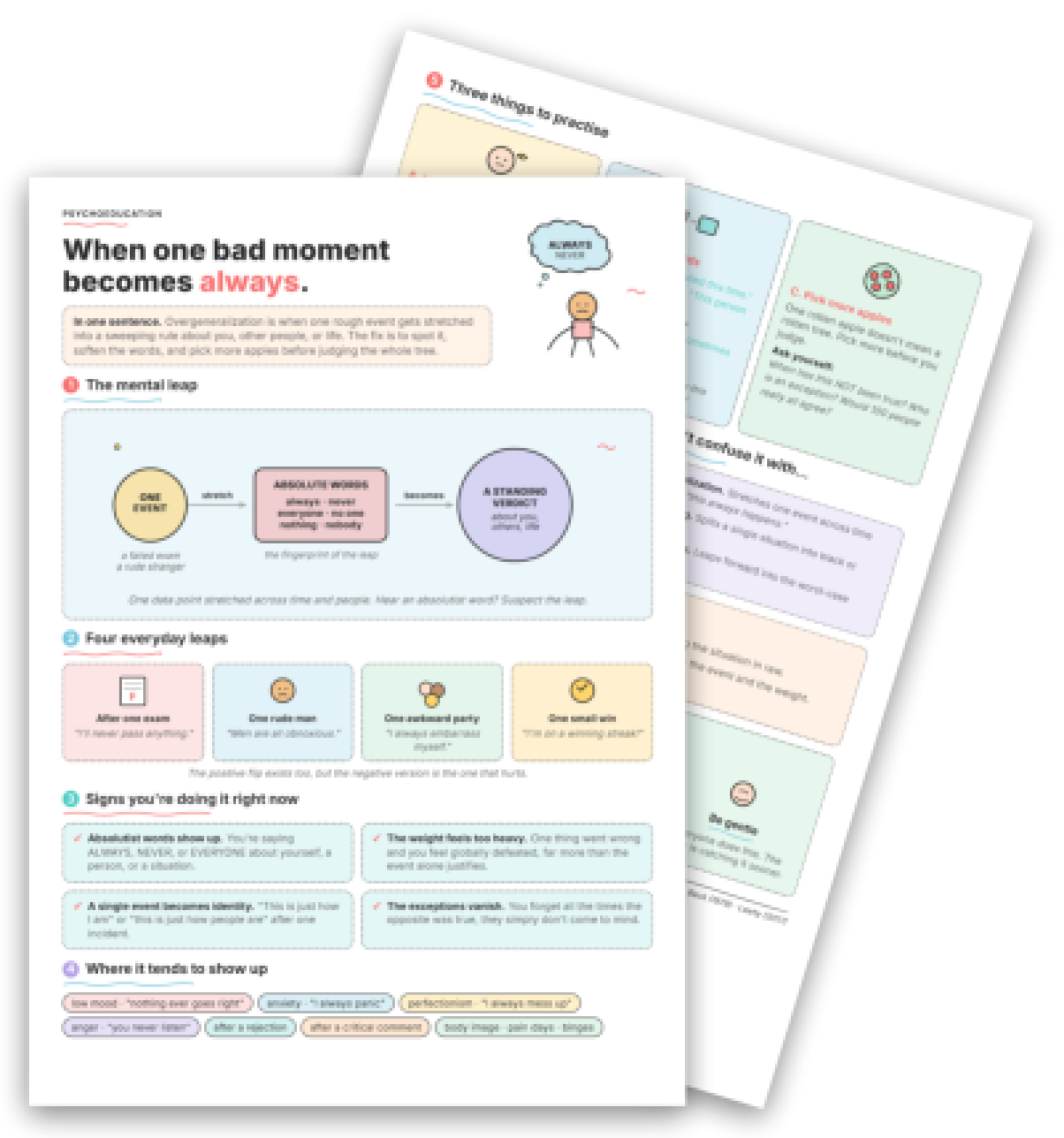
The PDF worksheet is organized across seven numbered sections, building from mechanism to practice. The opening panel frames the distortion in one sentence: "Overgeneralization is when one rough event gets stretched into a sweeping rule about you, other people, or life." This is the anchor you hand the patient before unpacking anything else.
Section 1 presents the core mechanism as a three-node flow: one event → absolute words → a standing verdict. The layout makes the stretch visible. Patients who would otherwise miss the logical gap between "a rude stranger" and "men are all obnoxious" can see it mapped in front of them. Section 2 offers four everyday examples, including a positive flip ("I'm on a winning streak!"), which usefully destigmatizes the pattern and broadens recognition beyond depression and self-criticism.
Section 3 provides four observable signs (absolutist language, disproportionate emotional weight, identity fusion, disappearance of exceptions), which doubles as a brief clinical marker list for your own formulation. Section 4 maps the clinical contexts where overgeneralization tends to appear: low mood, anxiety, perfectionism, anger, rejection, body image, a useful reminder that this distortion is not depression-specific.
The practice section (Section 5) structures three techniques: Notice and name it (labeling creates defusion), Soften the words ("I always fail" → "I failed this time"), and Pick more apples (a counterexample search built around the question "When has this NOT been true?"). Section 6 offers a polarity test, flipping the overgeneralization to reveal that both extremes misfire. Section 7 draws a clean distinction between overgeneralization, all-or-nothing thinking, and catastrophizing, which many patients conflate. The fiche closes with a "To discuss in session" block and a four-point summary panel, both designed to structure the debrief.
> Key point: This worksheet is not a take-home questionnaire the patient fills out alone. It is a visual support that facilitates the explanation in session: you open it together, walk through the mechanism panel by panel, and the patient leaves with a concrete reference rather than a concept they heard once and will struggle to recall.
750+ clinical tools
A library built with and for clinicians, ready to use in session and extend between appointments.
Access all the toolsHow and When to Introduce the Worksheet
The worksheet fits naturally from the second or third session onward, once the presenting complaint is mapped and the cognitive triangle has been introduced. For patients presenting with low mood, chronic self-criticism, or low self-esteem, it can be integrated into the psychoeducation phase. For those with anxiety or anger, it works well alongside identifying automatic thoughts.
A useful framing: "I'd like to show you a pattern that tends to make things feel heavier than they need to. It's not about you specifically, it's something most people do without noticing." This normalizes without minimizing and sets up the destigmatizing examples in Section 2.
Debrief by asking which of the four signs in Section 3 the patient recognizes most readily, and which of the softening substitutes (sometimes, this time, in this situation) feels most usable. For patients where softening words feel impossible, the fiche itself names this as worth exploring together, a natural bridge to downward arrow work or cognitive restructuring exercises. Pair the worksheet with the companion guided CBT exercise on always/never thinking when you want structured between-session practice to reinforce what was introduced in session.
One contraindication to note: patients in acute crisis or with significant cognitive impairment may find the multi-panel format overwhelming. In those cases, restrict the session to the three-node diagram in Section 1 and the softening word list, and return to the rest when stabilization allows. The worksheet does not replace the therapeutic frame; it sharpens the explanation and gives the patient a durable reference point to carry between sessions.
Use it with your patients
Share this tool in the mobile app and follow the work between sessions.
Sources
- Beck, A. T., Rush, A. J., Shaw, B. F., & Emery, G. (1979). Cognitive Therapy of Depression. Guilford Press.
- Burns, D. D. (1980). Feeling Good: The New Mood Therapy. William Morrow and Company.
- Raes, F., Griffith, J. W., Craeynest, M., Williams, J. M. G., Hermans, D., Barry, T. J., Takano, K., & Hallford, D. J. (2023). Overgeneralization as a Predictor of the Course of Depression Over Time: The Role of Negative Overgeneralization to the Self, Negative Overgeneralization Across Situations, and Overgeneral Autobiographical Memory. Cognitive Therapy and Research, 47(4), 598-613.
Your session continues in your patients' pocket
Use with a patientYour resources, available everywhere
The handouts, exercises, programs and audios above: you choose which ones to make available to your patients, in the mobile app dedicated to them.
And far more than a library
The app goes well beyond resources, to support your patients every day:
Related categories
Explore other clinical resources by category.

Anxiety
Clinical hub for anxiety disorders: CBT and ACT worksheets, psychoeducation sheets, and exercises for assessment and treatment across the anxiety spectrum.

Mood
Evidence-based worksheets and clinical tools for mood disorders: CBT, ACT, and positive psychology resources for psychologists and therapists.

Identity
Clinical resources for self-identity work in therapy: CBT, ACT, schema tools for clinicians addressing self-concept, core beliefs, and identity disruption.

Cognition
Printable cognitive therapy worksheets and clinical tools for therapists: CBT, ACT, schema work, defusion, distortions, and belief restructuring.

Understand
Clinical hub for the therapeutic aim 'Understand': worksheets and tools to build patient insight across CBT, ACT, schema therapy and more.

Build awareness
Clinical worksheets and tools to build awareness in therapy: cognitive distortions, schemas, emotions, ACT and CBT resources for practitioners.