
Clinical picture. T., a man in his late thirties, presented with longstanding worry that he described as "just the way I am," alongside persistent fatigue and a pattern of cancelling social commitments. He had not previously connected his jaw clenching, night waking, and tendency to rehearse worst-case scenarios as expressions of the same underlying process. The clinician introduced the psychoeducation handout mid-session, inviting T. to read the three-channel model aloud and mark which items felt familiar. He circled nearly every item in the body and behaviour columns, then paused at the avoidance section and said, quietly, that he had not realised cancelling was part of anxiety rather than a reasonable preference. This shared reference point opened a more precise conversation about the avoidance loop in subsequent sessions, without T. feeling pathologised.
Understanding Anxiety: PDF Worksheet, Tools and Exercises for Clinical Practice
A visual psychoeducation handout clinicians can use in session to map anxiety's three-channel structure, the avoidance loop, and evidence-based pathways forward.
Clinical vignettes
Naming the Three Channels
Useful vs. Problem Anxiety
Clinical picture. M., a woman in her mid-twenties referred for panic disorder, arrived convinced that any felt anxiety was dangerous and required immediate suppression. Early sessions had stalled partly because the framing of anxiety as inherently problematic reinforced her avoidance of all physical arousal. The clinician used the handout's useful-versus-problem distinction to introduce a more graduated view: anxiety that rises, serves a function, and fades is not the target of treatment. M. identified that her anxiety around a genuine work deadline had resolved on its own, contrasting that with the panic episodes that arrived without a clear trigger and persisted for hours. This differentiation reduced some of her global fear of internal states and allowed the subsequent work on interoceptive exposure to begin on more stable ground.
Psychoeducation on anxiety often stalls at the same clinical moment: the patient nods, says they understand, and continues to treat avoidance as the only rational response. This fiche PDF cuts through that impasse by externalising the anxiety model as a visual support used directly in session, making an abstract mechanism concrete enough to actually shift the patient's frame.
Use this resource with your patients
Handout, exercises and materials ready to use, right inside SessionFuel.
Why anxiety's three-channel structure resists verbal explanation
When you explain the anxiety model orally, patients tend to hear only their own presenting category. The patient with predominantly somatic symptoms fixates on the body; the chronic worrier dismisses the behavioural dimension entirely. What rarely lands from speech alone is the simultaneous interplay of cognitive, somatic, and behavioural channels, the very interplay that sustains the disorder.
The avoidance loop is the most clinically consequential part to convey. Patients almost universally understand that avoidance brings short-term relief. What they fail to internalise is that this relief is precisely what trains the brain to read the trigger as genuinely dangerous. Without a visual representation of the full cycle, the insight stays abstract and does not generalise to between-session behaviour. For patients whose primary maintenance behaviour is checking rather than overt avoidance, the Reassurance-Seeking exercise makes a useful parallel companion. For a broader audit of which coping strategies are adaptive versus which are feeding the loop, the Adaptive vs Maladaptive Coping handout extends the conversation naturally.
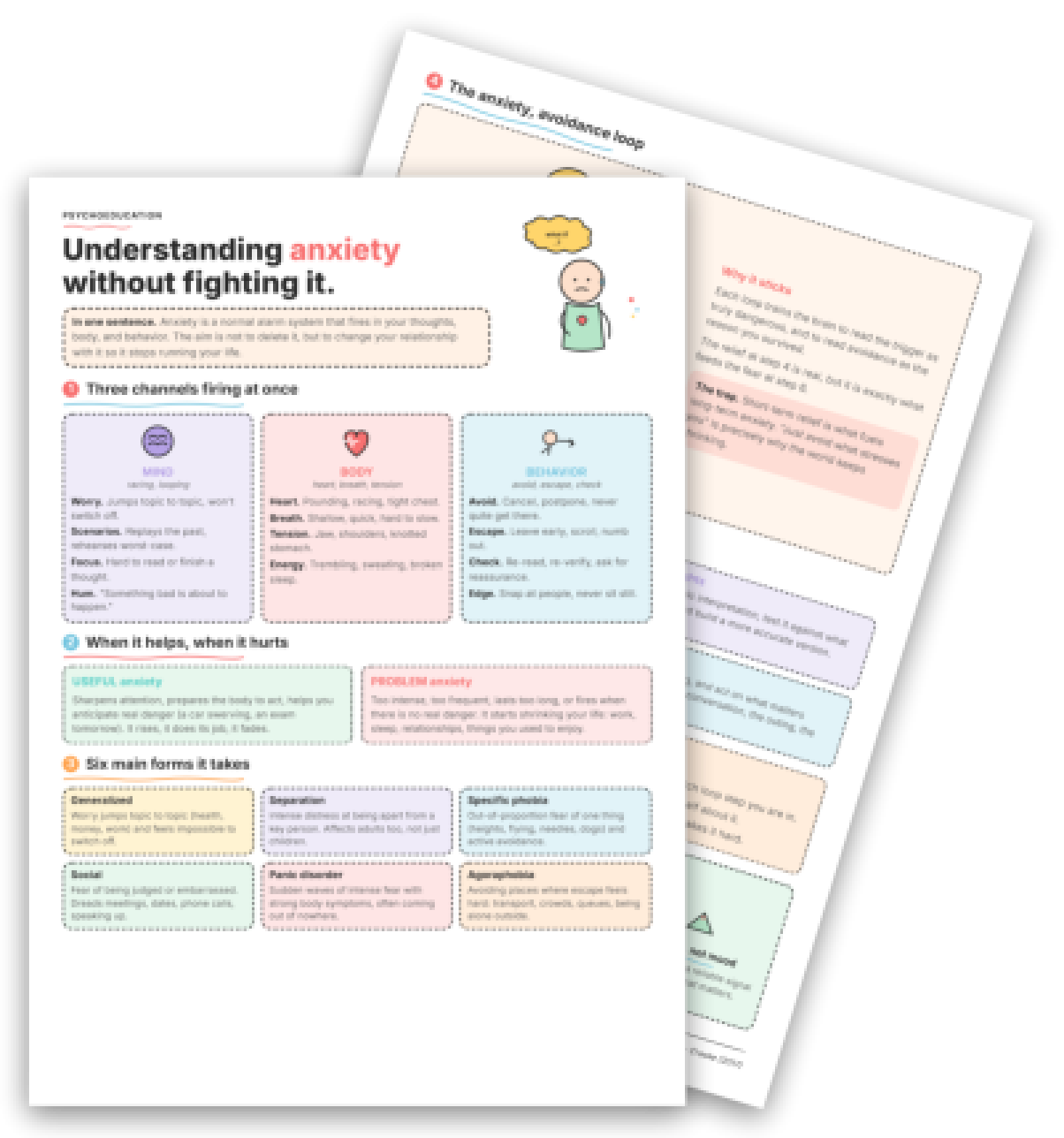
What the handout contains: a five-section visual map
The fiche is structured into five numbered sections, each designed as a discussion anchor rather than a reading exercise. Section 1, "Three channels firing at once," presents Mind, Body, and Behavior in parallel columns, each populated with specific, named symptoms: racing and looping thoughts, worst-case scenarios, and attentional narrowing under Mind; pounding heart, shallow breath, jaw tension, and broken sleep under Body; avoidance, escape, checking, and irritability under Behavior. Seeing all three columns simultaneously, rather than hearing them enumerated in sequence, allows the patient to locate themselves across the full picture at a glance.
Section 2, "When it helps, when it hurts," provides a clinically precise distinction between useful anxiety (rises, does its job, fades) and problem anxiety (too intense, too frequent, or firing without real danger). This framing is particularly useful early in psychoeducation: it repositions the therapeutic goal away from symptom elimination and toward relationship change, consistent with the ACT model. Patients who are ready to begin cognitive defusion work after this session find the transition intuitive.
Section 3 covers six clinical forms: generalised, separation, specific phobia, social anxiety, panic disorder, and agoraphobia, without flattening them into a diagnostic checklist. Section 4 maps the anxiety-avoidance loop as a six-step cycle: trigger, alarm, avoidance, relief, the false lesson ("avoiding saved me"), and progressive world-shrinkage. The fiche states plainly: "Short-term relief is what fuels long-term anxiety." That sentence, on paper, often lands harder than the same words spoken. Section 5 summarises four evidence-based directions: graduated approach, cognitive reappraisal, somatic regulation, and values-based action. A built-in "To discuss in session" block closes the handout with three ready-to-use prompts, structuring the debrief before you even ask a question.
> Key takeaway: this handout is a visual support that facilitates explanation in session, not a self-administered questionnaire. The clinician guides the patient through each section; the patient leaves with a concrete reference map, not homework to complete alone.
750+ clinical tools
A library built with and for clinicians, ready to use in session and extend between appointments.
Access all the toolsWhen and how to introduce it in session
The fiche fits most naturally in early psychoeducation sessions, after the initial assessment and before introducing exposure or formal cognitive restructuring. It is particularly well-suited for patients who intellectualise without embodying the model, for those presenting with Generalised Anxiety Disorder, and for patients who struggle to articulate why avoidance feels necessary.
A low-labelling introduction: "I want to show you something that maps what happens in anxiety, so we can look at it together and see where you recognise yourself." That framing positions the handout as collaborative rather than didactic.
Once you have worked through the visual together, use the three "To discuss in session" prompts to debrief: which loop step the patient identified with this week, any somatic sensation that felt alarming, and one small approach step they are willing to try before next appointment. The Anxiety Check-In exercise pairs well for ongoing between-session monitoring, and the Anxiety Self-Assessment can sharpen the formulation if the symptom picture is still unclear at this stage.
For patients where the avoidance map resonates and they are ready to build a structured plan, Building an Exposure Hierarchy and the Exposure Therapy program provide concrete next steps. When the cognitive dimension predominates, Anxiety and Limiting Beliefs extends the work on the belief layer sustaining the loop. For a fuller between-session curriculum, the four-lesson Anxiety Psychoeducation program builds on exactly the model this handout introduces.
With patients in acute distress or with limited psychological-mindedness, pacing the five sections across two sessions rather than one is a reasonable adaptation. The fiche does not replace the case formulation; it makes the formulation visible.
Use it with your patients
Share this tool in the mobile app and follow the work between sessions.
Sources
- Clark, D. A., & Beck, A. T. (2023). The Anxiety and Worry Workbook: The Cognitive Behavioral Solution (2nd ed.). Guilford Press.
- Barlow, D. H. (2002). Anxiety and Its Disorders: The Nature and Treatment of Anxiety and Panic (2nd ed.). Guilford Press.
- National Institute for Health and Care Excellence (NICE) (2011). Generalised Anxiety Disorder and Panic Disorder in Adults: Management (Clinical Guideline CG113, amended 2022).
Your session continues in your patients' pocket
Use with a patientYour resources, available everywhere
The handouts, exercises, programs and audios above: you choose which ones to make available to your patients, in the mobile app dedicated to them.
And far more than a library
The app goes well beyond resources, to support your patients every day:
Related categories
Explore other clinical resources by category.

Anxiety
Clinical hub for anxiety disorders: CBT and ACT worksheets, psychoeducation sheets, and exercises for assessment and treatment across the anxiety spectrum.

Understand
Clinical hub for the therapeutic aim 'Understand': worksheets and tools to build patient insight across CBT, ACT, schema therapy and more.

CBT
CBT worksheets, cognitive restructuring exercises & behavioral tools for clinicians. Evidence-based resources for every phase of cognitive behavioral therapy.

Integrative
Integrative therapy clinical resources: worksheets, psychoeducation programs, and exercises for eclectic, multimodal practice across orientations.

Trauma
Clinical hub on trauma and PTSD: assessment, differential diagnosis, treatment phases, and printable resources for practitioners. 155 chars.

Mood
Evidence-based worksheets and clinical tools for mood disorders: CBT, ACT, and positive psychology resources for psychologists and therapists.