
Clinical picture. M., a woman in her late 30s, presented with generalized anxiety and a longstanding pattern of situational avoidance, particularly around professional meetings. Her clinician introduced the four-question check-in as a between-session homework task, asking her to complete it independently each week and bring her written responses to the next appointment. At her second review, M. rated her anxiety at 5 out of 10, down from 8 the previous week, and identified that she had stayed in a team meeting for its full duration rather than leaving early. She struggled to name active coping strategies for question four, which became the focus of the subsequent session. The exercise gave the clinician a concrete entry point rather than relying on the patient's often vague retrospective account.
Anxiety Self-Monitoring: A Structured Progress Check-In
Help anxious patients rate their anxiety, claim their wins, and stay accountable to progress with a four-question structured homework exercise.
Clinical vignettes
Reclaiming Progress After Avoidance
Sustaining Accountability in Longer-Term Work
Clinical picture. T., a man in his mid-50s, had been in treatment for health-related anxiety for several months and reported a subjective sense of stagnation. The clinician introduced the structured check-in at that juncture, framing it as a way to capture incremental change that tends to go unnoticed over time. Over three consecutive weeks, T.'s self-rated scores remained between 4 and 6, yet his responses to question two consistently surfaced moments of adaptive behavior, such as delaying reassurance-seeking by several hours, that he had not spontaneously reported. Question three revealed that medical waiting rooms remained a high-difficulty context requiring further targeted work. The regular written format appeared to reduce the retrospective bias that had previously made progress difficult to track.
The Clinical Problem: Progress That Stays Invisible
Anxiety rarely moves in a straight line. Patients feel better one week, flooded the next, and arrive at appointments unable to say with any precision what has actually changed. This is not avoidance, it is the natural limits of retrospective self-report without structure. Without a framework, meaningful shifts go unnoticed, resilience goes unclaimed, and the patient's sense of therapeutic momentum can erode.
A second difficulty is translating subjective experience into usable clinical data. Asking "how has your anxiety been?" produces impressionistic answers. What you need is a regular, structured snapshot: a quantified rating, a retrospective success review, a prospective goal, and a coping inventory. Verbal exploration alone rarely yields all four in a consistent format. Tools like the Anxiety Self-Reflection: A Structured Five-Question Clinical Exercise and the Graded Exposure Self-Report: Tracking Anxiety Progress address related gaps; this exercise fills the specific niche of periodic progress monitoring across the full arc of treatment.
Use this resource with your patients
Handout, exercises and materials ready to use, right inside SessionFuel.
What the Exercise Contains
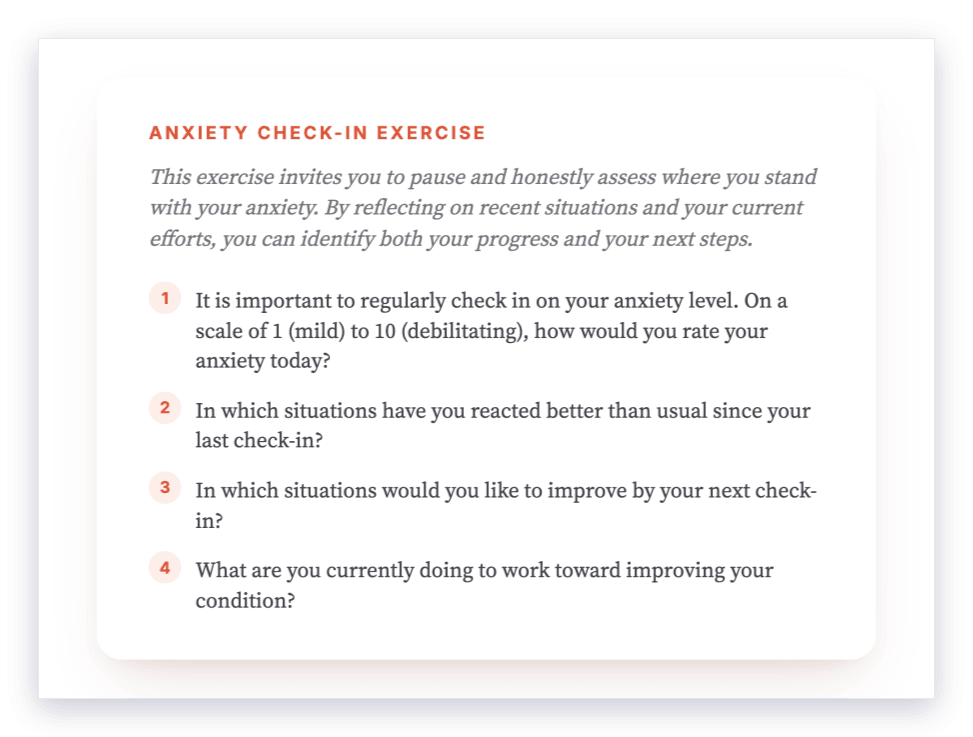
The exercise is built around four sequential questions. Above is a static preview of those questions as they appear in the tool. Note that this image simply lists the questions in order with a brief introductory note, it is not the exercise itself. The full guided experience, with patient-facing instructions, reflective space, and interactive prompts, is completed by the patient autonomously in the app, not in this image.
The first question anchors the session with a quantified anxiety rating (1 = mild, 10 = disabling). This single number, tracked over time, makes progress legible where words fail. The second question is deliberately retrospective and strength-focused: it pulls the patient toward celebrating personal successes and naming their own resilience, rather than cataloguing what went wrong. The third question introduces a concrete forward commitment, aligning naturally with SMART goal-setting logic. The fourth asks the patient to inventory their active coping efforts, a question that surfaces both adaptive strategies and gaps, feeding directly into work with tools like Coping Strategy Effectiveness or Healthy vs. Unhealthy Coping Strategies.
This exercise is available to patients through the patient app of SessionFuel, the dedicated mobile application reserved for the patients of clinicians who use SessionFuel: you assign the exercise directly from your clinician dashboard, and your patient completes it on their own phone between sessions.
Key insight: Four questions, completed autonomously every week or fortnight, generate a longitudinal anxiety trace that no single conversation can replicate, and they give you and your patient something concrete to work with from the first minute of the next appointment.
750+ clinical tools
A library built with and for clinicians, ready to use in session and extend between appointments.
Access all the toolsUse it with your patients
Share this tool in the mobile app and follow the work between sessions.
Integrating It as Between-Session Homework
This exercise is designed to be assigned as autonomous work between consultations, not discussed during the appointment itself. The patient completes it on their own, and the material they produce becomes the starting point of your next session together.
Who it suits best: patients with generalised anxiety, social anxiety, phobias, or any presentation where tracking fluctuating anxiety levels has clinical value. It also works well for patients early in treatment who need to build self-monitoring habits before more demanding interventions.
How to introduce it: explain that regular check-ins serve the same function as a clinical measure, they capture signal across time, not just in the moments the patient feels worst. Pair it with a brief word about why the Exploring Your Anxiety Experience framework matters: the check-in tracks the number; the session explores the meaning.
How to use what the patient brings back: the anxiety rating opens a rapid triage: is the trajectory stable, improving, or worsening? Question two is your entry point for reinforcing self-efficacy, do not let it pass quickly. Question three connects naturally to weekly behavioral review work and to worry and attention capture if a specific situation dominates. Question four reveals the patient's active coping repertoire in their own words, and any gaps there feed directly into coping skills for anxiety work or the broader My Fight Against Anxiety progress review.
Assign it on a fixed rhythm, weekly or fortnightly, so the longitudinal pattern becomes visible. Over several cycles, the data the patient generates between sessions becomes one of the most honest indicators of where the work is actually landing.
Your session continues in your patients' pocket
Use with a patientYour resources, available everywhere
The handouts, exercises, programs and audios above: you choose which ones to make available to your patients, in the mobile app dedicated to them.
And far more than a library
The app goes well beyond resources, to support your patients every day:
Related categories
Explore other clinical resources by category.

Anxiety
Clinical hub for anxiety disorders: CBT and ACT worksheets, psychoeducation sheets, and exercises for assessment and treatment across the anxiety spectrum.

CBT
CBT worksheets, cognitive restructuring exercises & behavioral tools for clinicians. Evidence-based resources for every phase of cognitive behavioral therapy.

Trauma
Clinical hub on trauma and PTSD: assessment, differential diagnosis, treatment phases, and printable resources for practitioners. 155 chars.

Mood
Evidence-based worksheets and clinical tools for mood disorders: CBT, ACT, and positive psychology resources for psychologists and therapists.

Identity
Clinical resources for self-identity work in therapy: CBT, ACT, schema tools for clinicians addressing self-concept, core beliefs, and identity disruption.

Emotions
Clinical resources on emotion regulation: worksheets, coping tools, CBT, REBT, and ACT exercises for therapists working across diagnoses and age groups.