
Clinical picture. M., a woman in her late 40s, presented with persistent low mood following redundancy; she described her life as "completely falling apart" and struggled to identify any area of functioning she considered intact. During a structured session, the clinician introduced the six-area worksheet and asked M. to complete the "doing well" column before naming any gaps. M. noted, with visible surprise, that her relationships with her adult children were warm and consistent, and that her sleep had actually improved since leaving a high-stress role. From there she identified one specific goal in the work domain: updating her professional profile by the following Friday. At the next appointment she reported having done so, and framed it as the first task she had completed with any sense of agency in several months.
Setting Life Goals: PDF Worksheet, Tools and Exercises for Clinicians
A structured six-area visual check-in helping patients break attentional tunnel vision, name strengths alongside gaps, and commit to specific, actionable goals in session.
Clinical vignettes
Six Areas Reveal an Unexpected Strength
Narrowing Scope in a Scattered Presentation
Clinical picture. T., a man in his early 30s, arrived describing difficulties across what felt to him like every aspect of life: financial strain, social withdrawal, disrupted eating, and a loss of any sense of purpose. The clinician used the six-area grid to slow the session down and contain the material, asking T. to place each concern in its corresponding column rather than cycling through them all at once. When the sheet was laid out, both the clinician and T. could see that the body and friends domains were the most depleted, while work and family showed modest protective factors. T. chose a single goal in the friends column: sending a message to one person he had been avoiding for six weeks. The action was small, but having it written as a specific, chosen commitment shifted his account of his situation from global overwhelm to something more bounded.
Goal-setting conversations have a way of narrowing fast in session. A patient in distress naturally focuses on whatever hurts most, and oral goal-work tends to follow that tunnel. This fiche PDF provides a visual six-area check-in that forces breadth before depth, giving you a shared map to work from rather than a freeform discussion that loops back to the same complaint.
Use this resource with your patients
Handout, exercises and materials ready to use, right inside SessionFuel.
Why Goal-Setting Explanations Stall in Session
When you explain goal-setting verbally, patients hear it as another item on a duty list: eat better, exercise more, call your mother. The motivational signal gets lost. Two things compound this. First, attentional narrowing under distress (well-documented in the rumination literature) means patients genuinely cannot see the domains of their life that are still functioning. Second, vague goals stated out loud feel more convincing than they are: "I need to see my friends more" lands as a plan, until nothing changes. Without a structured visual, there is no way to distinguish an outcome goal from an action goal, no way to see that six areas exist and not just one, and no way for the patient to carry anything concrete out of the room.
The fiche addresses exactly this. It works as a psychoeducation support you walk through together, not a questionnaire the patient fills in alone before the session.
What the Fiche Contains: A Six-Area Visual Check-In
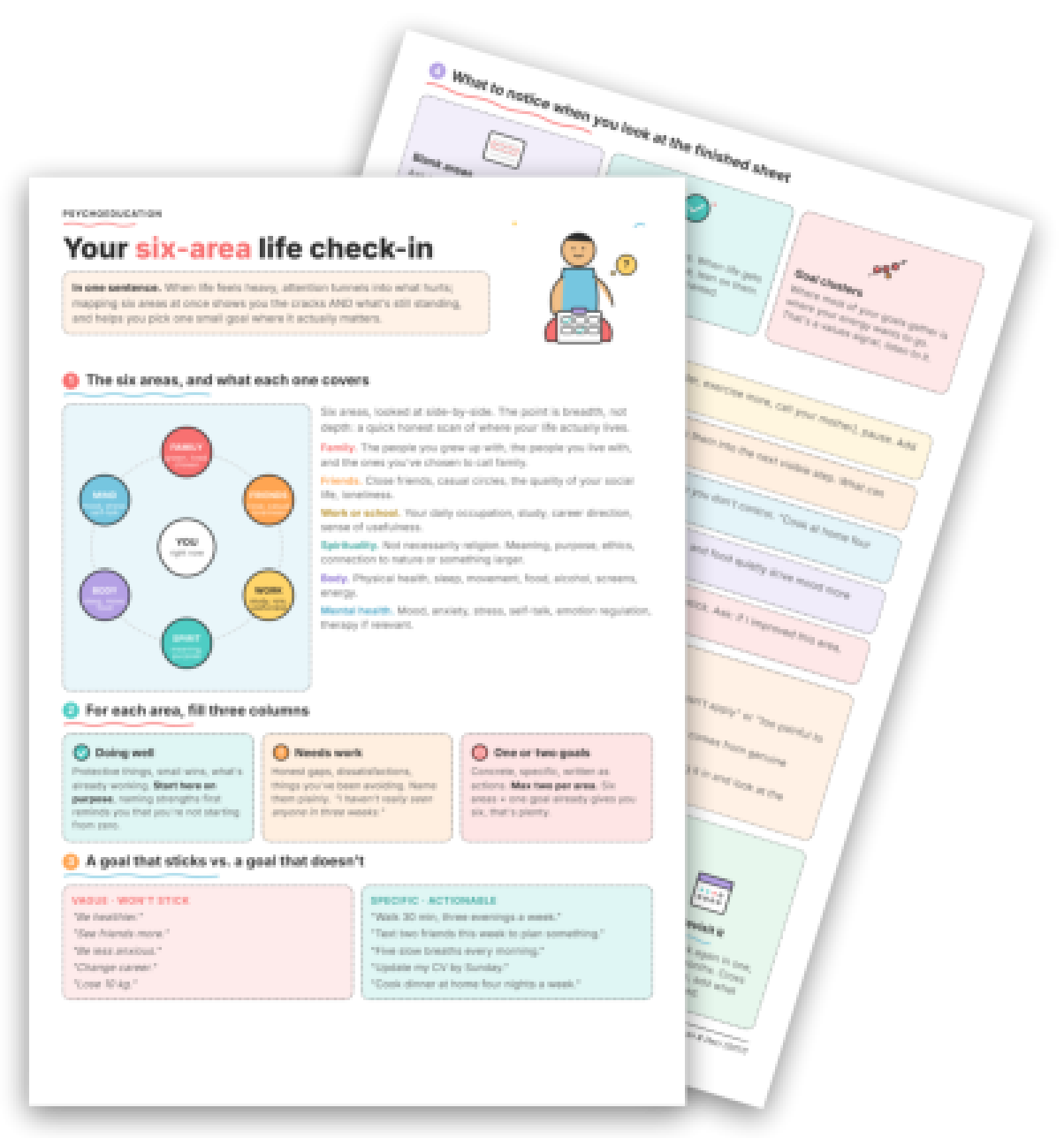
The fiche opens with a one-sentence rationale: "When life feels heavy, attention tunnels into what hurts; mapping six areas at once shows you the cracks AND what's still standing." That framing alone does clinical work you would otherwise spend several minutes establishing.
The six areas, laid out side by side in the visual, are: Family (grown, lived, chosen), Friends (close, casual, loneliness), Work or school (daily occupation, sense of usefulness), Spirituality (meaning, purpose, ethics), Body (sleep, movement, food, energy), and Mental health (mood, stress, self-talk, emotion regulation). Each area maps to a three-column grid: Doing well, Needs work, and One or two goals. The instruction to start with strengths is explicit and deliberate: "naming strengths first reminds you that you're not starting from zero." This anchors the exercise squarely in what motivational interviewing refers to as building discrepancy from a position of self-efficacy, not deficit.
A dedicated panel contrasts vague versus specific goals with concrete paired examples: "Be healthier" versus "Walk 30 min, three evenings a week"; "See friends more" versus "Text two friends this week to plan something." The visual contrast here does something oral explanation cannot: patients see immediately why their usual formulations will not move them. A fifth panel names five common traps, including "should" goals, outcome goals masquerading as action goals, and borrowed goals handed down by a partner or parent. The fiche closes with explicit "To discuss in session" prompts, including what to do when an area is completely blank and when revisiting the sheet at one or three months shows no movement.
> To retain: this fiche is a visual support that facilitates the explanation of life goal-setting in session; it gives the patient a concrete reference to take home, not a homework task to complete in isolation.
750+ clinical tools
A library built with and for clinicians, ready to use in session and extend between appointments.
Access all the toolsWhen and How to Introduce the Fiche
The fiche fits naturally at a formulation or goal-clarification stage, typically sessions two to four once initial anamnesis is complete. It also works well at a transitional moment, when a patient has stabilised somewhat but reports feeling stuck or directionless, which is a profile where purely symptom-focused work starts to lose traction.
For patients with low self-esteem or strong self-critical patterns, frame it before handing it over: "We're going to start by writing down what's already working, before anything else." This pre-empts the tendency to fill only the Needs work column. For patients doing goal-setting and behavior change work or values clarification, the fiche adds structural breadth across life domains rather than depth on a single area. You can complement it with the Life Goals Across Eight Domains worksheet for patients who want more domain granularity, or with the 6 and 12 Month Goals exercise once proximal targets are set here.
Debrief by asking which column the patient resisted most, and whether any area was left blank. A blank area is the single most clinically rich signal the fiche generates: it opens onto avoidance, grief, or schema-level withdrawal far more cleanly than a direct question would. Pair the fiche with a current activity inventory if the patient cannot articulate what they actually do with their time, or with a work-life balance assessment when professional and personal domains are severely unbalanced.
The fiche includes a "Revisit it" instruction at the bottom: date it, return at one, three, or six months. That built-in longitudinal structure lets you use the same sheet as a progress marker across the treatment arc, not just a one-off snapshot.
Use it with your patients
Share this tool in the mobile app and follow the work between sessions.
Sources
- Frisch, M. B. (2006). Quality of Life Therapy: Applying a Life Satisfaction Approach to Positive Psychology and Cognitive Therapy. John Wiley and Sons.
- Stewart, V., McMillan, S. S., Hu, J., Ng, R., El-Den, S., O'Reilly, C., and Wheeler, A. J. (2022). Goal Planning in Mental Health Service Delivery: A Systematic Integrative Review. Frontiers in Psychiatry.
Your session continues in your patients' pocket
Use with a patientYour resources, available everywhere
The handouts, exercises, programs and audios above: you choose which ones to make available to your patients, in the mobile app dedicated to them.
And far more than a library
The app goes well beyond resources, to support your patients every day:
Related categories
Explore other clinical resources by category.

Identity
Clinical resources for self-identity work in therapy: CBT, ACT, schema tools for clinicians addressing self-concept, core beliefs, and identity disruption.

Transitions
Clinical hub for life transitions: tools, worksheets and exercises to support psychosocial adjustment, role change and identity work in practice.

Build awareness
Clinical worksheets and tools to build awareness in therapy: cognitive distortions, schemas, emotions, ACT and CBT resources for practitioners.

Engage & motivate
Clinical hub: printable worksheets and exercises to build therapeutic engagement and motivation across ACT, CBT, and integrative practice. For clinicians.

ACT
Clinical hub for Acceptance and Commitment Therapy (ACT): worksheets, exercises, programs and audio resources for practitioners using the ACT model.

CBT
CBT worksheets, cognitive restructuring exercises & behavioral tools for clinicians. Evidence-based resources for every phase of cognitive behavioral therapy.