
Clinical picture. T., a man in his early forties referred for mild depression and low energy, reported starting and abandoning exercise routines repeatedly over two years, each time concluding he lacked willpower. During a session focused on behavioural activation, the clinician introduced the informational sheet and worked through the six conditions with him. Together they identified two specific breakdowns: his goals had always been vague wishes ("get back in shape") with no defined rhythm, and the effort level he set in week one was consistently too high relative to his current fitness. T. revised his plan to a 20-minute walk after dinner on weekdays, tied to an existing habit, and added a simple paper log as a visible progress marker. At three-week follow-up he had maintained the rhythm on four of five weekday evenings and reported less preoccupation with perceived personal failure.
Staying Motivated: PDF Worksheet, Tools and Exercises for Clinical Practice
A structured PDF worksheet with tools and exercises to explain the six conditions of sustainable motivation, identify what has broken down, and give patients a concrete lever to adjust this week.
Clinical vignettes
Reframing a Stalled Exercise Goal
Identifying a Borrowed Goal in Therapy
Clinical picture. M., a woman in her late twenties presenting with chronic low-grade anxiety, described persistent guilt over not pursuing a professional certification her parents had long encouraged. She had enrolled twice and withdrawn both times, interpreting this as a motivation deficit. Using the sheet as a structured prompt, the clinician invited her to examine the values-alignment condition: whose goal was this, and what did it cost her when she pursued it? M. articulated clearly that the certification held no personal meaning and that her energy did engage when she described a separate project she had quietly been developing. The clinician normalised that a borrowed goal runs out of fuel quickly regardless of effort, and redirected goal-setting work toward the self-chosen project. Subsequent sessions showed reduced avoidance behaviour and a more stable sense of agency in that domain.
Motivation dips are among the most common complaints patients bring mid-treatment, yet explaining why motivation fails is surprisingly hard to do verbally. Most patients hear "you need more willpower" and promptly attribute the dip to a character flaw. This PDF worksheet reframes the entire conversation before it goes in that direction, giving you and the patient a shared map with six concrete levers to inspect together.
Use this resource with your patients
Handout, exercises and materials ready to use, right inside SessionFuel.
Why Motivation Resists Oral Explanation in Session
The folk model of motivation is binary: you either have it or you don't. Patients present with global self-verdicts ("I'm lazy," "I have no discipline") that feel true and close down inquiry. When a clinician tries to challenge these verbally, the reframe lands as reassurance rather than as a structural insight the patient can actually use.
The second trap is temporal. Patients often describe procrastination patterns or inconsistent effort without realising they are conflating very different problems: a goal misaligned with their values, a difficulty level that is objectively too high, or the simple absence of any reinforcement signal. Those are distinct mechanisms, and sorting them orally in session takes longer than it should.
A visual support resolves both problems. It externalises the model, shifts the conversation from character to conditions, and lets the patient identify their own failure point rather than receiving a clinician's interpretation.
What the Fiche Contains: A Visual Tool for Explaining Motivation in Session
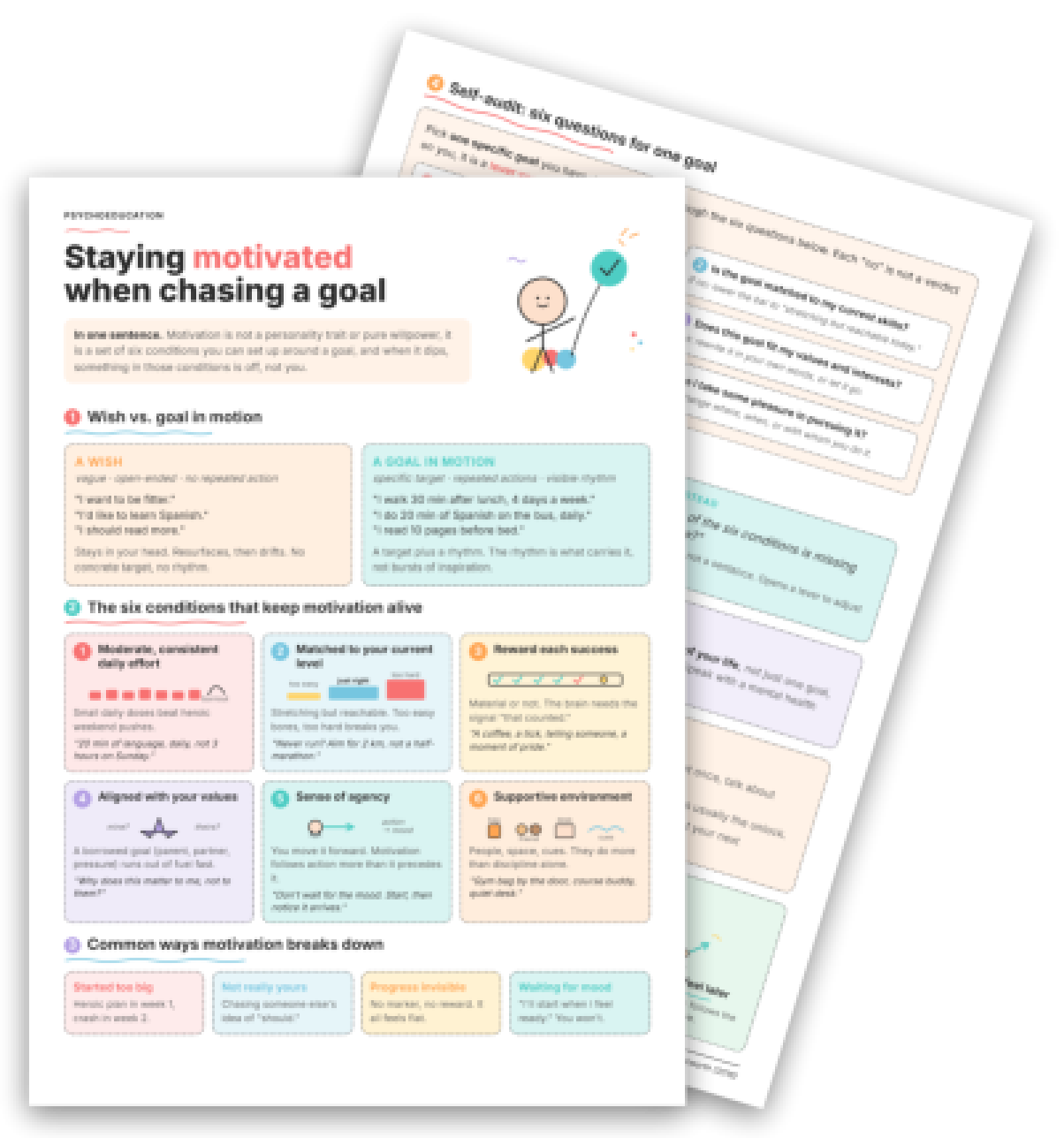
The printable is structured across five panels. The first contrasts a wish ("I'd like to learn Spanish") with a goal in motion ("20 min of Spanish on the bus, daily"), making the distinction between vague intention and rhythmic commitment immediately visible, without a lecture.
The second and most clinically dense panel maps the six conditions that keep motivation alive: effort calibration, level-matching, reward signalling, values alignment, sense of agency, and environmental design. Each condition includes a brief orienting sentence and a concrete example. The layout allows the patient to scan all six at once, which is something a spoken explanation cannot replicate.
The third panel names four common breakdown patterns: starting too large, chasing a borrowed goal, invisible progress, and waiting for the mood. Patients routinely recognise themselves in one of these without prompting, which accelerates formulation.
The fourth panel is a six-question self-audit anchored to a single goal the patient chooses in session. Each question maps to one of the six conditions and ends with a conditional prompt: "If no: shrink the daily dose so it survives a bad day." This is the core psychoeducation tool: not a questionnaire to complete alone, but a visual scaffold the clinician walks through with the patient, question by question.
The fifth panel presents the reframe explicitly. "Which of the six conditions is missing right now?" replaces "I'm lazy" as the operative question. Printed in two columns, it shows patient and clinician exactly what is being replaced and why.
> Key point: The fiche is a visual support that facilitates the explanation of motivation in session. It gives you a shared reference, a diagnostic grid, and something the patient takes home as a concrete anchor, not a task to complete independently.
750+ clinical tools
A library built with and for clinicians, ready to use in session and extend between appointments.
Access all the toolsWhen and How to Introduce It
The fiche fits most naturally at a mid-treatment moment when a patient reports stalling on a goal they appeared committed to, or at the start of any goal-focused work following an initial motivational assessment. It pairs well with SMART goal-setting tools and can precede or follow a 6- and 12-month goal planning exercise.
A low-threshold introduction: "Before we talk about what went wrong, I'd like us to look at a short framework together. It breaks motivation into six conditions, and usually one of them is the culprit." This frames it as diagnostic, not corrective, which protects the alliance.
Work through the self-audit panel together, picking one goal the patient cares about. Any "no" answer becomes a direct agenda item for the following session. The Motivational Dip exercise and the Goal-Setting and Motivation exercise make natural follow-up assignments once the patient has identified their specific lever.
One contraindication worth noting: the fiche includes an explicit caution that a pervasive, unexplained motivational drop across multiple domains warrants a depression screen rather than a six-conditions audit. If that pattern is present, the depression psychoeducation worksheet and the Breaking Action Inertia in Depression exercise are the more appropriate starting points. For patients in the contemplation or preparation stage of change, combining this fiche with the Stages of Change framework helps contextualise why the six conditions are not yet all in place.
The fiche does not replace the clinical formulation. What it does is compress a 20-minute psychoeducation sequence into a shared visual that the patient can return to between sessions when the next dip arrives.
Use it with your patients
Share this tool in the mobile app and follow the work between sessions.
Sources
- Ryan, R. M., & Deci, E. L. (2017). Self-Determination Theory: Basic Psychological Needs in Motivation, Development, and Wellness. Guilford Press.
- Gollwitzer, P. M. (1999). Implementation intentions: Strong effects of simple plans. American Psychologist, 54(7), 493-503.
- Csikszentmihalyi, M. (1990). Flow: The Psychology of Optimal Experience. Harper & Row.
Your session continues in your patients' pocket
Use with a patientYour resources, available everywhere
The handouts, exercises, programs and audios above: you choose which ones to make available to your patients, in the mobile app dedicated to them.
And far more than a library
The app goes well beyond resources, to support your patients every day:
Related categories
Explore other clinical resources by category.

Identity
Clinical resources for self-identity work in therapy: CBT, ACT, schema tools for clinicians addressing self-concept, core beliefs, and identity disruption.

Transitions
Clinical hub for life transitions: tools, worksheets and exercises to support psychosocial adjustment, role change and identity work in practice.

Understand
Clinical hub for the therapeutic aim 'Understand': worksheets and tools to build patient insight across CBT, ACT, schema therapy and more.

Build awareness
Clinical worksheets and tools to build awareness in therapy: cognitive distortions, schemas, emotions, ACT and CBT resources for practitioners.

Engage & motivate
Clinical hub: printable worksheets and exercises to build therapeutic engagement and motivation across ACT, CBT, and integrative practice. For clinicians.

CBT
CBT worksheets, cognitive restructuring exercises & behavioral tools for clinicians. Evidence-based resources for every phase of cognitive behavioral therapy.