
Clinical picture. A, a man in his early forties, presented with a moderate depressive episode characterised by marked behavioural withdrawal; he had stopped his daily walks several months prior and described a persistent sense of being stuck. His clinician introduced the J'avance pas exercise as between-session homework, asking him to work through the five structured questions before the next appointment. A identified two blocking thoughts, chiefly the conviction that he would feel too fatigued to complete even a short circuit and that the effort would confirm his incapacity. Working through question 3, he generated a concrete workaround: starting with a five-minute walk to the corner and returning, with no distance expectation beyond that. At the following session he reported having attempted the walk twice, noting that the anticipatory fatigue had been worse than the activity itself, which opened a productive discussion about cognitive overestimation of effort in depression.
Breaking Action Inertia in Depression: A Guided Exercise
A structured 5-question homework tool helping depressed patients name, examine, and overcome the blocks keeping them from a chosen activity.
Clinical vignettes
Naming the Block, Resuming the Walk
Reconnecting With a Suspended Hobby
Clinical picture. S, a woman in her mid-thirties with recurrent depression, had not touched her sketchbooks in over a year; she mentioned this in passing, framing it as proof she was beyond recovery. The clinician offered the J'avance pas exercise as a structured way to examine that assumption rather than accept it, and S completed the questions at home. She listed three obstructive thoughts, including the belief that anything she produced would be worthless and that starting would force her to confront how much she had lost. For each, she generated modest, testable solutions: drawing for ten minutes without showing the result to anyone and choosing a subject with no personal significance. She returned the following week having completed one short session, reporting that the exercise had made the inertia feel less opaque, though she remained cautious about generalising from a single attempt.
Why action inertia in depression resists words alone
Depression does not simply make patients sad. It makes moving feel impossible. Patients frequently arrive in your office knowing exactly what they should do and being entirely unable to do it. That gap between intention and action is one of the most frustrating clinical targets in depression work, and one of the hardest to bridge through conversation alone.
When you explain the self-reinforcing loop of depression verbally, patients often nod and still go home and do nothing. The problem is not a lack of understanding. It is that blocking thoughts sit between wanting and doing, and those thoughts need to be externalized, named, and answered one by one. A purely oral exchange rarely creates enough traction for that process. Patients need a structured moment to do that cognitive work themselves, on their own terms.
This exercise answers that clinical need directly. It targets the specific activity a patient is avoiding, maps the thought-level obstacles, solicits their own solutions, and closes with a values-based commitment. It complements tools like Situational Avoidance in Depression and works naturally alongside Weekly Activity Scheduling.
Use this resource with your patients
Handout, exercises and materials ready to use, right inside SessionFuel.
What this exercise contains
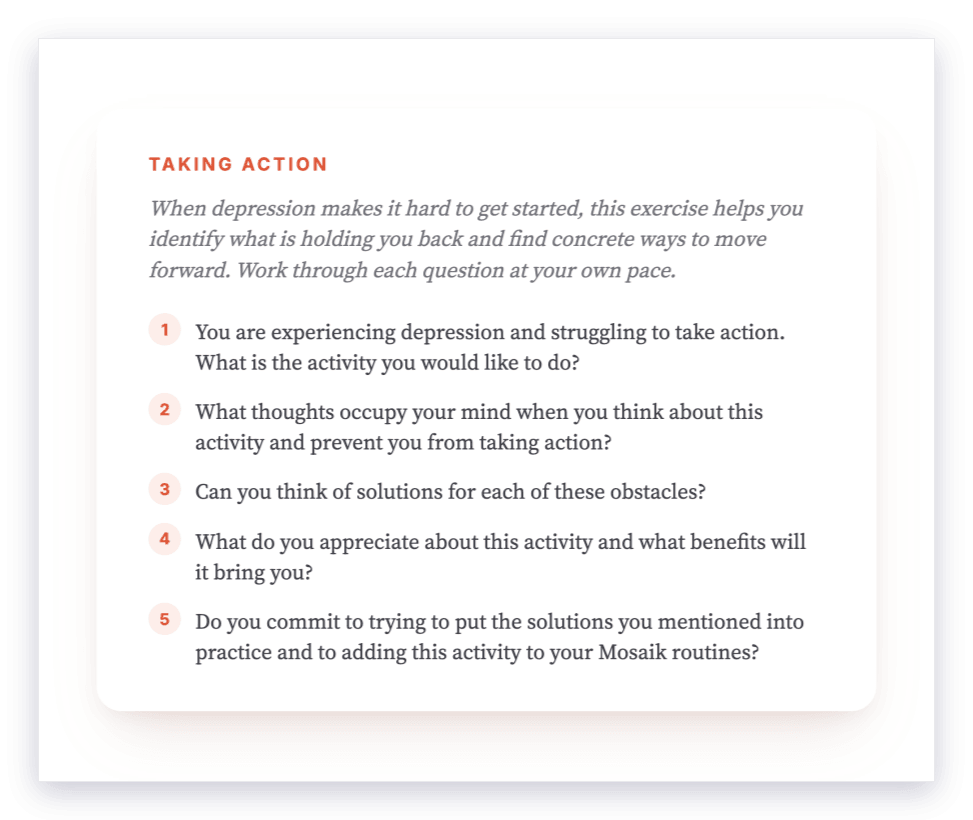
The exercise moves through five tightly sequenced questions. The patient begins by naming one concrete activity they want but cannot manage to do. This specificity is deliberate: vague goals stay vague. The second question surfaces the blocking thoughts attached to that activity, making implicit cognitive barriers explicit and writable. The third question is the pivot: it asks the patient to generate their own solutions to each barrier, placing them in an active, problem-solving stance rather than a helpless one. For clinicians who use solution-focused approaches, this step will feel immediately familiar.
The fourth question shifts register entirely, asking what the patient values and anticipates gaining from the activity. This is not a superficial motivational nudge. Naming positive anticipation is a direct counterweight to the negativity bias of depression, and it connects naturally to behavioral activation rationale. The fifth question closes with a commitment to attempt the solutions named and to build the activity into a regular routine.
The image above lists these five questions in order with a brief orienting introduction. This image is a static preview only. The full guided exercise, including patient-facing instructions and space to write responses, is experienced by the patient directly in the app, on their own, not through this image.
This exercise is available to your patients through the mobile application that is the patient-side interface of SessionFuel. You assign it as homework from your SessionFuel clinician account, and your patient then completes it independently on their phone, between two appointments, at their own pace.
Key insight: The clinical value of this exercise lies in its full sequence: identifying the activity, naming the blocking thoughts, generating personal solutions, anchoring motivation in genuine values, and committing. Skipping to the commitment step without the prior cognitive work produces fragile intentions.
750+ clinical tools
A library built with and for clinicians, ready to use in session and extend between appointments.
Access all the toolsUse it with your patients
Share this tool in the mobile app and follow the work between sessions.
How to integrate this as between-session homework
This exercise suits patients who are moderately engaged but stuck: they have enough insight to name a desired activity but cannot translate that insight into behavior. It is less suited to severely anhedonic patients who cannot identify any activity at all (in that case, the Activity Menu or Current Activity Inventory may be better starting points).
Introduce it by asking the patient directly: "Is there something you've been wanting to do but keep putting off?" Once they name something, assign the exercise as work to do before your next meeting. Frame it as an experiment, not a performance demand. Patients who struggle with procrastination patterns or feelings of uselessness may need a brief normalization before they engage.
When the patient returns, the material they produced becomes your session entry point. Read what they wrote for their blocking thoughts (question 2): these often carry cognitive distortions worth restructuring together. Review the solutions they proposed (question 3) and assess whether any were attempted. Whether or not the activity happened, question 4 gives you access to genuine motivational anchors you can return to in future sessions. The fifth question's commitment can feed naturally into celebrating progress in later sessions, or into building the next weekly behavioral review.
For patients working through broader motivational difficulties, this exercise fits well inside the Finding Motivation for Change program, and pairs usefully with Sadness in Therapy when emotional heaviness is the central barrier.
Your session continues in your patients' pocket
Use with a patientYour resources, available everywhere
The handouts, exercises, programs and audios above: you choose which ones to make available to your patients, in the mobile app dedicated to them.
And far more than a library
The app goes well beyond resources, to support your patients every day:
Related categories
Explore other clinical resources by category.

Mood
Evidence-based worksheets and clinical tools for mood disorders: CBT, ACT, and positive psychology resources for psychologists and therapists.

Behaviours
Clinical hub for behaviors in therapy: worksheets and tools for coping, eating disorders, CBT formulation, and maladaptive behavioral patterns.

Cognition
Printable cognitive therapy worksheets and clinical tools for therapists: CBT, ACT, schema work, defusion, distortions, and belief restructuring.

CBT
CBT worksheets, cognitive restructuring exercises & behavioral tools for clinicians. Evidence-based resources for every phase of cognitive behavioral therapy.

Anxiety
Clinical hub for anxiety disorders: CBT and ACT worksheets, psychoeducation sheets, and exercises for assessment and treatment across the anxiety spectrum.

Trauma
Clinical hub on trauma and PTSD: assessment, differential diagnosis, treatment phases, and printable resources for practitioners. 155 chars.