
Clinical picture. A., a man in his late thirties, presented with a third depressive episode following a redundancy. He described a pattern he could not name: mounting fatigue, cancelled social engagements, and a growing conviction that he was a burden to others. In the fourth session, the clinician introduced the cycle of depression worksheet, walking through each node with A. and asking him to map his own recent week onto the loop. A. immediately identified withdrawal as his dominant entry point, noting that unread messages had accumulated into what he called "proof" of his worthlessness. The clinician proposed one small behavioural task before the next session, framed explicitly as an experiment rather than a test of willpower; A. sent a single reply to a friend and reported a modest but noticeable shift in energy that he attributed, for the first time, to his own action rather than to chance.
The Cycle of Depression: PDF Worksheet, Tools and Exercises
A visual PDF worksheet to help clinicians explain the self-reinforcing loop of depression in session, with tools and exercises for behavioral and cognitive intervention.
Clinical vignettes
Behavioural Entry Point in Recurrent Depression
Psychoeducation Reducing Self-Blame
Clinical picture. M., a woman in her mid-fifties referred after a prolonged period of low mood following a chronic pain diagnosis, arrived to her second appointment stating she felt ashamed of her inability to "just get on with things." The clinician shared the informational sheet and spent the session reading through the five nodes together, pausing at the distinction between depression and laziness. M. became visibly less tense when the clinician noted that the loop is self-reinforcing by design, not by choice, and that the body node alone, fatigue and disrupted sleep, is sufficient to block the action most people expect from themselves. Over the following fortnight M. reported reduced self-critical rumination, not resolution of the depression, but a shift away from attributing her withdrawal to a character flaw that allowed her to engage more consistently with scheduled activity.
Explaining depression as a self-reinforcing system often falls flat in session. Patients hear the word "loop" and nod politely, then leave with no clearer map of why willpower alone fails them. This fiche PDF gives you a concrete visual anchor to make the maintenance cycle legible mid-session, in under five minutes, and leaves the patient with something they can return to between appointments.
Use this resource with your patients
Handout, exercises and materials ready to use, right inside SessionFuel.
Why the Depression Cycle Is Hard to Explain Out Loud
The core clinical difficulty is not the concept itself. It is the gap between intellectual understanding and felt recognition. Most patients already know, abstractly, that thoughts, mood, and behaviour interact. What they cannot see, without a visual prompt, is the self-reinforcing directionality: how withdrawal generates new stressors, which feed the automatic thoughts that deepen low affect, which drain the body, which makes further retreat feel like the only available option. Lewinsohn's behavioural model and Beck's cognitive triad both describe this architecture, but a verbal account rarely makes the circularity tangible enough to shift something.
The second sticking point is shame and misattribution. Patients frequently arrive believing depression reflects a character defect, or that it is simply protracted sadness they should be able to shake. Dismantling this orally takes session time that could otherwise go toward building a concrete formulation or introducing behavioural activation exercises. A single well-structured visual makes the reframe faster and stickier.
750+ clinical tools
A library built with and for clinicians, ready to use in session and extend between appointments.
Access all the toolsWhat the Fiche Contains: A Visual Map of the Maintenance Loop
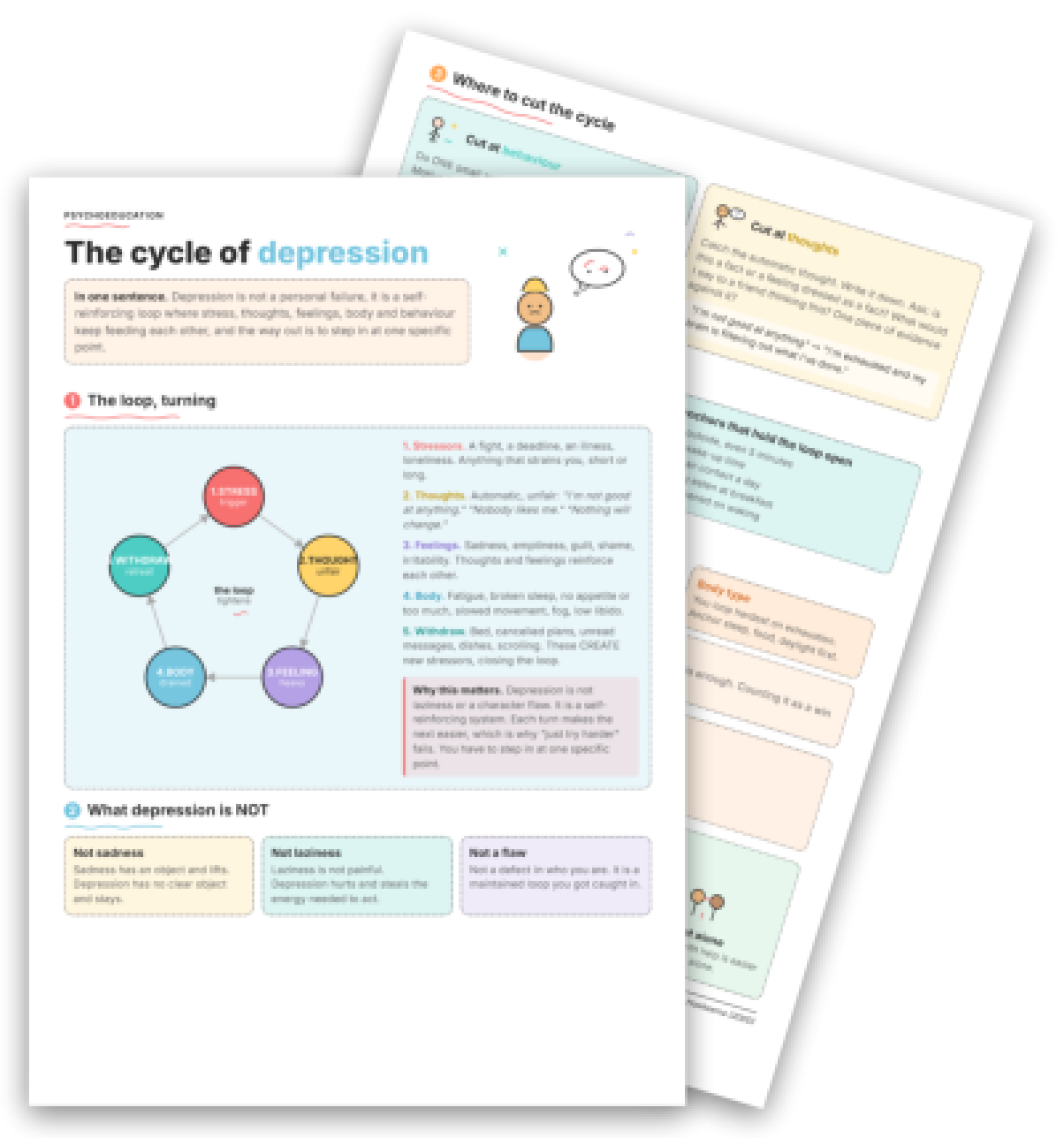
The resource is built around five labelled nodes arranged as a closed loop: Stress, Thought, Feeling, Body, Withdraw. Each node carries a short clinical descriptor. The Withdraw node is explicitly flagged as the point that creates new stressors, closing the loop, a formulation that makes the self-perpetuating logic immediately visible on the page in a way that speech alone cannot replicate. Alongside the loop diagram, the fiche distinguishes depression from sadness, laziness, and character flaw across a dedicated panel, providing the destigmatisation frame before any intervention is proposed.
Two intervention cut-points are then laid out in parallel: cutting at behaviour (the "do ONE small action BEFORE you feel like it" rule, grounding the core principle that motivation follows action) and cutting at thoughts (catching the automatic thought, writing it down, asking "is this a fact or a feeling dressed as a fact?"). A panel of early-warning signs follows, including sleep drift, rising screen time, and hygiene changes, useful for the kind of collaborative early-relapse planning you might embed after stabilisation. The final section offers a three-subtype map (rumination type, withdrawal type, body type) pointing each profile toward its highest-leverage cut-point, and a "worst days" protocol that reduces the therapeutic ask to one of three minimal anchors.
The layout makes visible what a verbal explanation flattens: that the loop has no starting point and no natural exit unless the patient steps in deliberately at one node. That visual argument does work that words alone rarely accomplish.
> Key takeaway: The fiche is a visual support that facilitates the explanation of the depression cycle in session. It is not a self-administered questionnaire, it is a psychoeducation aid the clinician uses actively, then hands to the patient as a concrete reference between appointments.
Use it with your patients
Share this tool in the mobile app and follow the work between sessions.
How to Introduce the Fiche and Use It in Session
Timing. The fiche fits naturally in early-to-mid treatment, once the diagnostic picture is clear and the therapeutic alliance is established enough to support psychoeducation. It pairs well with the Understanding Depression psychoeducation program if you are running a structured curriculum, or with tools for identifying automatic thoughts when the cognitive intervention begins.
Profiles. It is particularly useful for patients who catastrophise their lack of motivation, those with a strong shame presentation around functional decline, and adolescents or young adults who interpret withdrawal as laziness. For patients already in an ACT-oriented approach to depression, the loop diagram maps cleanly onto experiential avoidance without requiring reframing.
Introducing it. A neutral, practical frame works best: "I want to show you something that maps what we've been describing. It doesn't mean you're broken, it means you got caught in a system that has its own logic." Trace the loop out loud while the patient follows on the page. Pause at the Withdraw node and ask which behaviours fit their own pattern. The three-subtype panel invites the patient to self-locate, which increases engagement and reduces the risk of a one-size-fits-all formulation.
Debriefing. Ask which cut-point feels the least inaccessible right now, not the most effective in theory. Use the Activity Menu for behavioral activation or weekly activity planning tools to operationalise the behaviour cut. For the thought cut, exercises targeting automatic thoughts and tools addressing rumination extend the work naturally. Track small wins explicitly, the Celebrating Progress in Depression exercise is a direct complement. If avoidance is a dominant feature, or motivation loss is the chief complaint, companion resources can be layered in as the work deepens.
The fiche does not replace the clinical relationship or the formulation. It makes the explanation sharper, saves session time, and gives the patient a reference they can actually use on a bad Tuesday at 11pm, without you in the room.
Your session continues in your patients' pocket
Use with a patientYour resources, available everywhere
The handouts, exercises, programs and audios above: you choose which ones to make available to your patients, in the mobile app dedicated to them.
And far more than a library
The app goes well beyond resources, to support your patients every day:
Related categories
Explore other clinical resources by category.

Mood
Evidence-based worksheets and clinical tools for mood disorders: CBT, ACT, and positive psychology resources for psychologists and therapists.

Behaviours
Clinical hub for behaviors in therapy: worksheets and tools for coping, eating disorders, CBT formulation, and maladaptive behavioral patterns.

Cognition
Printable cognitive therapy worksheets and clinical tools for therapists: CBT, ACT, schema work, defusion, distortions, and belief restructuring.

Understand
Clinical hub for the therapeutic aim 'Understand': worksheets and tools to build patient insight across CBT, ACT, schema therapy and more.

Build awareness
Clinical worksheets and tools to build awareness in therapy: cognitive distortions, schemas, emotions, ACT and CBT resources for practitioners.

CBT
CBT worksheets, cognitive restructuring exercises & behavioral tools for clinicians. Evidence-based resources for every phase of cognitive behavioral therapy.