
Clinical picture. T., a man in his late forties, presented with a six-month depressive episode marked by progressive social withdrawal and near-total loss of daily structure; he had stopped attending his weekly football training and was declining most calls from friends. The clinician introduced the psychoeducational sheet on coping skills, walking through the depression loop diagram together and identifying where T. recognised himself most clearly, namely the withdrawal link. They agreed on two small, concrete actions: a ten-minute walk before breakfast and a brief daily text to one friend, both anchored to existing habits rather than dependent on mood. At the next session T. reported completing the walk on five of seven days; he noted, with some surprise, that moving had briefly lifted the flat quality of his mornings rather than requiring energy he did not have.
Coping Skills for Depression: PDF Worksheet, Tools and Exercises
A visual psychoeducation sheet helping clinicians explain behavioral activation, social reconnection, gratitude retraining, and grounding as four complementary in-session tools for depression.
Clinical vignettes
Behavioural Activation in a Withdrawn Patient
Rumination and the Return to Present Moment
Clinical picture. M., a woman in her early thirties with recurrent depression, described her evenings as dominated by repetitive negative thoughts about past decisions, a pattern she had not previously labelled as rumination. The clinician used the sheet to name this as a specific target and introduced two practices: the five-four-three grounding sequence for acute moments of looping thought, and a brief daily breath-focused exercise of five to eight minutes. M. was sceptical that noticing her breath would change anything, so the clinician reframed the aim as practising the return itself rather than achieving calm. Over three weeks M. began using the grounding sequence at the start of her evenings and reported that while the rumination had not disappeared, she was spending less time inside it before redirecting attention.
Telling a patient with depression that action comes before motivation is one of the most clinically accurate and hardest-to-land statements in CBT. The self-sustaining loop, low mood, energy drain, withdrawal, anhedonia, deeper low mood, is intellectually clear to us, but patients in the middle of it rarely experience it as a loop. They experience it as evidence. This fiche PDF gives you a visual structure to show that loop explicitly and place four concrete coping skills directly inside it, so the psychoeducation lands rather than evaporates between sessions.
Use this resource with your patients
Handout, exercises and materials ready to use, right inside SessionFuel.
Why the Depression Loop Resists Oral Explanation
The core obstacle is not comprehension, it is attribution. When a patient declines an invitation or skips the walk they planned, they read it as confirmation that they are too depleted to act. The waiting-to-feel-like-it heuristic is presented by the depressive cognitive system as wisdom, not symptom. Verbal explanation alone tends to produce intellectual agreement without behavioral shift, partly because the patient has no anchor to return to between sessions.
The same difficulty applies to the distinctions your patients need most: that behavioral activation is not productivity, that a gratitude practice is not forced positivity, and that mindfulness is not emptying the mind. Each of these misconceptions actively undermines the skills you are trying to build. Without a shared visual reference, you end up re-correcting them session after session.
What the Fiche Contains: Four Skills Mapped onto the Loop
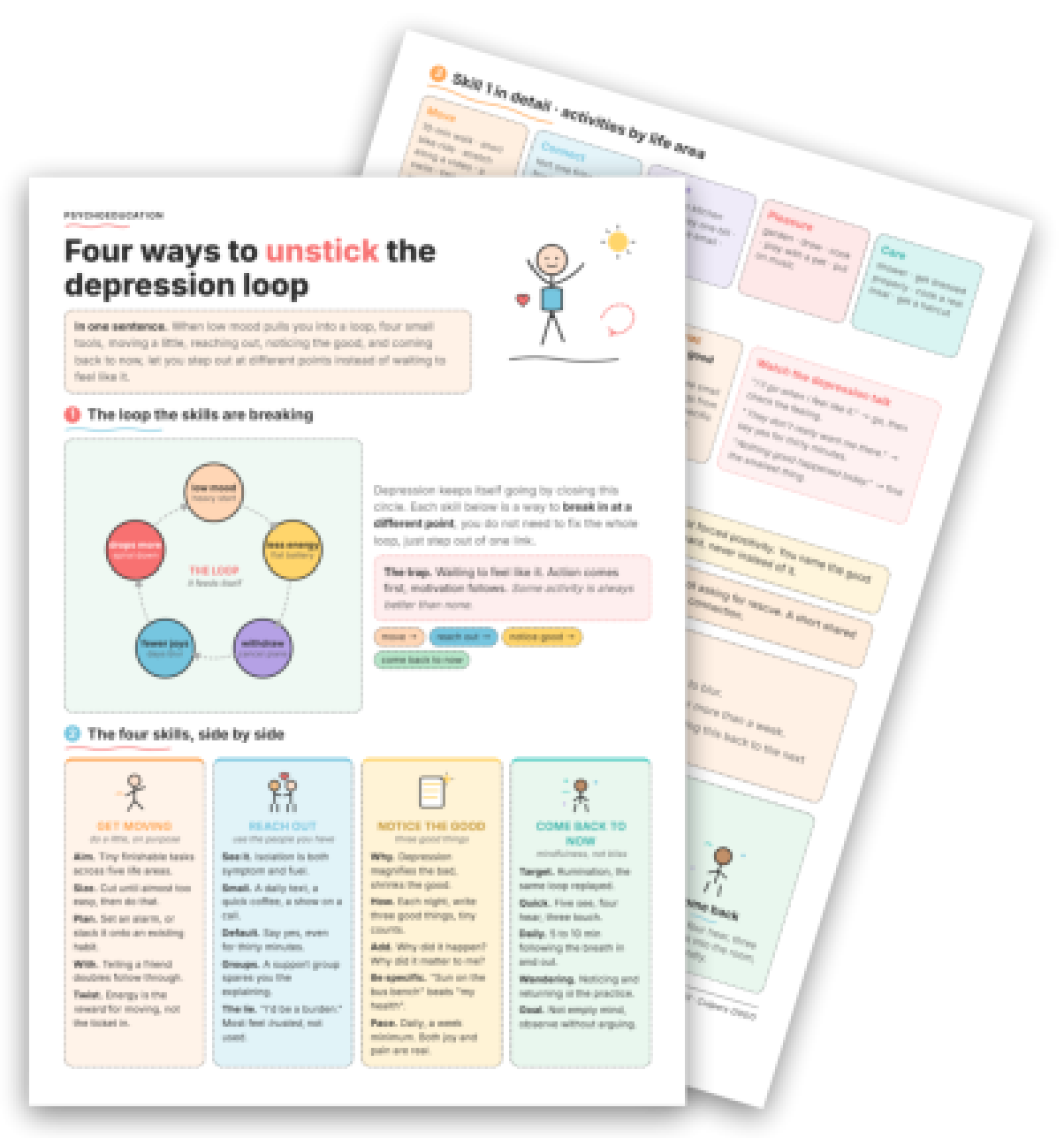
The fiche PDF opens with a circular diagram labeling each stage of the depression maintenance cycle, low mood → less energy → withdraw → fewer joys → drops more, and explicitly marks each of the four skills as a point of entry into that circle. The message is structural: you do not need to fix the whole loop, you just need to step out at one link.
A side-by-side panel then presents the four skills with the same compact format for each:
- Get Moving: behavioral activation framed as tiny, finishable tasks across five life areas (Move, Connect, Handle, Pleasure, Care), with an explicit activity menu for each
- Reach Out: reframes isolation as both symptom and fuel, addresses the "I'd be a burden" automatic thought directly with the line "Most feel trusted, not used"
- Notice the Good: the three-good-things protocol (Seligman, 2005), with a specificity prompt, "Sun on the bus bench" beats "my health", and the instruction to add a brief why
- Come Back to Now: the 5-4-3 grounding sequence as a quick rumination interrupt, alongside a short daily breath practice, with the clarification that "noticing and returning is the practice"
A later panel, "A day with all four, lightly", maps each skill onto a moment (morning activation, midday contact, anytime reset, bedtime review), which is clinically useful for patients who find the framework abstract. The fiche also includes a "Useful distinctions" block and a closing "To discuss in session" section listing three concrete signals worth bringing back to therapy, including "when even the smallest activation feels impossible."
> Key point: the fiche is a visual support that facilitates the explanation of the depression loop and its four exit points in session; it leaves the patient a concrete reference to take home, not a form to fill in alone.
750+ clinical tools
A library built with and for clinicians, ready to use in session and extend between appointments.
Access all the toolsHow and When to Introduce It
The fiche fits naturally once a shared formulation of the presenting picture is in place, typically from the second or third session onward. It works well alongside a structured understanding of depression and pairs directly with behavioral exercises such as weekly activity scheduling or identifying what the patient is avoiding.
To introduce it without clinical labeling, you might say: "I want to show you something that maps what you've been describing, a loop that keeps itself going, and four places where we can step in." Then walk through the diagram together, asking which link feels most familiar this week. That question alone anchors the skill to the patient's actual experience rather than to a generic model.
For patients whose motivation is particularly low or whose rumination is prominent, the "Come Back to Now" and "Get Moving" panels are often the most immediate entry points. For patients with significant social withdrawal, "Reach Out" opens a direct conversation about the "I'd be a burden" belief, which connects cleanly to adaptive versus maladaptive coping work you may already be doing.
One limit to note: the fiche assumes sufficient cognitive accessibility to engage with short text and simple diagrams. For patients in a severe episode, pare the session back to one skill and one panel. Progress review can follow with Celebrating Progress in Depression once the patient has a few activation attempts to name.
The fiche does not replace the therapeutic relationship or the formulation; it makes the explanation clearer and gives the patient a map to carry between sessions.
Use it with your patients
Share this tool in the mobile app and follow the work between sessions.
Sources
- Martell, C. R., Dimidjian, S., Herman-Dunn, R. (2022). Behavioral Activation for Depression: A Clinician's Guide (2nd ed.). Guilford Press.
- Segal, Z. V., Williams, J. M. G., Teasdale, J. D. (2013). Mindfulness-Based Cognitive Therapy for Depression (2nd ed.). Guilford Press.
- Santini, Z. I., Fiori, K. L., Feeney, J., Tyrovolas, S., Nielsen, L., Koyanagi, A., Haro, J. M., Kaplan, M. (2016). Social support and protection from depression: systematic review of current findings in Western countries. British Journal of Psychiatry, 209(4), 284-293.
Your session continues in your patients' pocket
Use with a patientYour resources, available everywhere
The handouts, exercises, programs and audios above: you choose which ones to make available to your patients, in the mobile app dedicated to them.
And far more than a library
The app goes well beyond resources, to support your patients every day:
Related categories
Explore other clinical resources by category.

Mood
Evidence-based worksheets and clinical tools for mood disorders: CBT, ACT, and positive psychology resources for psychologists and therapists.

Understand
Clinical hub for the therapeutic aim 'Understand': worksheets and tools to build patient insight across CBT, ACT, schema therapy and more.

Regulate
Clinical resources for emotion regulation: worksheets, ACT exercises, and psychoeducation tools for affect regulation across diagnoses. For clinicians.

Build skills
Skill-building resources for clinicians: printable worksheets and exercises for coping, assertiveness, and communication skills training in therapy.

CBT
CBT worksheets, cognitive restructuring exercises & behavioral tools for clinicians. Evidence-based resources for every phase of cognitive behavioral therapy.

Mindfulness (MBSR/MBCT)
Clinical hub for MBSR and MBCT resources: guided audios, body scans, psychoeducation programmes, and mindfulness exercises for practitioner use in session.