
Clinical picture. M., a 38-year-old man with a three-year history of alcohol use disorder, presented in early outpatient recovery reporting repeated lapses he attributed to weak character. His self-blame was reinforcing avoidance of coping planning. The clinician introduced the five-family framework from the psychoeducational sheet, explicitly naming sobriety as a skills problem rather than a willpower problem, and worked with M. to identify which families were underdeveloped in his current repertoire. M. had strong social ties but almost no emotion-regulation strategies or trigger-prevention habits, which helped him see the lapses as a gap to fill rather than a personal failing. Over the following two sessions, he built a written prevention plan and named three emotion-focused techniques he was willing to practice, reporting a modest but concrete reduction in post-lapse shame.
Coping Skills for Addictions: PDF Worksheet, Tools and Exercises
A visual PDF worksheet clinicians can use in session to introduce the five families of coping skills, reframe willpower narratives, and give patients a concrete relapse-prevention map to keep.
Clinical vignettes
Reframing Sobriety as a Skills Gap
Using the Craving Arc During High-Risk Evenings
Clinical picture. T., a 45-year-old woman in recovery from opioid use disorder, described evenings alone as her most consistent trigger, stating that cravings felt "endless" and that she saw no point in resisting them. The clinician walked her through the craving-arc diagram, explaining that most cravings peak at 20 to 30 minutes and drop without intervention inside an hour. Together they built a short list of diversions T. genuinely enjoyed, including a bath, a specific playlist, and a call to one named contact, sequenced as a one-hour plan she could start the moment a craving arose. At the next session T. reported using the plan twice; both cravings had subsided before the hour was up, and she noted that having a concrete sequence reduced the sense of helplessness that had previously accelerated her urge to use.
Patients in early sobriety rarely lack motivation. What they lack is a repertoire: a set of skills concrete enough to deploy when a craving peaks at 2am. Explaining this orally in session is possible, but the information scatters. This PDF worksheet anchors the conversation in a shared visual structure patients can take away and actually use.
Use this resource with your patients
Handout, exercises and materials ready to use, right inside SessionFuel.
Why the "try harder" frame keeps failing in session
The single most common cognitive obstacle in addiction work is the willpower attribution. Patients who relapse read it as moral failure; clinicians who collude with that framing inadvertently reinforce shame and reduce the probability of return. Reframing sobriety as a skills acquisition problem, not a character problem, is the therapeutic pivot, and it maps cleanly onto the Marlatt and Gordon relapse-prevention model.
The difficulty is that the reframe sounds abstract when stated verbally. Patients hear it, nod, and leave without anything to hold. The same week, a craving arrives, the patient has no organised response, and the implicit conclusion is that their willpower failed again. What the fiche PDF does is externalise the skills map so that the reframe becomes visible, not just audible. You can point to it, walk through it together, and hand it over as a practical reference, not a homework form.
This is especially relevant for patients who present with maladaptive coping patterns (substance use as the default regulation strategy) or for those whose emotional drivers remain unaddressed beneath the addictive behaviour.
What the fiche contains, and what the visual layout shows
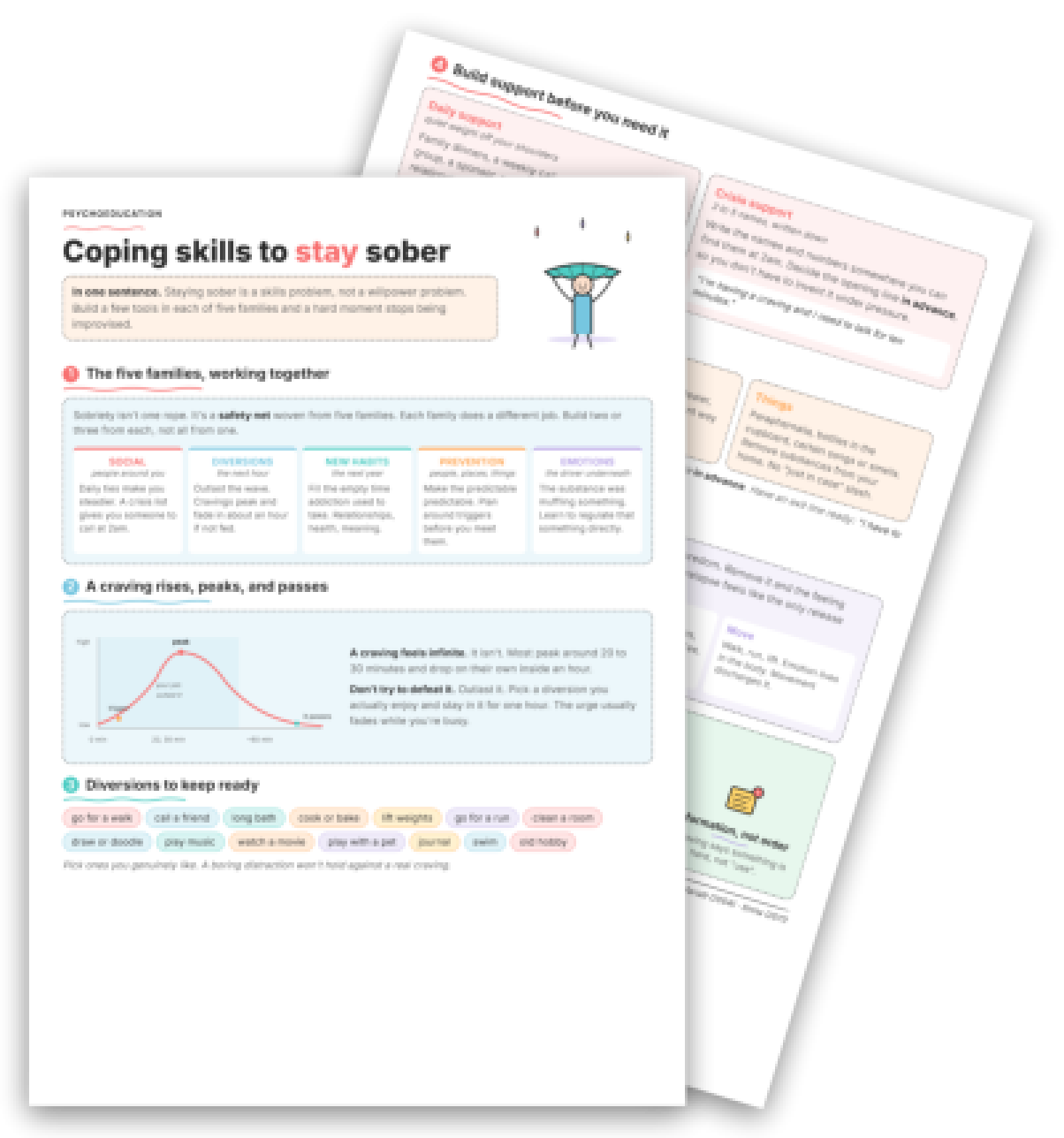
The fiche is organised around six panels, each doing a distinct clinical job.
- Panel 1: The five families. "Sobriety isn't one rope. It's a safety net woven from five families." The five categories, Social, Diversions, New Habits, Prevention, and Emotions, are presented side by side with a one-line functional description for each. The layout makes explicit that no single category is sufficient: "Build two or three from each, not all from one." Showing this visually prevents the common pattern of patients over-relying on one strategy (typically avoidance of triggers) while leaving the emotional regulation and social support columns empty.
- Panel 2: The craving arc. A simple time-course diagram showing a craving peaking around 20 to 30 minutes and fading inside one hour. This panel does work that verbal explanation rarely achieves: it concretises the finite, wave-like quality of craving, which is the physiological underpinning of urge surfing and confronting avoidance. Patients who can see the arc are more likely to commit to outlasting it.
- Panel 3: A ready-to-use diversion menu. Fourteen specific activities (walk, cook, journal, play music, swim, and others) presented as options the patient can pre-select. The note is precise: "Pick ones you genuinely like. A boring distraction won't hold against a real craving." This panel supports building a personalised activity menu as a collaborative in-session task.
- Panel 4: Support mapping (daily and crisis). The fiche distinguishes steady daily support from crisis-level support, and provides a concrete prompt: three to five names written down with a pre-decided opening line. "I'm having a craving and I need to talk for ten minutes." Scripting the opening line in advance is a low-effort but high-yield intervention that most patients would not think of alone.
- Panel 5: Trigger mapping. A structured breakdown of people, places, and things, including specific examples (old using partners, routes past a dealer, paraphernalia at home). This feeds directly into building new behavioural habits and is aligned with decision-making at critical moments in ACT-informed practice.
- Panel 6: Emotion regulation. Four brief exercises (4-4-6 breathing, three-line journaling, safe-place imagery, movement) framed explicitly around the function the substance was serving. The panel states plainly that "the substance was muffling something" and names the target directly: regulate that something directly.
> Key point: this fiche is a visual support that facilitates the explanation of coping skills in session. It is not a self-directed questionnaire. The clinician walks through it with the patient, using the diagrams and categories as a shared reference, then leaves it as a concrete take-home anchor.
750+ clinical tools
A library built with and for clinicians, ready to use in session and extend between appointments.
Access all the toolsWhen and how to introduce it in session
The fiche fits naturally in the early stabilisation phase, once the anamnèse is complete and the therapeutic alliance is established enough for psychoeducation. It is particularly well-suited to sessions where you are working on building discrepancy and motivation for change, or when a patient is moving from contemplation to active engagement with their sobriety.
You can introduce it with a simple frame: "I'd like us to map out what you'll actually do the next time a craving comes. Not willpower, concrete tools." Walking through the craving arc first tends to reduce shame and increase receptivity; most patients have never seen their experience described as a wave that peaks and passes.
For the debrief, ask which families are already populated, which are thin, and which feel most threatening to build. Patients with high emotion regulation deficits will typically have an empty Panel 6 and benefit from pairing the fiche with structured work on that gap. The trigger-mapping panel can seed a graded exposure plan for patients whose avoidance of high-risk contexts has become functionally disabling.
One contraindication worth noting: in acute ambivalence or pre-contemplation, the fiche may arrive too prescriptively. In those cases, motivational interviewing remains the priority, and the fiche is better held until the patient is genuinely asking for the skills layer.
The fiche does not replace the formulation or the relational frame. It makes the skills map visible, gives patients something to return to between sessions, and keeps the conversation grounded in competence rather than character.
Use it with your patients
Share this tool in the mobile app and follow the work between sessions.
Sources
- Marlatt, G. A., Gordon, J. R. (1985). Relapse Prevention: Maintenance Strategies in the Treatment of Addictive Behaviors. Guilford Press.
- Witkiewitz, K., Marlatt, G. A. (2011). Relapse Prevention for Addictive Behaviors. Substance Abuse Treatment, Prevention, and Policy, 6(1), 17.
- Recovery Research Institute. Relapse Prevention (RP / MBRP).
Your session continues in your patients' pocket
Use with a patientYour resources, available everywhere
The handouts, exercises, programs and audios above: you choose which ones to make available to your patients, in the mobile app dedicated to them.
And far more than a library
The app goes well beyond resources, to support your patients every day:
Related categories
Explore other clinical resources by category.

Emotions
Clinical resources on emotion regulation: worksheets, coping tools, CBT, REBT, and ACT exercises for therapists working across diagnoses and age groups.

Behaviours
Clinical hub for behaviors in therapy: worksheets and tools for coping, eating disorders, CBT formulation, and maladaptive behavioral patterns.

Relationships
Clinical worksheets and tools on relational functioning: attachment, schemas, assertiveness, and communication skills for therapists. Printable PDF resources.

Understand
Clinical hub for the therapeutic aim 'Understand': worksheets and tools to build patient insight across CBT, ACT, schema therapy and more.

Regulate
Clinical resources for emotion regulation: worksheets, ACT exercises, and psychoeducation tools for affect regulation across diagnoses. For clinicians.

Build skills
Skill-building resources for clinicians: printable worksheets and exercises for coping, assertiveness, and communication skills training in therapy.