
Clinical picture. R., a man in his late 40s presenting with mild depression, reported repeatedly failing to follow through on a morning exercise goal despite strong motivation. He described the gap between intention and action as evidence of a personal defect. The clinician introduced the habit-building worksheet, reframing the problem: the goal was too large and lacked a reliable cue. Together they identified an existing anchor, making coffee, and attached a two-minute walk around the block immediately after. At the next session R. noted he had walked six of seven mornings; the clinician used the single miss as an opportunity to review cue clarity rather than reinforce self-criticism.
HandoutBehaviours & addictionsEmotions & stressActivationEngage & motivatePrevent relapseCBTACTPositive psychology
Building New Habits: PDF Worksheet, Tools and Exercises
A printable PDF worksheet, tools, and concrete exercises to help patients translate vague intentions into durable daily routines, session by session.
Clinical vignettes
Habit Stacking After Persistent Avoidance
Environment Redesign for Sleep Hygiene
Clinical picture. T., a woman in her early 30s with chronic insomnia and generalised anxiety, had tried multiple times to stop using her phone in bed but described willpower as unreliable under stress. Using the informational sheet as a shared reference, the clinician shifted the focus from resolve to environment: the phone charger was moved to the hallway, a paperback novel was placed on the bedside table, and a small calendar was taped to the fridge for daily checkmarks. Four weeks later T. reported the routine felt automatic on most nights, though it still broke down when anxiety spiked; this pattern became productive clinical data rather than a sign of failure.
Patients arrive with clear goals and fall back within weeks, not because they lack motivation but because they conflate the goal with the habit. Explaining this distinction verbally rarely lands. This fiche PDF gives you a shared visual map to make the mechanism concrete during the session itself, and sends the patient home with a reference they can actually use.
Use this resource with your patients
Handout, exercises and materials ready to use, right inside SessionFuel.
Why habit formation is so hard to explain out loud
The core clinical difficulty is that patients experience goal pursuit as the mechanism of change, when the mechanism is actually contextual repetition of a small action. Willpower feels like the lever, so they keep pulling it. When you explain this verbally, most patients nod and then go home and try harder at the goal rather than redesigning the cue-action-reward chain.
A second obstacle is the miss catastrophe: patients who track a streak interpret a single skipped day as collapse, often abandoning the habit entirely. This abstinence violation effect is a common clinical sticking point, and it's difficult to pre-empt with words alone. A visual structure that names the slip as data before it happens changes what the patient does when it occurs.
For patients with procrastination patterns, low motivation tied to depression, or difficulty translating values into committed action, the conceptual gap between intention and routine is especially wide. These are exactly the patients for whom an in-session visual anchor pays off most.
What the fiche contains, and what the visual layout does
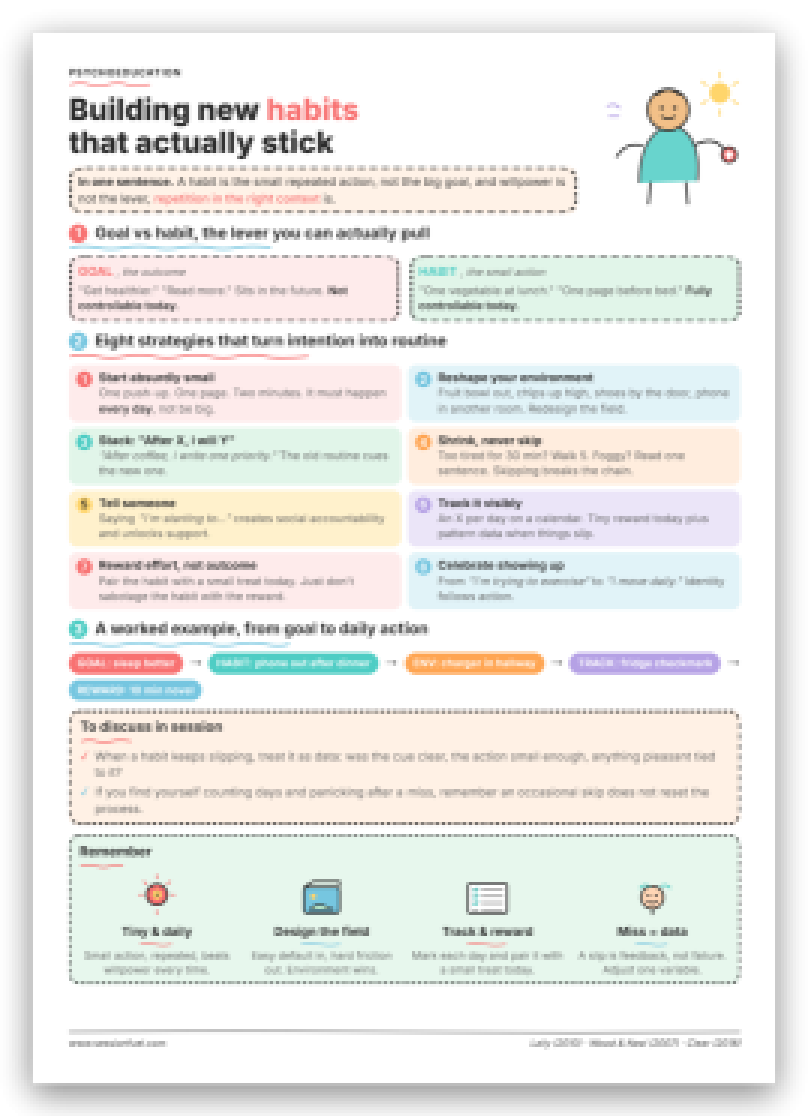
The fiche PDF is structured across three numbered panels, a worked example, and a summary block, all on a single printable page.
Panel 1 draws a direct contrast between Goal (outcome, sits in the future, not controllable today) and Habit (small action, "fully controllable today"). Seeing that contrast in a two-column layout does something the oral explanation does not: it externalizes the distinction, lets the patient point to it, and gives the clinician a shared object to return to when goal-thinking creeps back in.
Panel 2 lists eight concrete strategies, each framed as an action principle:
- Start absurdly small: one push-up, one page, two minutes, happening every day
- Reshape your environment: redesign defaults so the habit is the path of least resistance
- Habit stacking: "After X, I will Y", anchoring the new behaviour to an existing cue
- Shrink, never skip: five minutes beats zero; skipping breaks the chain
- Social accountability: naming the habit aloud to someone
- Visible tracking: a daily X on a calendar, generating both reward and pattern data
- Reward effort, not outcome: pairing the action with a small immediate treat
- Identity shift: from "I'm trying to" toward "I do"
Panel 3 walks through a fully worked example (goal: sleep better / habit: phone out after dinner / environment: charger in hallway / tracking: fridge checkmark / reward: ten minutes of a novel), showing how the eight principles assemble into a single concrete plan.
The fiche closes with a "To discuss in session" block and a four-point "Remember" summary. These are your debrief anchors, not a patient self-assessment. The whole sheet functions as a visual support that facilitates explanation in session, not a worksheet the patient fills out alone.
> Key takeaway: The fiche is a visual psychoeducation tool you use in session to make the goal-vs-habit distinction concrete and to pre-empt the "miss = failure" belief before it undoes the patient's first attempt.
Clinical library
750+ clinical tools
A library built with and for clinicians, ready to use in session and extend between appointments.
Access all the toolsSeveral resource types
Psychoeducation handouts
Understand at a glance
Interactive exercises
To do and fill in
Interactive programs
A structured path
Audios
Meditation and relaxation
Psychometric tests
Automatic scoring
When and how to introduce it in session
This fiche fits naturally in the early behavioural phase of a treatment plan, once goals have been set and the patient has already expressed frustration with their own attempts to change. It integrates directly with goal-setting and behaviour change work, with current activity mapping, and with behavioural activation protocols in depression.
A low-stigma introduction: "I want to show you something about how habits actually form, because I think the way you've been approaching this is making it harder than it needs to be." This frames the fiche around mechanism, not personal failure.
In session, work through Panel 1 together before moving to Panel 2. Ask the patient to choose one strategy that feels feasible this week and one that feels hardest. The worked example in Panel 3 serves as a model for building the patient's own structured plan before they leave.
At the next session, the "To discuss in session" prompts on the sheet are your debrief script: was the cue clear, was the action small enough, was anything pleasant tied to it? For patients prone to motivation loss or avoidance patterns, folding in a weekly behavioural self-review extends the work between sessions. For adolescent or ADHD profiles, growth mindset framing pairs well with the identity-shift principle in Strategy 8.
The fiche does not replace the therapeutic relationship or the formulation of the maintaining cycle; it makes the psychoeducation component faster, clearer, and more likely to be remembered when willpower fails at 10 pm on a Tuesday.
Use it with your patients
Share this tool in the mobile app and follow the work between sessions.
Sources
- Gardner, B., Lally, P., & Wardle, J. (2012). Making health habitual: the psychology of 'habit-formation' and general practice. British Journal of General Practice, 62(605), 664-666.
- Clear, J. (2018). Atomic Habits: An Easy and Proven Way to Build Good Habits and Break Bad Ones. Avery / Penguin Random House.
Patient mobile app
Your session continues in your patients' pocket
Use with a patientYour resources, available everywhere
The handouts, exercises, programs and audios above: you choose which ones to make available to your patients, in the mobile app dedicated to them.
Psychoeducation handoutsInteractive exercisesInteractive programsAudiosPsychometric tests
And far more than a library
The app goes well beyond resources, to support your patients every day:
Standardized tests
Therapy journal
Gamification
Wellbeing challenges
Introspection prompts
Therapist homework
Related categories
Explore other clinical resources by category.

Emotions
Clinical resources on emotion regulation: worksheets, coping tools, CBT, REBT, and ACT exercises for therapists working across diagnoses and age groups.

Behaviours
Clinical hub for behaviors in therapy: worksheets and tools for coping, eating disorders, CBT formulation, and maladaptive behavioral patterns.

Engage & motivate
Clinical hub: printable worksheets and exercises to build therapeutic engagement and motivation across ACT, CBT, and integrative practice. For clinicians.

Prevent relapse
Prevention as a therapeutic aim: clinical framing, risk stratification, and printable resources for relapse prevention and early intervention in mental health.

ACT
Clinical hub for Acceptance and Commitment Therapy (ACT): worksheets, exercises, programs and audio resources for practitioners using the ACT model.

CBT
CBT worksheets, cognitive restructuring exercises & behavioral tools for clinicians. Evidence-based resources for every phase of cognitive behavioral therapy.