
Clinical picture. M., a man in his late thirties, was referred for alcohol use that his GP described as hazardous; M. himself arrived saying he saw no real problem, only stress. The clinician introduced the stages-of-change framework using the psychoeducational sheet, reading through the precontemplation description aloud with him rather than at him. M. paused at the phrase "I can stop whenever" and said, quietly, that he had actually tried once last year and lasted nine days. That disclosure shifted the working hypothesis from precontemplation toward contemplation, and the session moved naturally into a pros-and-cons exercise rather than information-giving. No commitment was sought; the goal was simply to locate him accurately in the spiral so subsequent sessions could match the intervention to the stage.
Stages of Change: PDF Worksheet, Tools and Exercises for Clinical Practice
A visual psychoeducation worksheet placing patients on the change spiral, naming ambivalence precisely, and reframing relapse as data rather than defeat.
Clinical vignettes
Locating a Patient in the Spiral
Reframing Relapse as Data
Clinical picture. T., a woman in her mid-forties, had been managing panic-driven avoidance for eight months and had made steady progress through the action stage, resuming public transport and returning to work. After a difficult family event she stopped commuting again for three weeks and came to the next session describing herself as "back to square one." The clinician used the spiral diagram from the informational sheet to show that relapse re-enters the cycle at a higher loop, not at the origin. Together they named the specific trigger, the family gathering, rather than treating the slip as global failure. T. identified that she had maintained the behaviour longer than in any previous attempt, which the sheet framed as carried learning; she moved into preparation again within the same session, with a revised trigger plan already in place.
Explaining the transtheoretical model verbally tends to produce polite nodding rather than real cognitive anchoring. The patient hears "there are stages to change" and misses the structurally important insight that keeps them stuck: they are being pushed toward action while sitting firmly in contemplation. This stages of change PDF worksheet gives that gap a visible shape, shared between clinician and patient, in the session itself.
Use this resource with your patients
Handout, exercises and materials ready to use, right inside SessionFuel.
Why the Stages of Change Resist Verbal Explanation
The core clinical difficulty is not the model's complexity. It is its counter-intuitive logic: movement is non-linear, relapse is structurally predicted, and ambivalence is the work rather than an obstacle to it. Explained orally, patients typically hear a permission slip ("it's okay to be slow") rather than a diagnostic map of where they currently stand and what kind of intervention actually matches that position.
Stage-mismatched interventions are one of the most consistently documented sources of premature dropout and treatment resistance. The entire architecture of Motivational Interviewing (Miller & Rollnick, 2013) rests on this: rolling with resistance only makes clinical sense once you know you are facing a contemplation-stage patient. Exploring ambivalence as a structured clinical exercise becomes far more tractable once patient and clinician share a common vocabulary for where on the spiral they actually are.
The relapse stage compounds this further. Without a visual reference, the "I've blown it" cognition dominates after a single lapse and can undo months of work. Patients rarely arrive pre-equipped with Prochaska and DiClemente's (1983) insight that a slip is structurally anticipated, not a verdict.
What the Worksheet Contains: a Visual Support for the Spiral
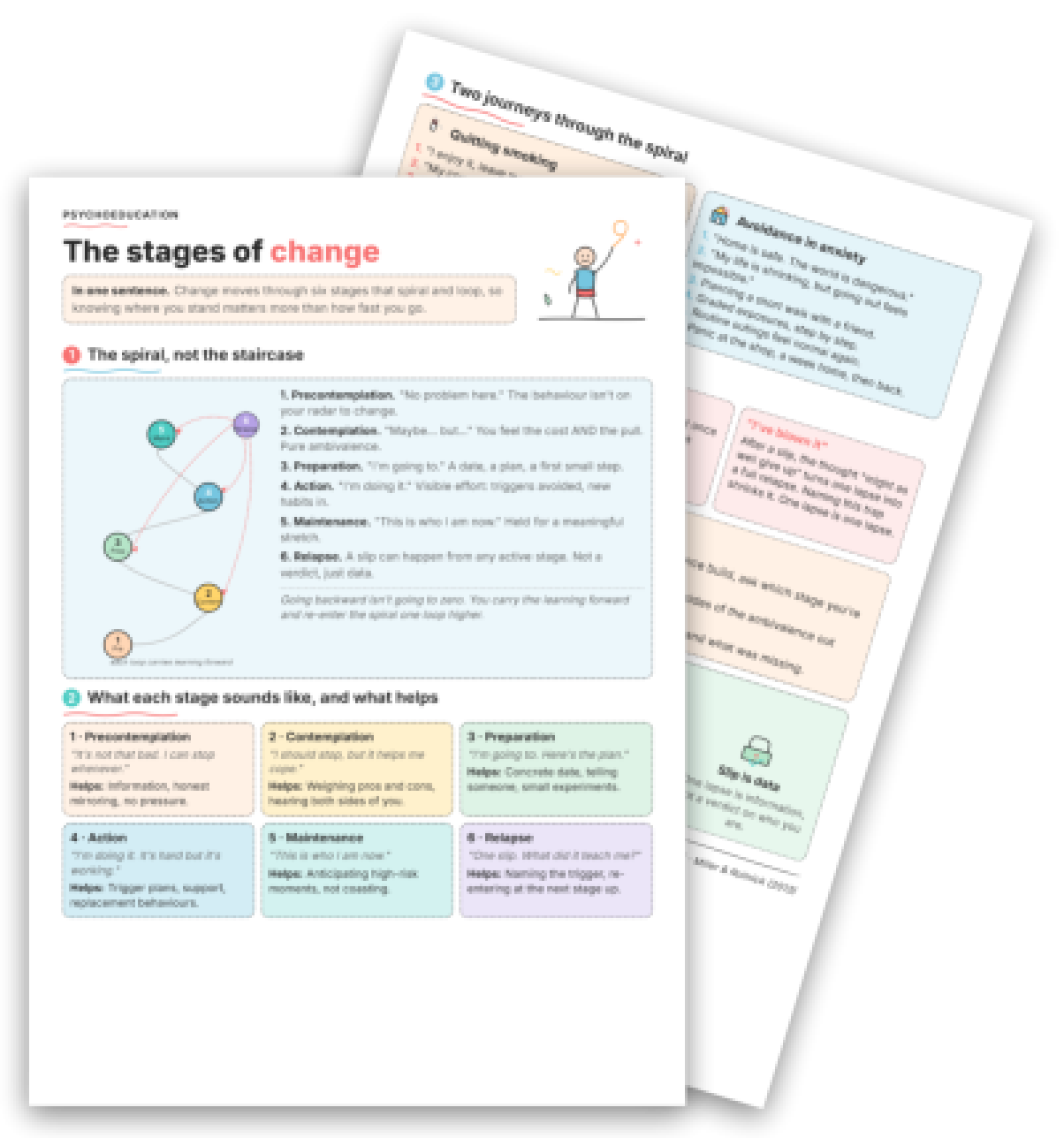
The fiche runs across four panels, each serving a distinct clinical function.
Panel 1 presents the spiral itself: six labeled stages from Precontemplation through Relapse, drawn not as a staircase but as a looping ascent, captioned "each loop carries learning forward." That single image encodes the non-linearity, the possibility of re-entry at a higher point, and the cumulative gain through apparent setbacks, faster than any verbal summary.
Panel 2 maps each stage to its characteristic patient voice and a brief clinical direction. "I should stop, but it helps me cope" lands in Contemplation; the fiche specifies "weighing pros and cons, hearing both sides of you" as the stage-matched move. You can point directly to the patient's language and locate them on the spiral together. Pair this panel with a decisional balance tool for contemplation-stage work, or a lapse and relapse management exercise once action has begun.
Panel 3 runs two full journeys through the spiral: quitting smoking and overcoming avoidance in anxiety. Both show the patient re-entering the spiral after a relapse at a structurally higher point, having carried learning forward. Clinicians working on changing avoidance patterns or building new habits will find this panel grounds abstract concepts in recognizable clinical trajectories.
Panel 4 names three traps: skipping to action before readiness is genuine, crushing ambivalence by silencing the resistant voice, and the "I've blown it" collapse from a single lapse into full relapse. The trap framing tends to land where moral or motivational framing fails. The closing "To discuss in session" section gives three verbatim clinical prompts you can use directly in the room.
> Key takeaway: This worksheet is a visual support that facilitates the explanation of the stages of change in session. It is not a self-administered questionnaire; it is a shared map the clinician uses to locate the patient precisely, match the intervention to the stage, and leave a concrete reference the patient takes home.
750+ clinical tools
A library built with and for clinicians, ready to use in session and extend between appointments.
Access all the toolsWhen and How to Introduce the Worksheet
The fiche fits naturally from the second or third session, once the initial case formulation is in place. It is particularly indicated when you observe:
- Explicit ambivalence: the patient articulates both the pull toward change and the pull away from it in the same breath
- Stage mismatch: action-level homework is being assigned to a patient clearly operating in contemplation
- Post-lapse shame: the patient returns after a slip and reads it as global failure
Introduce it without labeling the patient: "There's a model I find useful for understanding how change actually moves. Let me show you where I think we are right now, and I'd like your read on it." Work Panel 1 together before moving to Panel 2. The two journeys panel is especially useful when building discrepancy in Motivational Interviewing work or when treating a patient whose coping patterns are linked to addiction.
For patients managing relapse after behavioral change, Marlatt and Gordon's relapse model pairs well here: the spiral normalizes the lapse while Marlatt's high-risk situation mapping gives it behavioral precision. Exploring healthy versus maladaptive coping strategies can extend the conversation started by Panel 4's trap analysis. When motivational dip is the presenting issue rather than post-lapse shame, the motivational dip exercise offers a structured complement for between-session work.
Debrief by asking which stage the patient recognizes in themselves, and whether their self-placement matches yours. The discrepancy, when it exists, is often the most clinically productive moment in the session. The fiche does not replace the therapeutic alliance; it makes the structural logic of change visible, shareable, and worth returning to across the entire course of treatment.
Use it with your patients
Share this tool in the mobile app and follow the work between sessions.
Sources
- Prochaska, J. O., Norcross, J. C., DiClemente, C. C. (1994). Changing for Good: A Revolutionary Six-Stage Program for Overcoming Bad Habits and Moving Your Life Positively Forward. William Morrow.
- Levounis, P., Arnaout, B., Marienfeld, C. (2023). Stages of Change Theory. StatPearls, National Center for Biotechnology Information.
Your session continues in your patients' pocket
Use with a patientYour resources, available everywhere
The handouts, exercises, programs and audios above: you choose which ones to make available to your patients, in the mobile app dedicated to them.
And far more than a library
The app goes well beyond resources, to support your patients every day:
Related categories
Explore other clinical resources by category.

Anxiety
Clinical hub for anxiety disorders: CBT and ACT worksheets, psychoeducation sheets, and exercises for assessment and treatment across the anxiety spectrum.

Mood
Evidence-based worksheets and clinical tools for mood disorders: CBT, ACT, and positive psychology resources for psychologists and therapists.

Identity
Clinical resources for self-identity work in therapy: CBT, ACT, schema tools for clinicians addressing self-concept, core beliefs, and identity disruption.

Emotions
Clinical resources on emotion regulation: worksheets, coping tools, CBT, REBT, and ACT exercises for therapists working across diagnoses and age groups.

Behaviours
Clinical hub for behaviors in therapy: worksheets and tools for coping, eating disorders, CBT formulation, and maladaptive behavioral patterns.

Understand
Clinical hub for the therapeutic aim 'Understand': worksheets and tools to build patient insight across CBT, ACT, schema therapy and more.