
Clinical picture. A, a man in his early forties, presented with alcohol use at a mild-to-moderate level and persistent difficulty engaging with behavioural targets despite good verbal insight. He described his after-work drinking as 'obviously stupid,' yet remained unable to reduce it across several sessions. The clinician introduced the Cost/Benefit Analysis Worksheet, asking A to rate each box on a personal 1-to-10 scale rather than a moral one. A scored short-term relief at 9 and short-term cost (poor sleep) at 4, then paused when he reached long-term benefits: he wrote 'proof I can unwind without my wife's help' and rated it 8. That single entry shifted the conversation from willpower to autonomy, and the pair spent the next session designing an alternative decompression ritual that preserved the sense of self-sufficiency A had not previously named.
Cost/Benefit Analysis: PDF Worksheet, Tools and Exercises
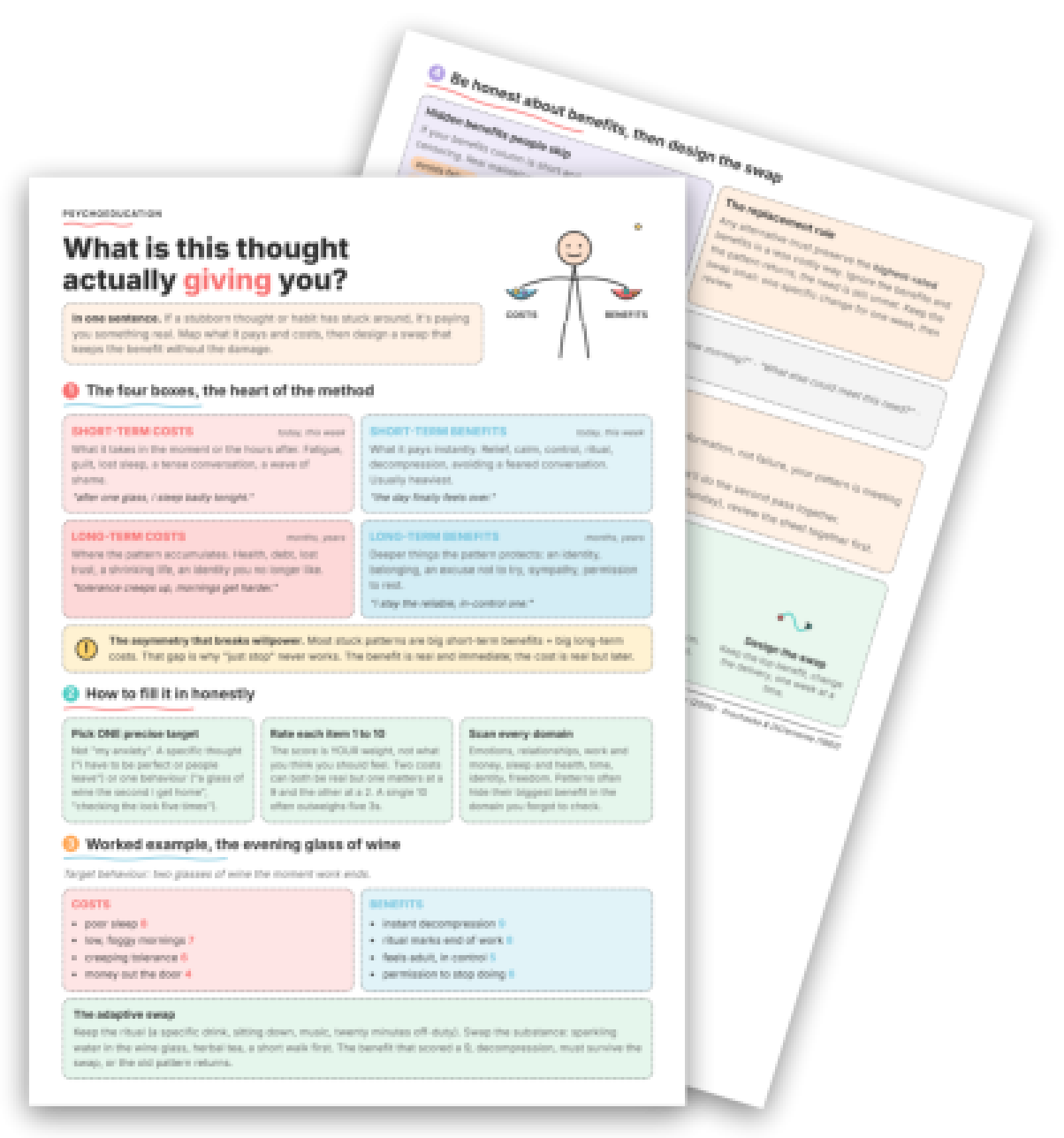
A structured visual PDF worksheet clinicians use in session to map the real payoff of a stuck thought or behavior, expose the short/long-term asymmetry, and design a genuine adaptive swap.
Clinical vignettes
Mapping the Payoff of Nightly Drinking
Perfectionism Thought Examined in Session
Clinical picture. M, a postgraduate student in her late twenties, met criteria for generalised anxiety and reported chronic procrastination driven by the thought 'if the work is not perfect, my supervisor will think I am a fraud.' Standard cognitive restructuring had produced limited change over four weeks. The clinician offered the worksheet targeting that specific thought rather than procrastination in general, and M completed the four boxes between sessions. She returned noting that the long-term benefit column surprised her: she had written 'the thought keeps me trying hard, which is the only thing I like about myself,' rated 10. This clarified that direct challenge to the belief felt threatening to her identity, and the clinical focus shifted toward building alternative sources of self-regard before attempting belief modification.
Patients caught in a maintaining pattern, nightly drinking, compulsive checking, systematic avoidance, frequently arrive knowing the behavior is costly and still unable to stop. Explaining ambivalence verbally rarely shifts that impasse. This PDF worksheet gives you a concrete visual structure to make the function of the pattern visible, in session, together.
Use this resource with your patients
Handout, exercises and materials ready to use, right inside SessionFuel.
Why Stuck Patterns Resist Explanation in Session
The standard clinical move is to name the cognitive or behavioral maintaining processes and invite the patient to weigh costs against benefits. Orally, this tends to produce a lopsided result: patients list costs readily (it's socially acceptable) and underreport benefits (shame, or genuine lack of awareness). What you end up with is a flat, moralistic accounting that confirms what the patient already "knows" without moving anything.
The deeper problem is temporal asymmetry. As the fiche makes explicit: "Most stuck patterns are big short-term benefits + big long-term costs." The benefit is immediate and visceral; the cost is real but deferred. That gap is precisely why behavioral injunctions, challenging avoidance, setting goals, building discrepancy in the spirit of motivational interviewing, land without traction if the benefit side of the ledger stays unnamed. The worksheet also flags a category clinicians know well: hidden benefits that patients censor in the consulting room, including "avoids failure," "excuse not to try," "permission to rest," or "punishes someone." Oral questioning rarely surfaces these; a grid with explicit prompts does.
This is also where the fiche connects naturally to building discrepancy work and to exploring the behavior's underlying emotional need. The cost/benefit map doesn't replace those frames; it makes them legible.
What the Fiche Contains: a Four-Box Visual Map
The PDF worksheet is organized around four quadrants: short-term costs, short-term benefits, long-term costs, long-term benefits. Each item is rated 1 to 10 by the patient, not by clinical consensus. The fiche explicitly instructs: "The score is YOUR weight, not what you think you should feel." That single instruction reorients the exercise away from moral judgment and toward functional analysis, which is the work.
A concrete worked example (two glasses of wine at the end of the workday) runs through the entire grid, with ratings already filled in, making it immediately usable as a teaching model during the session. It shows that a decompression benefit rated 9 will always outweigh a sleep cost rated 8 in the short term, even if the long-term accumulation is severe. That visual comparison does something that a verbal explanation cannot: it makes the asymmetry structural, not just conceptual.
The worksheet also includes a section on designing an adaptive swap, anchored to the replacement rule: any alternative must preserve the highest-rated benefits in a less costly form. If you ignore the benefit, the pattern returns because the underlying need remains unmet. This maps cleanly onto the Choice Point framework and onto adaptive versus maladaptive coping work. Four pocket questions are printed on the sheet for between-session use, including "What is this giving me right now?" and "What else could meet this need?"
> Key takeaway: The fiche is a visual support that facilitates in-session explanation of the cost/benefit mechanism. It is not a homework questionnaire the patient fills out alone; it is a psychoeducation tool the clinician uses jointly to make ambivalence visible, create shared vocabulary, and leave the patient with a concrete reference.
750+ clinical tools
A library built with and for clinicians, ready to use in session and extend between appointments.
Access all the toolsWhen and How to Introduce the Worksheet
The worksheet fits naturally from the second or third session onward, once you have a working formulation and at least one clearly identified maintaining behavior. It is particularly well-suited for presentations where evaluating the actual utility of a thought or habit is clinically central: addiction and substance use, OCD rituals, reassurance-seeking loops, avoidance in anxiety, or rigid REBT-style demands.
A workable introduction: "I'd like us to look at what this pattern is actually giving you, not just what it costs. Most patterns stick around because they're doing something useful. Let's map both sides together." Avoid framing it as an assessment of the patient's willpower or insight.
During debrief, watch for a short benefits column: that is the signal to revisit hidden benefits explicitly, using the fiche's own list as a prompt. A single high-rated item on either side often reorganizes the conversation entirely. The fiche closes with a "To discuss in session" block that guides this debrief, including the instruction to bring the sheet back "before a known high-risk moment," making it a living clinical tool rather than a one-session exercise.
One limit worth naming: for patients with severe risk-related decision distortions or active dissociation, the rating step can be experienced as destabilizing. Scaffold accordingly before introducing self-scored exercises.
The fiche does not replace the therapeutic frame; it makes the function of a pattern legible enough that genuine change work can begin.
Use it with your patients
Share this tool in the mobile app and follow the work between sessions.
Sources
- Janis, I. L., & Mann, L. (1977). Decision Making: A Psychological Analysis of Conflict, Choice, and Commitment. Free Press.
- Miller, W. R., & Rollnick, S. (2013). Motivational Interviewing: Helping People Change (3rd ed.). Guilford Press.
- Miller, W. R., & Rose, G. S. (2015). Motivational Interviewing and Decisional Balance: Contrasting Responses to Client Ambivalence.
Your session continues in your patients' pocket
Use with a patientYour resources, available everywhere
The handouts, exercises, programs and audios above: you choose which ones to make available to your patients, in the mobile app dedicated to them.
And far more than a library
The app goes well beyond resources, to support your patients every day:
Related categories
Explore other clinical resources by category.

Behaviours
Clinical hub for behaviors in therapy: worksheets and tools for coping, eating disorders, CBT formulation, and maladaptive behavioral patterns.

Cognition
Printable cognitive therapy worksheets and clinical tools for therapists: CBT, ACT, schema work, defusion, distortions, and belief restructuring.

Build awareness
Clinical worksheets and tools to build awareness in therapy: cognitive distortions, schemas, emotions, ACT and CBT resources for practitioners.

Restructure
Clinical hub for cognitive restructuring worksheets: distortion identification, belief disputation, ABC model, and schema work for evidence-based practice.

Engage & motivate
Clinical hub: printable worksheets and exercises to build therapeutic engagement and motivation across ACT, CBT, and integrative practice. For clinicians.

CBT
CBT worksheets, cognitive restructuring exercises & behavioral tools for clinicians. Evidence-based resources for every phase of cognitive behavioral therapy.