
Clinical picture. A, a woman in her late thirties, presents with recurrent panic attacks and a six-month history of progressively restricting her activities: she has stopped commuting by train and now works from home almost exclusively. In session four, the clinician introduces the four-quadrant vicious cycle diagram, walking through how cancelling train journeys brought rapid relief but prevented any disconfirmation of her belief that she would collapse in public. A recognised the pattern immediately, noting that her "safe zone" had halved in size since she first started avoiding. She agreed to map her own loop on the worksheet before the next session, identifying the short-term benefit column as the part she had never previously questioned. No commitment to behavioural change was pressed at this stage; the goal was simply recognition of the mechanism.
Vicious Cycle: Costs and Benefits: PDF Worksheet, Tools and Exercises
A visual psychoeducation tool helping clinicians map the short-term relief and long-term cost loop that keeps any presenting problem alive in session.
Clinical vignettes
Avoidance Maintaining Panic Disorder
Reassurance Seeking in Health Anxiety
Clinical picture. M, a man in his mid-forties referred by his GP, describes checking his blood pressure at home up to twelve times daily and sending weekly symptom summaries to his practice nurse. The clinician used the costs-and-benefits worksheet to help M plot the 90-second relief that followed each reading against the 90-day cost: his threshold for alarm had dropped steadily, and the absence of checking for even a few hours now produced intense discomfort. M initially pushed back, arguing that monitoring was responsible self-care rather than a coping response. Reviewing the long-term cost column together, he acknowledged that his confidence in tolerating physical sensations unaided had eroded markedly over two years. The worksheet framed subsequent discussion of a structured reduction in checking as logical rather than risky, which shifted the tenor of his engagement.
Most patients already suspect their avoidance or reassurance-seeking is backfiring. The clinical difficulty is not intellectual buy-in; it is getting them to see the mechanism clearly enough to act on it. This vicious cycle PDF worksheet gives you a concrete visual framework for exactly that, turning a conceptually slippery loop into a shared map you can build together in session.
Use this resource with your patients
Handout, exercises and materials ready to use, right inside SessionFuel.
Why the vicious cycle is hard to convey verbally
The core obstacle is temporal dissociation. Relief arrives in seconds, cost accumulates over months, and the nervous system is wired to weight immediate feedback far more heavily than diffuse long-run consequences. Saying "your avoidance is making things worse" tends to land as moral commentary rather than mechanistic insight.
A second problem: patients consistently underreport the payoff. They can name what avoidance costs them, but they struggle to articulate what it gives them. Without accounting for the benefit, the behavior's stickiness remains opaque, and the conversation about adaptive versus maladaptive coping feels like judgment. Clinically, you need both sides of the equation on the table before any real cost-benefit conversation is possible.
Verbal psychoeducation also conflates what are actually four distinct moments in a loop. Patients hear a continuous explanation; they need a spatial layout they can trace.
What the fiche contains: a four-quadrant loop and an eight-response taxonomy
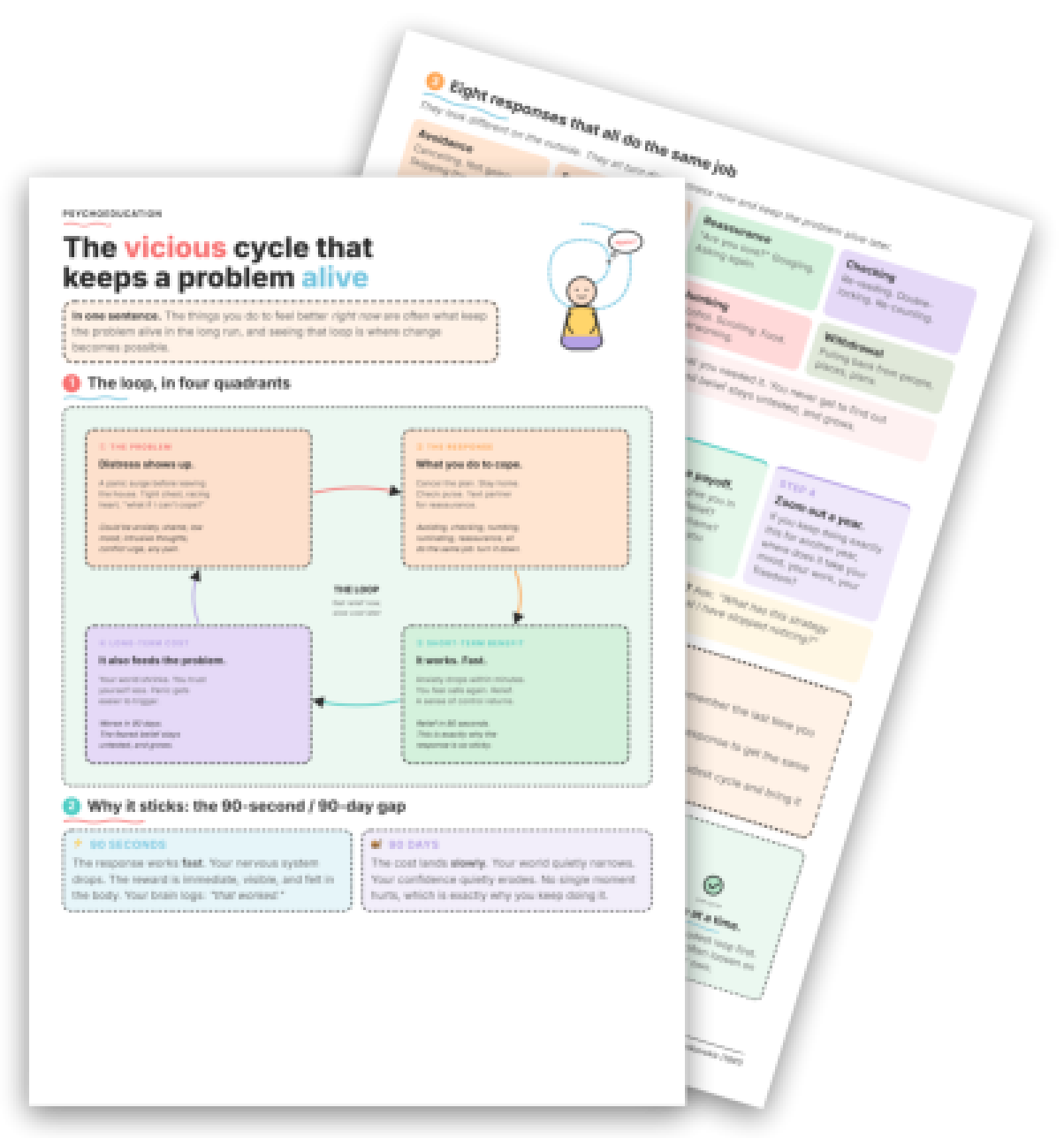
The fiche is structured around four labelled quadrants arranged as a closed circuit: ① The Problem (the triggering distress), ② The Response (the coping move), ③ Short-Term Benefit ("Relief in 90 seconds"), ④ Long-Term Cost ("Worse in 90 days"). The visual layout makes the loop self-evident. A patient can literally follow the arrows around the page, which no amount of verbal description replicates.
A dedicated section on the 90-second / 90-day gap then names precisely why the loop is so sticky: "The reward is immediate, visible, and felt in the body. Your brain logs: 'that worked.'" That formulation is clinically precise and immediately usable as a psychoeducation anchor with most presentations.
> To retain: this fiche is a visual support that facilitates the in-session explanation of the vicious cycle; it is not a questionnaire the patient completes alone, but a shared diagram that builds a common vocabulary and leaves them with a concrete reference between appointments.
The fiche then lists eight response types that all serve the same function: avoidance, safety behaviours, reassurance, checking, rumination, suppression, numbing, and withdrawal. Seeing them together on one page is often the moment a patient recognises their own pattern across domains they had treated as unrelated, a transdiagnostic insight that maps directly onto the CBT maintaining processes framework and onto what the psychological safety crutches sheet addresses from another angle.
A four-step mapping exercise closes the sheet: Name it narrowly (one cycle, one sheet), List the response including mental moves, Honour the payoff ("Without payoff, you wouldn't do it"), Zoom out a year. Two diagnostic prompts handle stuck patients: "What would I have to feel if I stopped doing this?" targets an empty Quadrant 3; "What has this strategy already cost me that I have stopped noticing?" targets an empty Quadrant 4. The schema maintenance vicious cycles sheet pairs naturally here for patients with entrenched early maladaptive schemas.
750+ clinical tools
A library built with and for clinicians, ready to use in session and extend between appointments.
Access all the toolsWhen and how to introduce the fiche
The fiche fits from session two or three onward, once initial formulation has surfaced the primary maintaining behaviour. It is broadly transdiagnostic: panic with safety behaviours, OCD with checking, social anxiety with avoidance loops, low mood with withdrawal, and any presentation where healthy versus unhealthy coping is already on the agenda.
Introduce it neutrally: "I want to show you a diagram that maps something we have been describing together, so we can look at it from the outside." Work through the four quadrants collaboratively before handing the sheet over. The "To discuss in session" prompts at the bottom are clinical decision points: use them to gauge readiness for a full cost-benefit analysis or to open a rationale for graded exposure.
One genuine contraindication: with patients in acute distress or in the very first sessions of a fragile alliance, foregrounding Quadrant 4 too early can activate shame rather than curiosity. Pace the long-term cost discussion accordingly, and consider confronting avoidance or a habituation rationale as the next clinical step once the loop is named and owned.
The fiche does not replace the clinical scaffolding; it makes that scaffolding legible to the patient before you build it together.
Use it with your patients
Share this tool in the mobile app and follow the work between sessions.
Sources
- Salkovskis, P. M. (1991). The Importance of Behaviour in the Maintenance of Anxiety and Panic: A Cognitive Account. Behavioural Psychotherapy, 19(1), 6-19.
- Tolin, D. F. (2016). Doing CBT: A Comprehensive Guide to Working with Behaviors, Thoughts, and Emotions. The Guilford Press.
Your session continues in your patients' pocket
Use with a patientYour resources, available everywhere
The handouts, exercises, programs and audios above: you choose which ones to make available to your patients, in the mobile app dedicated to them.
And far more than a library
The app goes well beyond resources, to support your patients every day:
Related categories
Explore other clinical resources by category.

Anxiety
Clinical hub for anxiety disorders: CBT and ACT worksheets, psychoeducation sheets, and exercises for assessment and treatment across the anxiety spectrum.

Mood
Evidence-based worksheets and clinical tools for mood disorders: CBT, ACT, and positive psychology resources for psychologists and therapists.

Relationships
Clinical worksheets and tools on relational functioning: attachment, schemas, assertiveness, and communication skills for therapists. Printable PDF resources.

Cognition
Printable cognitive therapy worksheets and clinical tools for therapists: CBT, ACT, schema work, defusion, distortions, and belief restructuring.

Build awareness
Clinical worksheets and tools to build awareness in therapy: cognitive distortions, schemas, emotions, ACT and CBT resources for practitioners.

Restructure
Clinical hub for cognitive restructuring worksheets: distortion identification, belief disputation, ABC model, and schema work for evidence-based practice.