
Clinical picture. T., a man in his mid-thirties, presents with persistent social anxiety that has escalated since a recent promotion placed him in more frequent team meetings. History-taking reveals chronic teasing throughout secondary school, from which he drew the enduring core belief that he is fundamentally uninteresting and likely to embarrass himself in groups. Using the two-layer psychoeducation sheet, the clinician maps the past layer (school humiliation, crystallised belief: "people find me boring") onto the present maintenance cycle: a colleague's neutral silence during a meeting triggers selective attention to facial expressions, fuels the prediction "they wish I would stop talking," produces shame and a hot flush, and ends in T. cutting his contributions short. Once T. could see the loop drawn out in full, he identified that leaving meetings early had never actually tested his prediction, and he agreed to a brief behavioural experiment the following week.
CBT Maintaining Processes: PDF Worksheet, Tools and Exercises
A printable visual aid helping clinicians explain, in session, how past beliefs and present maintenance cycles keep psychological difficulties alive.
Clinical vignettes
Old Belief, Present Loop in Social Anxiety
Perfectionist Belief Sustaining Low Mood
Clinical picture. A., a woman in her late forties referred for persistent low mood, describes a childhood in which emotional warmth from her mother was consistently conditional on high achievement. The clinician introduces the past-and-present worksheet to externalise the pattern rather than explore it purely through narrative. The past layer shows a critical parenting environment crystallising the assumption "unless I perform perfectly, I am worthless"; the present layer shows a recurring cycle in which a minor administrative error at work triggers prolonged self-focused rumination, selective recall of past failures, a heavy dysphoric state, and progressive withdrawal from colleagues. A. noted, with some surprise, that the worksheet made the loop feel less like a character flaw and more like a learned mechanism, which opened space to discuss where behavioural activation might interrupt the cycle at step five.
Explaining the link between a patient's history and their current symptoms is one of those explanations that sounds clean in supervision and lands poorly in the room. This CBT PDF worksheet gives you a precise visual scaffold for that conversation, one you can walk through together rather than narrate into the air.
Use this resource with your patients
Handout, exercises and materials ready to use, right inside SessionFuel.
Why CBT Maintaining Processes Resist Oral Explanation
The clinical challenge is not conceptual. Most patients follow the logic of core beliefs when you describe it step by step. What they struggle to hold is the simultaneity: the idea that an old belief formed under a critical parent or a school humiliation is, right now, in this session, quietly filtering which events feel threatening and keeping a five-node cycle spinning. Laid out verbally, it reads as a sequence. What patients miss is that it is a loop, self-reinforcing, feeding itself moment by moment, and that the past and present layers are not two separate stories but one integrated mechanism.
Patients also tend to hear historical explanations as blame assignments. Without a visual anchoring the distinction, the phrase "your past shapes your present" easily collapses into "your parents are responsible for your suffering", which closes things down rather than opening them. The fiche addresses that directly.
What the Fiche Contains: A Two-Layer Visual Map
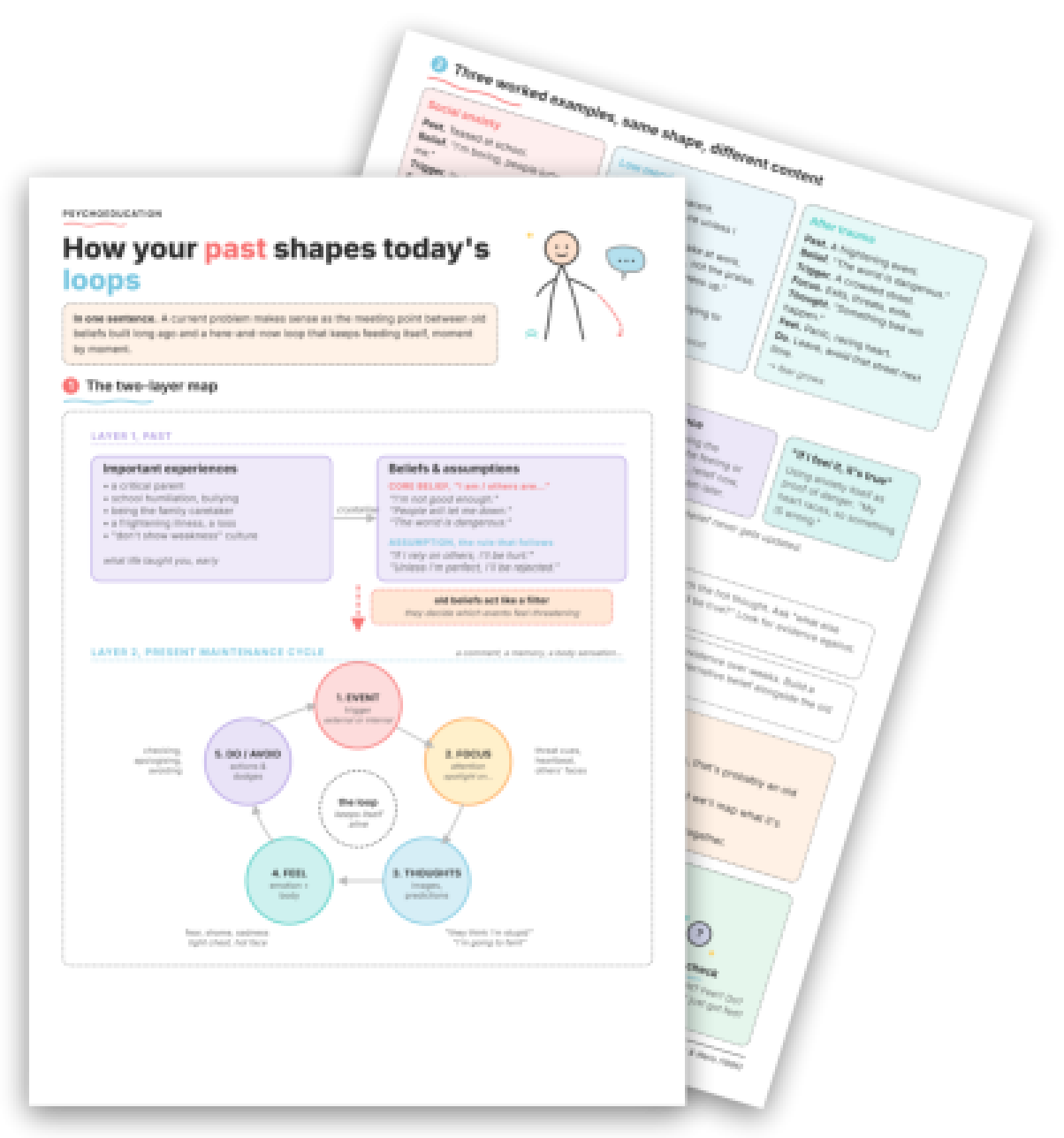
The fiche opens with its premise in a single sentence: "A current problem makes sense as the meeting point between old beliefs built long ago and a here-and-now loop that keeps feeding itself, moment by moment." That sentence alone is worth reading aloud with the patient before turning the page.
The two-layer map is the structural centre of the worksheet. Layer 1 (Past) shows how specific experiences, "a critical parent," "school humiliation," "being the family caretaker", crystallise into core beliefs ("I'm not good enough", "people will let me down") and conditional assumptions ("unless I'm perfect, I'll be rejected"). An arrow then shows how those beliefs act as a perceptual filter feeding into Layer 2. Layer 2 (Present) displays the five-node maintenance cycle: event, focus, thoughts, feel, do/avoid, with concrete examples in each node (e.g., "scanning faces for boredom" under Focus, "checking, apologising, avoiding" under Do/Avoid). The loop arrow closing the cycle makes visually explicit what oral explanation rarely conveys: the cycle has no natural exit.
Three worked examples follow, social anxiety, low mood, and post-trauma presentation, each tracing the same architecture through different clinical content. A patient who does not recognise themselves in one example often does in another. The fiche then names four engines that maintain the loop: attentional bias, safety behaviours, avoidance, and emotional reasoning ("if I feel it, it's true"). The final panel maps four intervention nodes, attention, thoughts, behaviour, and beliefs, each with a brief practical prompt, plus a "To discuss in session" block with three specific conversation starters.
> To note: This fiche is a visual support that facilitates the psychoeducation conversation in session. It is not a self-administered questionnaire. Its value is in sitting with the patient and moving through the layers together, building a shared language for the formulation.
750+ clinical tools
A library built with and for clinicians, ready to use in session and extend between appointments.
Access all the toolsWhen and How to Propose This Worksheet
The natural moment is after the initial anamnèse, once you have enough historical material to personalise the map but before the patient is deep in active skills-based work. You can introduce it simply: "I'd like to show you a diagram that maps how the things you've been describing fit together. It won't tell you anything you don't already know, but it puts it in a shape that's easier to work with."
For patients who intellectualise or who have already seen the CBT cognitive model elsewhere, the two-layer structure adds the historical dimension that transdiagnostic CBT models often flatten. For patients with low self-esteem, social anxiety, perfectionism, or presentations with a clear schema-level driver, the Layer 1 content tends to land with significant recognition.
Use the three worked examples as a selection exercise: ask the patient which scenario feels closest, then rebuild the cycle with their own material in the margins. The "Remember" block at the foot of the fiche, "Logical, not crazy", "One node at a time", "Not blame", is worth reading together before the patient takes it home. It pre-empts the most common distortions of psychoeducation and leaves them with a self-check question: "Focus? Thought? Feel? Do? Which old belief just got fed?"
For patients who find automatic thoughts elusive or who benefit from tracing belief origins, this worksheet pairs naturally with a downward-arrow exercise, a core belief clarification tool, or the longitudinal case formulation (5 Ps) as a more structured formulation companion. The fiche does not replace those tools, it makes the patient ready for them.
Use it with your patients
Share this tool in the mobile app and follow the work between sessions.
Sources
- Beck, J. S. (2020). Cognitive Behavior Therapy: Basics and Beyond. Guilford Press.
- Kuyken, W., Padesky, C. A., & Dudley, R. (2009). Collaborative Case Conceptualization: Working Effectively with Clients in Cognitive-Behavioral Therapy. Guilford Press.
- Salkovskis, P. M. (1991). The importance of behaviour in the maintenance of anxiety and panic: A cognitive account. Behavioural and Cognitive Psychotherapy.
- Beck, A. T., Rush, A. J., Shaw, B. F., & Emery, G. (1979). Cognitive Therapy of Depression. Guilford Press.
Your session continues in your patients' pocket
Use with a patientYour resources, available everywhere
The handouts, exercises, programs and audios above: you choose which ones to make available to your patients, in the mobile app dedicated to them.
And far more than a library
The app goes well beyond resources, to support your patients every day:
Related categories
Explore other clinical resources by category.

Anxiety
Clinical hub for anxiety disorders: CBT and ACT worksheets, psychoeducation sheets, and exercises for assessment and treatment across the anxiety spectrum.

Trauma
Clinical hub on trauma and PTSD: assessment, differential diagnosis, treatment phases, and printable resources for practitioners. 155 chars.

Mood
Evidence-based worksheets and clinical tools for mood disorders: CBT, ACT, and positive psychology resources for psychologists and therapists.

Cognition
Printable cognitive therapy worksheets and clinical tools for therapists: CBT, ACT, schema work, defusion, distortions, and belief restructuring.

Understand
Clinical hub for the therapeutic aim 'Understand': worksheets and tools to build patient insight across CBT, ACT, schema therapy and more.

Build awareness
Clinical worksheets and tools to build awareness in therapy: cognitive distortions, schemas, emotions, ACT and CBT resources for practitioners.