
A., a woman in her early 40s, presented with persistent work-related anxiety and difficulty sleeping, describing her distress as 'coming out of nowhere.' During the second session, the clinician introduced the 5 Ps framework as a shared working document, inviting her to place her childhood experience of conditional praise under Predisposing factors and to articulate the core belief 'I am only acceptable when I perform flawlessly.' Mapping the Precipitating trigger (a lukewarm quarterly review) onto the Presenting loop of rumination, avoidance, and shame gave A. a visible logic for symptoms she had previously experienced as random. By the fourth session she had begun drafting a revised rule for living, and reported modest but consistent improvement in her willingness to submit work without repeated checking.
Longitudinal Case Formulation (5 Ps): PDF Worksheet, Tools and Exercises
A visual PDF worksheet clinicians can use in session to map predisposing factors, core beliefs, triggers, and protective resources with patients.
Clinical vignettes
Mapping Perfectionism Across Sessions
Formulation as Entry Point for a Reluctant Client
T., a man in his late 20s, was referred following a second episode of low mood and was openly sceptical about therapy, saying he did not see the point of 'talking about the past.' The clinician used the 5 Ps structure not as a historical excavation but as a practical map, starting with Presenting problems and Protective factors before moving to earlier layers. When T. noticed that an Old Rule ('If I never ask for help, no one can use my weakness against me') connected early experiences of an unpredictable home to his current social withdrawal, his engagement shifted noticeably. He did not arrive at a reformulated rule within the session, though he agreed to keep the worksheet and return with observations, which he did.
Most patients arrive with a convincing sense that their difficulties came from nowhere. Presenting the 5 Ps longitudinal formulation verbally, without any visual scaffold, rarely shifts that perception: the clinician speaks, the patient nods, and the historical thread stays invisible. This fiche PDF gives you a shared map to draw on together in session, so that the causal architecture of the patient's difficulties becomes something they can see, not just hear.
Use this resource with your patients
Handout, exercises and materials ready to use, right inside SessionFuel.
Why the 5 Ps Resist an Oral Explanation
The longitudinal case formulation is conceptually familiar to every practitioner trained in CBT, schema therapy, or any model drawing on Persons (2008) or Johnstone and Dallos (2014). The clinical challenge is not theoretical: it is the gap between what you hold in your head and what the patient can actually integrate. When you narrate the model verbally, patients often hear a list of problems rather than a connected story. They lose the vertical logic: that a predisposing environment generates a core belief, which hardens into an old rule for living, which then becomes brittle when a precipitating trigger arrives and the presenting symptoms erupt.
Without a visual, the distinction between predisposing and precipitating collapses. Protective factors get mentioned last and forgotten first. And the concept of an If/Then rule, so central to schema-informed work, floats without a hook. The fiche anchors all of this on a single page.
What the Fiche Contains: A Visual Map of the Patient's History
The fiche PDF is structured across three panels, all strictly grounded in the Macneil (2012) and Johnstone and Dallos (2014) tradition.
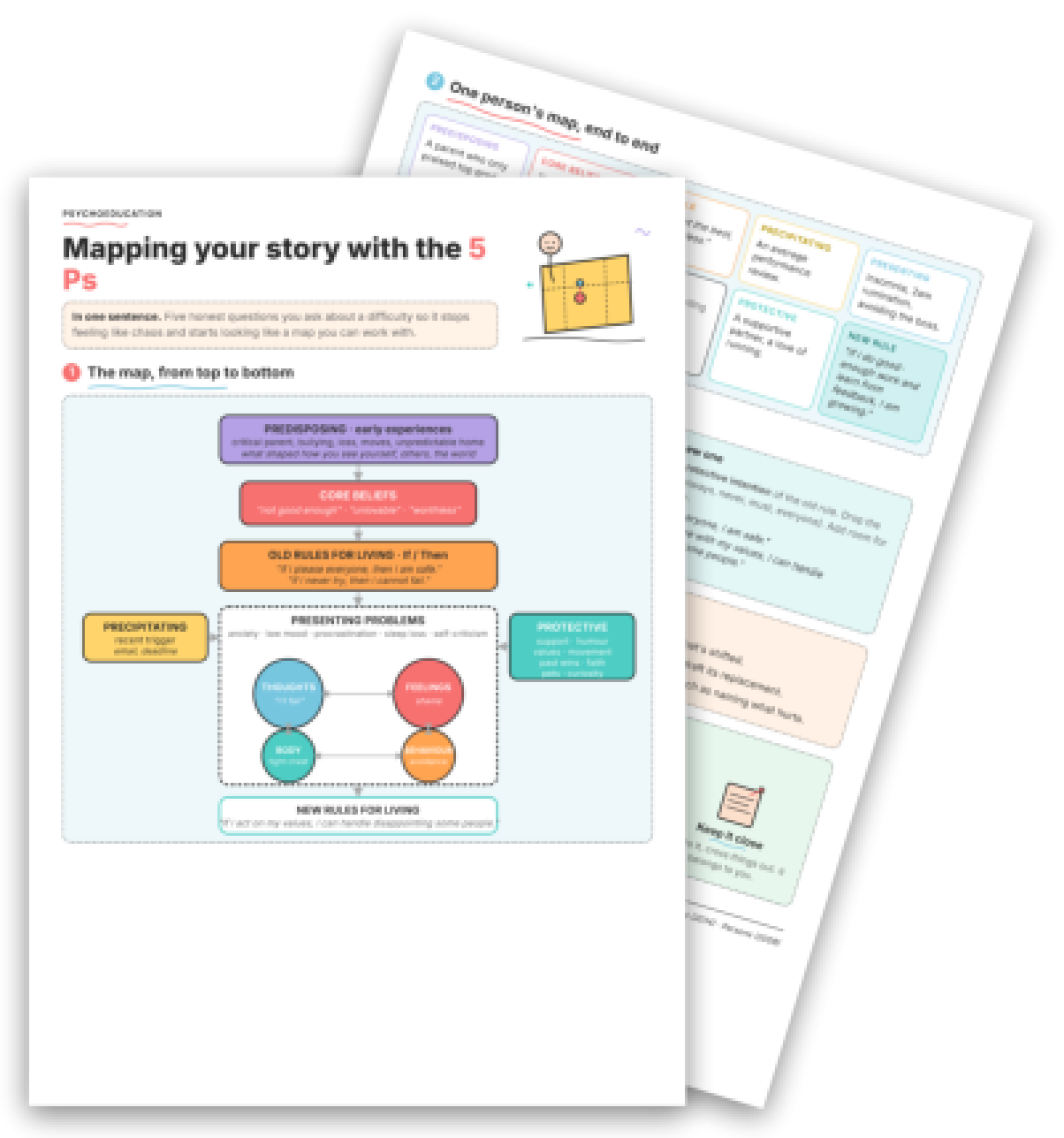
Panel 1 presents the full model top to bottom: Predisposing factors (early experiences such as "critical parent, bullying, loss, unpredictable home") flow into core beliefs ("not good enough," "unlovable," "worthless"), then into old rules for living in explicit If/Then form ("If I please everyone, then I am safe"). Below the midpoint sit the Precipitating trigger, the Presenting problems with their four-part loop (thoughts, feelings, body, behaviour), and finally the Protective factors: support, humour, movement, past wins. A space at the bottom invites a new rule for living to replace the old one.
Panel 2 runs a fully worked example end to end, showing how a parent who "only praised top grades" seeds the belief "I am not good enough," the rule "If I'm not the best, I'm worthless," and an eventual presenting picture of insomnia, rumination, and boss avoidance. This worked example is what makes the first panel clinically legible: patients see the logic instantiated before applying it to themselves.
Panel 3 moves to intervention: testing the old rule with three targeted questions ("Is this rule actually working for me? What does it cost me? What does it give me?"), identifying behavioural signs that the rule is active (over-apologising, perfectionism, people-pleasing, self-silencing, harsh inner voice after small mistakes), and drafting a replacement that keeps the rule's protective intention while removing the absolutes. Three "To discuss in session" prompts close the panel, making it explicit that this is collaborative work, not solo homework.
> Key point: the fiche is a visual support that facilitates the explanation of longitudinal case formulation in session. It is not a self-report questionnaire; it is an in-session psychoeducation tool that leaves the patient with a concrete, personal map they can return to between appointments.
750+ clinical tools
A library built with and for clinicians, ready to use in session and extend between appointments.
Access all the toolsWhen and How to Introduce This Fiche
Timing. The fiche fits naturally from the second or third session onward, once you have enough anamnesis to sketch the predisposing column alongside the patient. Introducing it too early, before the alliance is established, risks the patient reading it as a diagnostic verdict rather than a working hypothesis.
Profiles. It is particularly useful in schema-focused presentations, chronic low self-esteem (pair it with core belief clarification work), approval-seeking patterns, perfectionism, and any presentation where the patient frames their difficulties as character flaws rather than learned adaptations. It also supports tracing a distressing automatic thought back to its underlying belief once the map is established.
How to frame it. A low-pathologising introduction might be: "I'd like to sketch out a kind of map with you, looking at where some of these patterns might have come from and what keeps them going. It's a working hypothesis, not a verdict." Walk through panel 1 together, then use panel 2 as an illustration before turning to the patient's own story. Leave the new rule section blank at first; return to it when you work on replacing a negative core belief and reinforcing its alternative.
Debrief. At the next session, ask what the patient noticed re-reading the map: which label surprised them, which felt accurate immediately, which felt wrong. Resistance to a predisposing factor or protective label is clinically rich material. Use the origins of beliefs exercise or a guided core beliefs self-reflection to deepen what the map surfaces. For the behavioural layer, automatic thought monitoring and adaptive versus maladaptive coping mapping integrate cleanly with the presenting section.
One limit to name: with patients in acute crisis or with significant dissociative features, a full longitudinal map can feel destabilising before adequate window-of-tolerance work is in place. Prioritise stabilisation first.
The fiche does not replace the formulation you carry in your clinical reasoning; it gives the patient access to a version of it, and that shared visibility is precisely what allows lasting work on the beliefs underneath the behaviour.
Use it with your patients
Share this tool in the mobile app and follow the work between sessions.
Sources
- Persons, J. B. (1989). Cognitive Therapy in Practice: A Case Formulation Approach. W. W. Norton and Company.
- Beck, J. S. (1995). Cognitive Behavior Therapy: Basics and Beyond. Guilford Press.
- Persons, J. B. (2008). The Case Formulation Approach to Cognitive-Behavior Therapy. Guilford Press.
- Kuyken, W., Padesky, C. A., Dudley, R. (2009). Collaborative Case Conceptualization: Working Effectively with Clients in Cognitive-Behavioral Therapy. Guilford Press.
Your session continues in your patients' pocket
Use with a patientYour resources, available everywhere
The handouts, exercises, programs and audios above: you choose which ones to make available to your patients, in the mobile app dedicated to them.
And far more than a library
The app goes well beyond resources, to support your patients every day:
Related categories
Explore other clinical resources by category.

Anxiety
Clinical hub for anxiety disorders: CBT and ACT worksheets, psychoeducation sheets, and exercises for assessment and treatment across the anxiety spectrum.

Mood
Evidence-based worksheets and clinical tools for mood disorders: CBT, ACT, and positive psychology resources for psychologists and therapists.

Identity
Clinical resources for self-identity work in therapy: CBT, ACT, schema tools for clinicians addressing self-concept, core beliefs, and identity disruption.

Cognition
Printable cognitive therapy worksheets and clinical tools for therapists: CBT, ACT, schema work, defusion, distortions, and belief restructuring.

Build awareness
Clinical worksheets and tools to build awareness in therapy: cognitive distortions, schemas, emotions, ACT and CBT resources for practitioners.

Restructure
Clinical hub for cognitive restructuring worksheets: distortion identification, belief disputation, ABC model, and schema work for evidence-based practice.