
Clinical picture. M., a 34-year-old marketing manager, presents with recurrent low mood and a persistent sense of emptiness despite objective professional success. He describes a pattern of working intensely before team presentations, monitoring colleagues' reactions in real time, and feeling a brief lift when praised, followed within hours by a return to flatness and a need to seek the next endorsement. In session, the clinician uses the informational sheet to name the hollow loop: the need, the performance, the fleeting reaction, and the return of the need louder than before. M. recognises the cycle immediately and notes, unprompted, that he has no clear sense of what he values when no one is watching. This shared conceptual frame becomes the basis for exploring where the equation between visibility and worth first formed.
Approval & Admiration Seeking Schema: PDF Worksheet, Tools and Exercises
A visual PDF worksheet to help clinicians explain the approval-seeking schema in session, map the hollow loop, and open schema therapy work with concrete psychoeducation.
Clinical vignettes
Praise That Never Quite Lands
Withdrawal as a Hidden Strategy
Clinical picture. L., a 28-year-old doctoral candidate, was referred after pulling back from her research group following a supervisor's mildly critical email. She had stopped attending optional seminars and described the withdrawal as indifference, yet reported checking her supervisor's published output and social media daily. The clinician introduces the avoidance coping mode from the schema sheet: stepping away from the very person whose approval is most wanted, while the longing remains intact. L. sits quietly for a moment and says the description feels uncomfortably accurate. The exchange opens space to examine how avoidance protects against anticipated rejection without reducing the underlying need, which then returns at the next significant evaluation moment.
Explaining the approval and admiration seeking schema verbally rarely lands on the first attempt. Patients tend to agree intellectually, then continue performing, shape-shifting, and scanning for reactions with the same intensity as before. This PDF worksheet gives you a concrete visual anchor: a structured psychoeducation support you can use directly in session to make the schema's mechanics visible and discussable.
Use this resource with your patients
Handout, exercises and materials ready to use, right inside SessionFuel.
Why This Schema Is Hard to Explain Without a Visual Support
The core difficulty is that approval-seeking feels like rational behaviour from the inside. Patients do not come in saying "I am addicted to external validation"; they come in describing exhaustion, relational frustration, or a nagging sense that even recognised achievements feel somehow flat. The schema operates below the level of conscious strategy, which means a verbal explanation can be heard as a personality critique rather than a named psychological mechanism.
There is a second layer. The paradox at the centre of the schema (the more you perform for approval, the less you can feel it when it arrives) is genuinely counterintuitive. Stating it aloud produces polite agreement. Showing it as a closed loop on a printed diagram produces recognition. That shift, from intellectual acquiescence to felt identification, is what the visual support makes possible.
Patients who present with low self-esteem, social anxiety, or the impostor syndrome pattern often carry a variant of this schema without having a name for it. The fiche gives you the vocabulary to introduce it cleanly, without pathologising tone.
750+ clinical tools
A library built with and for clinicians, ready to use in session and extend between appointments.
Access all the toolsWhat the Fiche Contains: A Session-Ready Visual Map
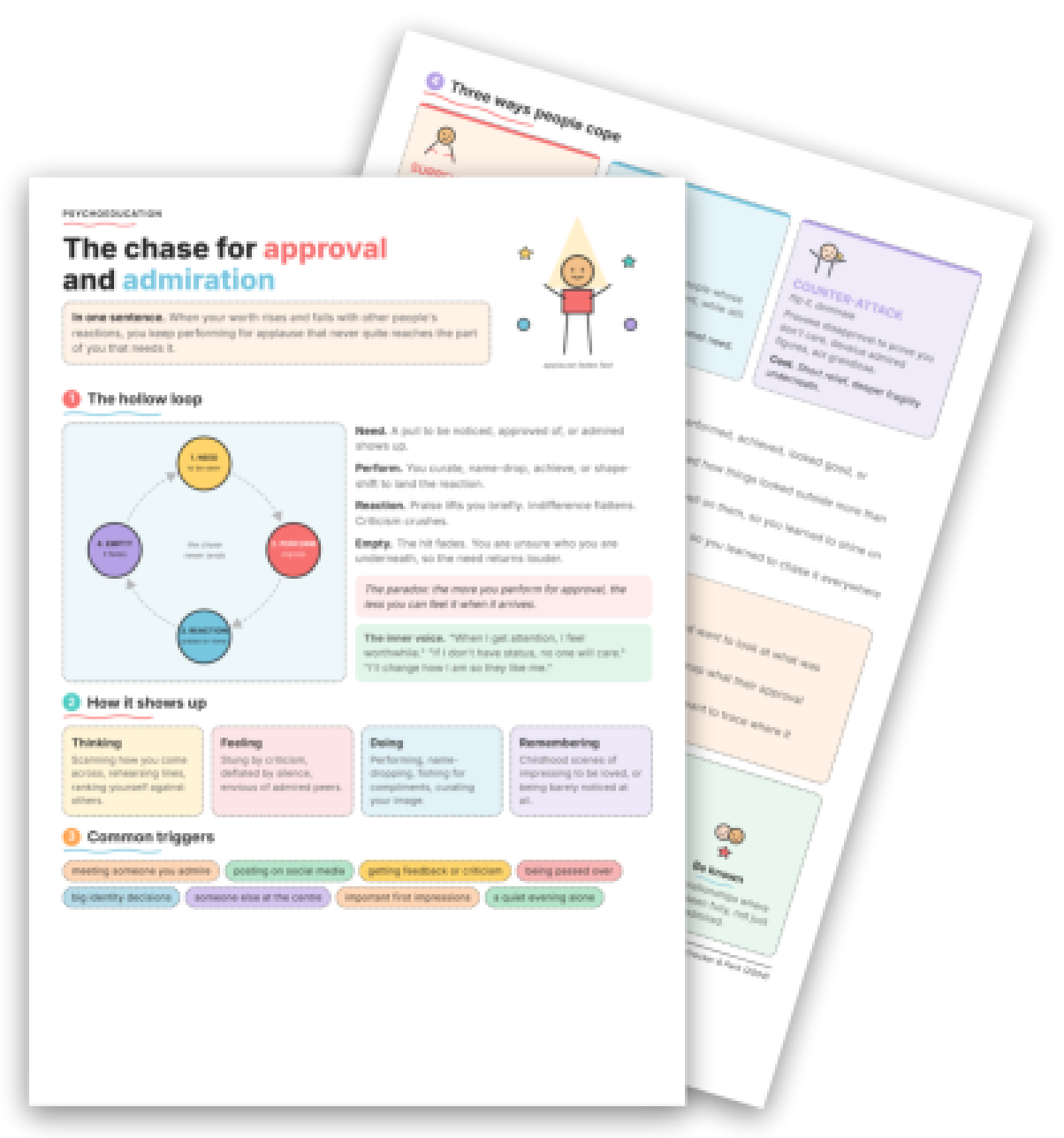
The PDF worksheet is structured around five panels, each targeting a distinct clinical function.
- The hollow loop: a four-step cycle (Need, Perform, Reaction, Empty) rendered as a diagram, making the self-perpetuating logic of the schema immediately visible. The caption captures the clinical core precisely: "the more you perform for approval, the less you can feel it when it arrives."
- How it shows up: a four-domain grid covering Thinking, Feeling, Doing, and Remembering. This format naturally leads into a brief functional analysis and often surfaces material patients had not previously connected (for instance, the "childhood scenes of impressing to be loved" framed under Remembering).
- Common triggers: eight concrete situations (posting on social media, getting feedback, being passed over, a quiet evening alone) that make the schema tangible rather than abstract, and are directly usable as between-session self-monitoring prompts.
- Three coping modes: Surrender, Avoidance, and Counter-attack, each with its behavioural signature and stated cost. This panel maps onto schema mode work and lets you introduce the range of ACT schemas and coping modes as a natural extension.
- Developmental origins: four pathways (conditional love, family emphasis on appearances, a reflective role, scarce attention) framed in plain language. You can use this panel to open belief origin tracing without it feeling like an interrogation.
- To discuss in session: three prompts co-written from the patient's vantage point, designed to structure the in-session debrief rather than serve as autonomous homework.
> Key point: the worksheet is a visual support that facilitates explanation in session, not a self-administered questionnaire. You guide the patient through it; they leave with a concrete reference document that names what you have just worked on together.
Use it with your patients
Share this tool in the mobile app and follow the work between sessions.
When and How to Introduce the Fiche
Timing matters. The fiche works best from the second or third session onward, once a working alliance is established and an initial formulation is taking shape. Introducing it earlier risks reducing it to a checklist; introducing it later, when the schema is already a shared concept, adds less.
For patients who present with constant social comparison and self-criticism, the hollow loop panel is the natural entry point. For patients whose identity feels fragmented by performance pressure, the developmental origins panel opens work that connects to clarifying core beliefs and, later, to reinforcing an alternative belief.
A useful framing: "I'd like to show you something that describes a pattern a lot of people recognise. We'll go through it together, and you tell me what fits." This positions the diagram as a shared inquiry rather than a verdict.
Debrief by sitting with the panel the patient reacted to most, particularly the hollow loop or the coping modes. The approval-seeking self-reflection exercise makes a strong follow-up assignment once the schema is named and the patient can observe it live. For patients who also show perfectionism or self-deprecation in relational contexts, the coping mode section opens naturally into those adjacent themes.
One practical limit: patients with strong counter-attack or grandiose presentations may initially reject the schema as irrelevant. In those cases, introduce the fiche later, after the fragility beneath the defence has had space to surface in session.
The fiche does not replace formulation or alliance; it sharpens both by giving you and your patient a shared map to return to as the work deepens.
Your session continues in your patients' pocket
Use with a patientYour resources, available everywhere
The handouts, exercises, programs and audios above: you choose which ones to make available to your patients, in the mobile app dedicated to them.
And far more than a library
The app goes well beyond resources, to support your patients every day:
Related categories
Explore other clinical resources by category.

Identity
Clinical resources for self-identity work in therapy: CBT, ACT, schema tools for clinicians addressing self-concept, core beliefs, and identity disruption.

Cognition
Printable cognitive therapy worksheets and clinical tools for therapists: CBT, ACT, schema work, defusion, distortions, and belief restructuring.

Understand
Clinical hub for the therapeutic aim 'Understand': worksheets and tools to build patient insight across CBT, ACT, schema therapy and more.

Build awareness
Clinical worksheets and tools to build awareness in therapy: cognitive distortions, schemas, emotions, ACT and CBT resources for practitioners.

Restructure
Clinical hub for cognitive restructuring worksheets: distortion identification, belief disputation, ABC model, and schema work for evidence-based practice.

CBT
CBT worksheets, cognitive restructuring exercises & behavioral tools for clinicians. Evidence-based resources for every phase of cognitive behavioral therapy.