
Clinical picture. A, a woman in her mid-thirties, presents with persistent low self-esteem and a pattern of self-deprecating remarks in professional settings; she reports systematically minimising her contributions when colleagues are present. The clinician introduces the four-question exercise as a between-session task, asking her to anchor it to a specific recent meeting in which she had dismissed her own proposal before anyone else could respond. On returning the following week, A had identified two concrete instances of competence she had previously discounted, and had drafted a rewritten version of the scene in which she stated her idea without preemptive apology. She noted, cautiously, that the rewriting felt unfamiliar but not implausible, which opened a productive discussion about the gap between perceived and actual standing among peers.
Self-Deprecation in Social Interactions: A Clinical Exercise
A structured four-question homework exercise helping patients catch self-diminishing patterns, reclaim their value, and rewrite the narrative.
Clinical vignettes
Reclaiming Value After a Team Meeting
Self-Diminishment in a Social Gathering
Clinical picture. M, a man in his late twenties with generalised anxiety and a longstanding habit of self-belittling jokes in group settings, had difficulty pinpointing what he actually gained from this pattern. The clinician assigned the exercise after a session in which M described deflecting a compliment at a friend's dinner by calling himself the least accomplished person in the room. Working through the questions between sessions, M listed several areas where he assessed himself as competent or equal to those present, a step he described as genuinely uncomfortable. His rewritten account of the dinner scene was brief and hedged, yet it contained no self-directed put-downs, which the clinician used as a basis for examining the protective function the original behaviour had served.
The Clinical Need: When Self-Deprecation Becomes a Reflex
Many patients do not experience self-deprecation as a choice. It happens automatically, at the moment someone compliments them, challenges them, or simply stands near them. They shrink. They qualify. They deflect. By the time they are back in your consulting room, they cannot always recall what they said or why they said it, only that they left the encounter feeling smaller.
The difficulty is not explaining the concept. You can introduce low self-esteem through Fennell's CBT model, map the defectiveness or shame schema, or explore social comparison dynamics with clarity. What is harder to produce in session is the moment of arrested movement, the pause where a patient actually stops, reconstructs the scene, and finds evidence of their own worth inside it. That requires time, solitude, and a structured prompt. It requires homework.
This exercise is built for patients who minimize their strengths reflexively, particularly in social and interpersonal contexts: those who disqualify compliments (see Difficulty Accepting Compliments), over-correct for perceived inadequacy, or compare themselves unfavorably even when the evidence does not warrant it (see Constant Social Comparison).
Use this resource with your patients
Handout, exercises and materials ready to use, right inside SessionFuel.
What the Exercise Contains
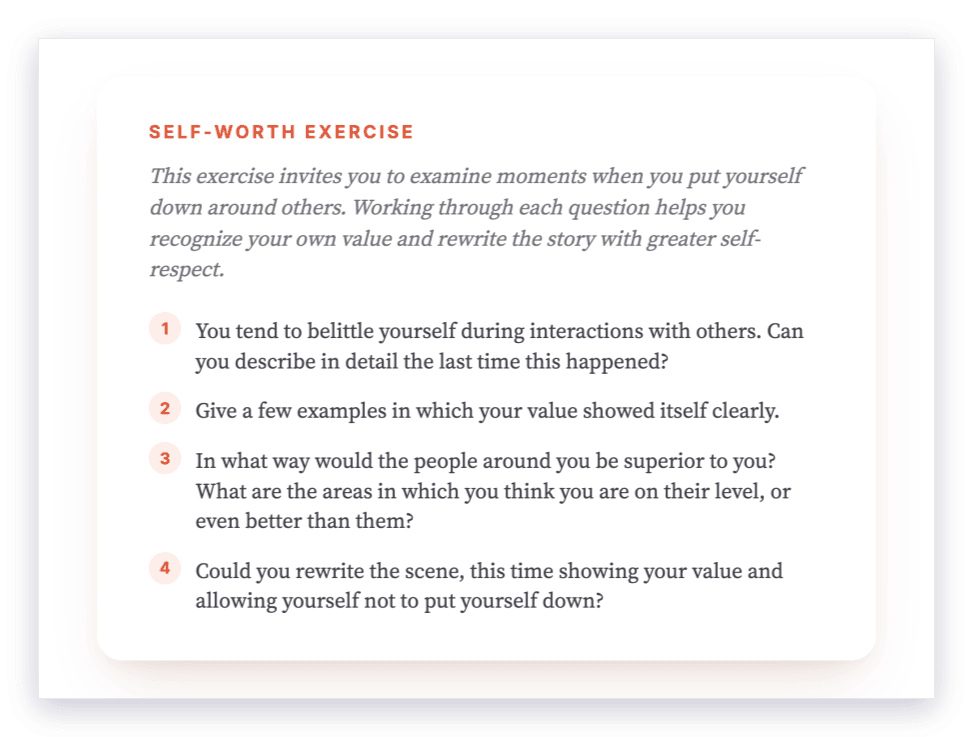
The image above lists the four questions of the exercise in order, with a short introductory framing. This is a static preview for the clinician. The full guided exercise, with patient-facing instructions and answer space, is experienced by the patient autonomously in the app, not in this image.
The exercise opens by asking the patient to narrate a specific recent scene in which they put themselves down during an interaction. This grounds the work in lived experience rather than abstraction. From there, the patient is invited to list concrete examples in which their value was evident, a deliberate counter-movement against negativity bias and the mental filter that erases positive self-relevant data.
The third question introduces a comparative lens with nuance: rather than asking the patient to dismiss perceived differences, it asks them to identify both where others may have an edge and where they themselves hold their own or excel. This mirrors the spirit of scaling beliefs about yourself, moving from binary self-labeling to dimensional appraisal.
The fourth question brings the work home through cognitive rewriting: the patient reconstructs the original scene, this time allowing themselves to occupy it without self-diminishment. This is a form of guided imagery and narrative repair that challenging negative thoughts approaches from the thought level, but here it is applied to a relational script.
Key clinical insight: Self-deprecation in social contexts often functions as a preemptive defense, the patient diminishes themselves before someone else can. The value of this exercise is that it makes the coping function visible, then offers a genuine behavioral alternative grounded in recalled evidence, not reassurance.
750+ clinical tools
A library built with and for clinicians, ready to use in session and extend between appointments.
Access all the toolsUse it with your patients
Share this tool in the mobile app and follow the work between sessions.
Assigning It Between Sessions: Who, How, and What to Do With What Comes Back
This exercise suits patients who are at least partially able to observe their self-deprecating patterns from a slight distance, not those in acute shame crisis, for whom shame-focused psychoeducation may need to come first. It works well alongside the Self-Image and Self-Esteem 4-Lesson Program or after a first pass with Feeling Not Good Enough.
To introduce it, you might say: "Between now and our next session, I'd like you to do a short written exercise. It starts with a real situation, something that actually happened recently, and walks you through it step by step." Keeping the framing concrete and time-bounded helps reduce avoidance.
This exercise is available to your patients through the SessionFuel patient app, the dedicated mobile interface for patients of clinicians who use SessionFuel. You assign it directly, and your patient completes it on their phone, on their own, between sessions.
When the patient returns, their written responses give you three immediate clinical entry points: the richness or poverty of the evidence they mustered (question 2 reveals attentional filtering in action), the degree to which they could locate genuine strengths relative to others (question 3), and the fluency or blockage in the rewriting task (question 4). Patients who cannot complete question 4 are telling you something important about shame tolerance. You can pair that observation with the Positive Traits Checklist or explore Celebrating Personal Successes as a next step.
The exercise also pairs naturally with Impostor Syndrome and Legitimacy for patients whose self-deprecation is concentrated in professional or achievement contexts, and with Approval-Seeking in Therapy when the function is social validation rather than self-protection.
Your session continues in your patients' pocket
Use with a patientYour resources, available everywhere
The handouts, exercises, programs and audios above: you choose which ones to make available to your patients, in the mobile app dedicated to them.
And far more than a library
The app goes well beyond resources, to support your patients every day:
Related categories
Explore other clinical resources by category.

Identity
Clinical resources for self-identity work in therapy: CBT, ACT, schema tools for clinicians addressing self-concept, core beliefs, and identity disruption.

Behaviours
Clinical hub for behaviors in therapy: worksheets and tools for coping, eating disorders, CBT formulation, and maladaptive behavioral patterns.

Cognition
Printable cognitive therapy worksheets and clinical tools for therapists: CBT, ACT, schema work, defusion, distortions, and belief restructuring.

Build awareness
Clinical worksheets and tools to build awareness in therapy: cognitive distortions, schemas, emotions, ACT and CBT resources for practitioners.

Restructure
Clinical hub for cognitive restructuring worksheets: distortion identification, belief disputation, ABC model, and schema work for evidence-based practice.

CBT
CBT worksheets, cognitive restructuring exercises & behavioral tools for clinicians. Evidence-based resources for every phase of cognitive behavioral therapy.