
Clinical picture. A, a woman in her late thirties presenting with persistent low self-worth alongside a pattern of minimising positive feedback from colleagues, was given the four-question exercise as between-session homework during a course of CBT. When asked to recall the last compliment received, she identified a supervisor's praise for a well-run meeting, yet her written response to question two revealed she had immediately attributed the outcome to "lucky timing" and "a cooperative group." Working through question three, she identified three concrete behaviours she alone had prepared, which she had not previously credited to herself. At the following session she reported that rewriting the scene in question four felt uncomfortable but produced a brief, unfamiliar sense of legitimacy she described as worth returning to.
Accepting Compliments: A Guided Self-Worth Exercise
A structured four-question homework tool helping patients examine compliment deflection, find genuine evidence, and rewrite the moment of acceptance.
Clinical vignettes
Deflection in a High-Achieving Patient
Compliment Avoidance in Social Anxiety
Clinical picture. M, a man in his mid-twenties with social anxiety and marked self-critical cognitions, had repeatedly reported changing the subject whenever someone complimented his work, fearing that acceptance would appear arrogant. The clinician introduced the exercise after several sessions in which this deflection pattern had been noted but not yet examined in structured form. His answer to question two named a specific verbal move: he had said "anyone would have done the same" in response to a friend's praise about his support during a difficult period. Question three proved difficult; M produced only one justification initially, though he returned the following week with two additions he had thought of later, suggesting the exercise continued to work outside the session. Rewriting the acceptance scene did not resolve his discomfort, but it made the avoidance visible to him in a way that verbal discussion alone had not achieved.
The clinical difficulty: when positive feedback bounces off
Most patients with low self-esteem can describe their negative self-image in precise detail. Ask them what others genuinely appreciate about them, and the room goes quiet. When a compliment does arrive, they neutralise it almost automatically: "They were just being kind," "Anyone could have done that," "They don't know the full picture." This pattern is not modesty. It is a cognitive operation, and it runs below conscious scrutiny.
The Disqualifying the Positive: PDF Worksheet, Tools and Exercises fiche names this distortion clearly. But naming it in a consultation rarely dissolves it. The patient nods, agrees the pattern exists, and then walks out and does exactly the same thing next time someone says something warm about them. What is missing is an experiential rehearsal: a moment where the patient actively holds a specific positive remark, examines their refusal of it, and practises a different response in writing. Words in a session often cannot produce that shift alone. A structured exercise can.
This dynamic appears frequently alongside impostor syndrome, self-deprecation in social interactions, and the perfectionism loop where achievements are instantly minimised. It also feeds the self-image and self-esteem difficulties that many patients carry across multiple domains of life.
Use this resource with your patients
Handout, exercises and materials ready to use, right inside SessionFuel.
What the exercise contains
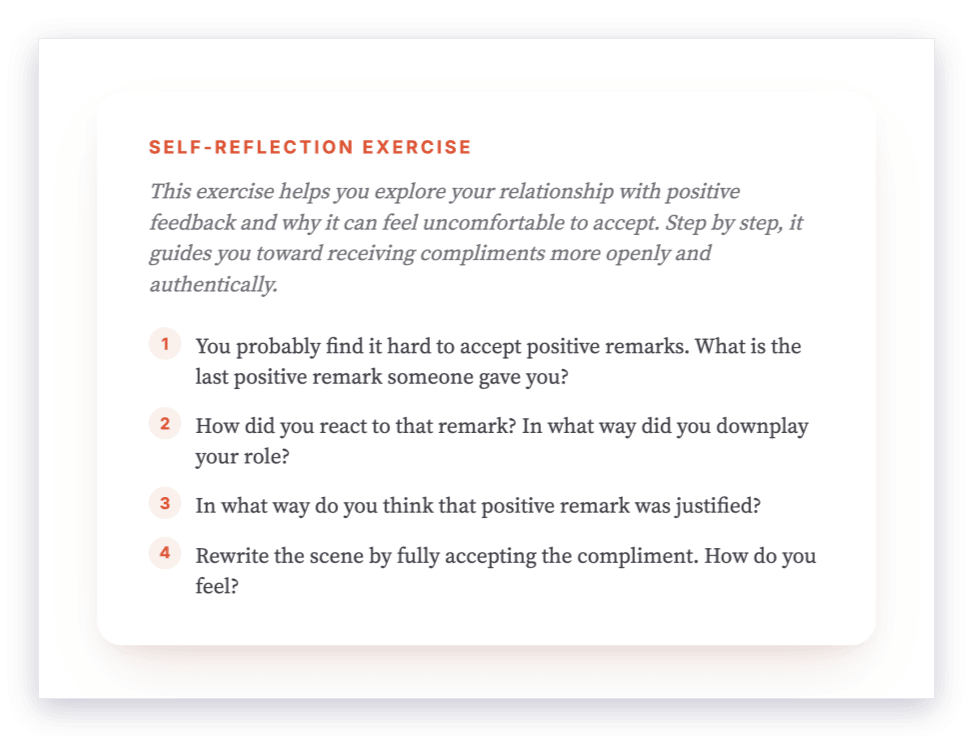
The exercise "Thank you for the compliment!" is built around four questions, in this order:
- The patient identifies the last positive remark someone made to them, starting from the assumption that accepting such remarks is genuinely difficult.
- They describe exactly how they reacted to that remark and, specifically, how they minimised their own role.
- They examine why the compliment is justified from their own perspective, searching for actual evidence.
- They rewrite the scene, this time accepting the compliment fully, and notice what they feel when they do.
The image above lists these questions as a static preview. It gives you a quick read of the structure, but it is not the exercise itself: the full guided experience, with patient-facing instructions and dedicated space to answer, is completed by the patient on their own in the app, not in this image.
The four-step arc moves the patient from an honest description of their deflection pattern to a genuine cognitive and behavioural rehearsal. Question 3 is the pivot: it asks the patient to become their own evidence-gatherer, a micro-version of the work described in Core Beliefs: Examining the Evidence. Question 4 then turns that evidence into a lived scene, adding the affective dimension that purely verbal restructuring tends to miss.
This exercise is available to patients through the mobile application that is the dedicated patient-side interface of SessionFuel: you assign it as homework, and your patient completes it directly on their phone, on their own, between two appointments.
750+ clinical tools
A library built with and for clinicians, ready to use in session and extend between appointments.
Access all the toolsUse it with your patients
Share this tool in the mobile app and follow the work between sessions.
How to integrate it into your practice
This exercise suits patients who are already past psychoeducation on cognitive distortions and are ready to apply restructuring to a specific, personal instance. It works particularly well for patients presenting with feeling not good enough, approval-seeking patterns, or those working through constant social comparison. It is also a natural complement to the Positive Traits Checklist when patients can name qualities abstractly but struggle to let positive input from others land.
Introduce it as concrete homework to complete between sessions, not as a reflection to do eventually. A brief framing works well: "Before we meet again, I'd like you to try something specific. There is a four-question exercise about what happens when someone says something positive about you. Work through it on your own, honestly, and bring it back." No further scaffolding is usually needed.
When the patient returns, the material they produce is clinically rich. The response to question 2, how they minimised their role, often reveals an automatic thought worth examining directly, using the Challenging Negative Thoughts worksheet or the five-column thought record. The rewritten scene from question 4 sometimes surfaces real affect: relief, discomfort, even grief. That affective signal is worth following.
Key insight: The exercise does not ask patients to pretend compliments are easy. It asks them to examine one specific instance, find their own evidence, and practise a response. That sequence, recall, deconstruct, justify, rewrite, converts an abstract pattern into something the patient can actually feel.
For patients working at the level of core beliefs about self or those whose deflection connects to a defectiveness or shame schema, this exercise can also function as a data-collection tool: each completed instance is one more piece of disconfirming evidence to bring into the deeper belief work.
Your session continues in your patients' pocket
Use with a patientYour resources, available everywhere
The handouts, exercises, programs and audios above: you choose which ones to make available to your patients, in the mobile app dedicated to them.
And far more than a library
The app goes well beyond resources, to support your patients every day:
Related categories
Explore other clinical resources by category.

Identity
Clinical resources for self-identity work in therapy: CBT, ACT, schema tools for clinicians addressing self-concept, core beliefs, and identity disruption.

Relationships
Clinical worksheets and tools on relational functioning: attachment, schemas, assertiveness, and communication skills for therapists. Printable PDF resources.

Restructure
Clinical hub for cognitive restructuring worksheets: distortion identification, belief disputation, ABC model, and schema work for evidence-based practice.

Repair & soothe
Clinical resources for the repair and soothe therapeutic aim: worksheets, exercises and tools to build self-compassion, reduce shame and restore emotional safety.

CBT
CBT worksheets, cognitive restructuring exercises & behavioral tools for clinicians. Evidence-based resources for every phase of cognitive behavioral therapy.

Compassion-focused
CFT clinical tools for practioners: exercises, programs and guided audio on shame, self-criticism, guilt and self-compassion. Ready to use in session.