
Compassion-Focused Therapy (CFT): Clinical Tools for Practice
Compassion-Focused Therapy (CFT), also referred to as compassion-based therapy or CFT, is a transdiagnostic approach developed by Paul Gilbert that integrates evolutionary psychology, attachment theory, and Buddhist-informed practices to target high shame and self-criticism. This page is designed for clinicians seeking structured, printable resources to support CFT-informed work across individual and group formats. The tools gathered here cover the full therapeutic arc: psychoeducation on core affects, in-session guided exercises, multi-session programs, and audio supports for experiential work. Each resource is ready to integrate into an existing care plan or to anchor a dedicated CFT-oriented treatment sequence.

The Three-System Model at the Heart of CFT
Compassion-Focused Therapy rests on a tripartite model of affect regulation: the threat system (detection of danger, criticism, shame), the drive system (seeking, achieving), and the soothing system (affiliation, compassionate self-relating). Many patients presenting with depression, chronic shame, eating disorders, trauma sequelae, or personality difficulties show a chronically overactive threat system and a markedly underdeveloped soothing system. CFT posits that this imbalance is not a character flaw but a product of evolutionary architecture and early social environment, a reframe that is itself therapeutic.
The clinician's task is not merely to challenge distorted cognitions, but to help the patient cultivate a genuinely compassionate inner stance toward their own suffering. This involves building capacity for warmth, strength, and wisdom directed at the self, qualities that many high-shame patients have never experienced as accessible. The model demands that the clinician first embody these qualities in the therapeutic relationship before any structured exercise can land.
Why CFT Adds Value Beyond Standard CBT
Where standard cognitive-behavioral approaches target the content of self-critical thoughts, CFT targets the tone and the relationship to those thoughts. A patient may acknowledge intellectually that a belief is irrational yet still relate to themselves with contempt. CFT addresses this gap by working at the level of motivation and felt sense, not only belief. This makes it particularly well-indicated when cognitive restructuring repeatedly stalls, when patients comply with homework but report no affective shift, or when self-devaluation is pervasive and ego-syntonic.
Identifying CFT Indications in Clinical Assessment
Shame, Self-Criticism, and the Fear of Compassion
Shame is the cardinal target affect in CFT. Clinically, it presents differently from guilt: where guilt involves distress about a specific act, shame involves a global negative appraisal of the self as defective, unworthy, or fundamentally flawed. Patients rarely volunteer shame spontaneously; it surfaces through avoidance of eye contact, minimization of distress, abrupt topic shifts, and the persistent sense of being "found out." The Shame in Therapy: A Guided Exercise to Break the Silence is designed precisely to lower the threshold for naming this affect in session, using structured prompts that normalize the experience before any exploratory work begins.
A complementary entry point for assessment is the Understanding Shame: A Structured Psychoeducation Program, which maps the phenomenology of shame across cognitive, somatic, and behavioral channels. Providing this psychoeducation early gives patients a shared language and reduces the isolation that shame typically generates.
Guilt, Responsibility, and Moral Distress
Pathological guilt is frequently entangled with shame but carries its own clinical texture: excessive responsibility-taking, ruminative self-blame, and difficulty tolerating the ambiguity of real moral complexity. The Guilt and Responsibility: A Guided Clinical Exercise supports careful differentiation between proportionate accountability and self-punitive guilt, a distinction CFT-informed work makes central. For clinicians managing more sustained presentations, the Guilt Psychoeducation Program: 6 Structured Clinical Sessions provides a session-by-session framework that can be delivered standalone or nested within a longer CFT sequence.
Core CFT Interventions and How the Exercises Support Them
Working with Self-Criticism and Negative Self-Labeling
Self-criticism in CFT is conceptualized as an internalized threat-system response, often modeled on early caregiving figures. Its function (self-protection, performance maintenance) must be acknowledged before its costs can be examined without triggering further shame. The Self-Devaluation in Session: A Guided Clinical Exercise helps clinicians externalize and slow down the self-critical process, making it observable. Similarly, the Negative Self-Labeling: A Guided Exercise for Self-Criticism addresses the specific pattern of global, totalizing labels ("I am not good enough," "I am fundamentally broken") that are particularly resistant to standard disputation.
These exercises work best after the patient has some familiarity with the threat/soothing system model. Introducing them too early, before a psychoeducational foundation is in place, risks the patient engaging cognitively while remaining affectively defended.
Perfectionism, Impostor Syndrome, and the Drive System
Perfectionism occupies an interesting position in CFT: it often lives at the intersection of the drive and threat systems, appearing as ambition while functioning as chronic threat appraisal. Clinicians will recognize the high-achieving patient who is never satisfied, who attributes success to luck and failure to identity. The Perfectionism in Therapy: A Guided Clinical Exercise supports a functional analysis of perfectionism that maps its emotional costs without prematurely attacking what the patient experiences as a valued coping strategy.
Impostor syndrome represents a related cluster, where competence is experienced as fraudulent and external validation fails to update the internal self-model. The Impostor Syndrome: A Guided Exercise on Legitimacy invites the patient to examine the evidence-weighting process that systematically discounts achievements. The Accepting Compliments: A Guided Self-Esteem Exercise is a behaviorally-anchored complement, targeting the micro-moments of deflection that maintain the impostor schema in everyday interactions.
For patients whose self-criticism is structured around social comparison, the Breaking the Cycle of Constant Comparison and Self-Criticism offers a focused intervention on a pattern that social media has intensified considerably in recent years.
Self-Acceptance and Processing Errors With Self-Compassion
Self-acceptance in CFT is not resignation; it is the active recognition of one's full humanity, including flaws, failures, and limitations, while retaining the motivation to grow. The Self-Acceptance Work: A Five-Question Guided Clinical Exercise provides a structured reflective sequence that many patients find less threatening than open-ended self-compassion work, precisely because it proceeds by discrete, bounded questions.
Error processing is a high-stakes moment for shame-prone patients. The Processing Mistakes With Self-Compassion: A Guided Exercise targets the specific sequence that unfolds after perceived failure: the threat spike, the self-punitive rumination, and the behavioral withdrawal. Using it in the session following a patient-reported setback is often more effective than introducing it in an anticipatory way.
Experiential and Audio-Based CFT Work in Session
Guided Audio as a Bridge to the Soothing System
CFT places significant weight on experiential practice: the soothing system is not activated by intellectual understanding alone. Guided audio resources allow patients to encounter compassionate affect in a controlled, scaffolded way, which is particularly important for those with an early history of threat in attachment relationships, where the very idea of self-directed warmth triggers fear or contempt.
The The Self-Compassion Bandage: Guided Audio for Clinicians is designed for in-session or between-session use and uses somatic imagery to make the compassion concept concrete. The Guided Audio Meditation: Compassion for Emotions in Session takes a different entry point, working through the patient's emotional experience rather than a body image, and can be used productively when somatic anchoring is contraindicated or poorly tolerated.
Both tracks are written for clinician guidance, allowing the practitioner to frame, pause, and debrief the exercise rather than simply pressing play.
Integrating CFT Resources into the Care Plan
Sequencing Across Phases of Treatment
A structured use of these resources follows a broadly phased logic:
- Psychoeducation and normalisation: Begin with the shame and guilt psychoeducation programs to build a shared conceptual framework and reduce the patient's sense of uniqueness in their suffering.
- Externalisation and functional analysis: Use the self-criticism, perfectionism, and self-labeling exercises to make threat-system patterns observable and to examine their function non-judgmentally.
- Experiential compassion work: Introduce the audio resources and the self-compassion exercise for mistakes once the patient has enough conceptual grounding to engage experientially without intellectualizing.
- Consolidation and self-acceptance: Close the sequence with self-acceptance and hope-focused work, using the Guided Exercise: Helping Patients Rediscover Hope When Stuck to consolidate motivational investment in the new self-relating pattern.
CFT in Group and Psychoeducation Formats
Several of the programs in this category are well-suited to group delivery. The six-session guilt program and the shame psychoeducation program both include content that generates productive group resonance: shared recognition of the experience reduces shame faster than individual reflection alone. When adapting these tools for group use, the clinician should plan time for interpersonal processing after each session, as the material can activate attachment dynamics within the group itself.
> Clinical vignette: A patient in her late thirties, referred for recurrent depression and persistent low self-worth, had completed two prior CBT courses with limited benefit. She identified intellectually with the thought records but reported feeling "unmoved" by them. In the first CFT-oriented session, the clinician used the Self-Devaluation in Session: A Guided Clinical Exercise to map the self-critical voice. The patient broke down when asked to consider what she would say to a close friend in the same situation. That moment of affective mismatch, between her relentless internal harshness and her natural warmth toward others, became the fulcrum of the entire treatment.
Clinical Vigilance and Limits of CFT-Based Tools
Contraindications and Adaptations
Fear of compassion is a recognised clinical phenomenon and not a trivial obstacle. For patients with severe early relational trauma, activating the soothing system can initially provoke grief, rage, or depersonalization, because safety and warmth are associated with previous loss or betrayal. The clinician should titrate exposure to self-compassion exercises carefully and monitor for backdraft reactions after sessions. In these cases, shorter, more cognitively scaffolded exercises are preferable to extended guided audio at the outset.
CFT is not a standalone approach for active psychosis, acute mania, or presentations where self-compassion might inadvertently reduce appropriate accountability (certain antisocial or narcissistic presentations where shame functions protectively for others). The resources here presuppose an established therapeutic alliance and a patient who has sufficient reflective capacity to engage with the material.
The Clinician's Own Relationship to Compassion
Practitioners implementing CFT are advised to attend to their own relationship with self-criticism and shame. CFT supervision often surfaces how clinicians' threat systems interact with challenging patients, particularly those who reject warmth or remain relentlessly self-attacking. Using some of these exercises in personal reflective practice or supervision can sharpen the clinician's felt sense of what the work asks of patients, and improve the quality of in-session modeling.
Tools in this category
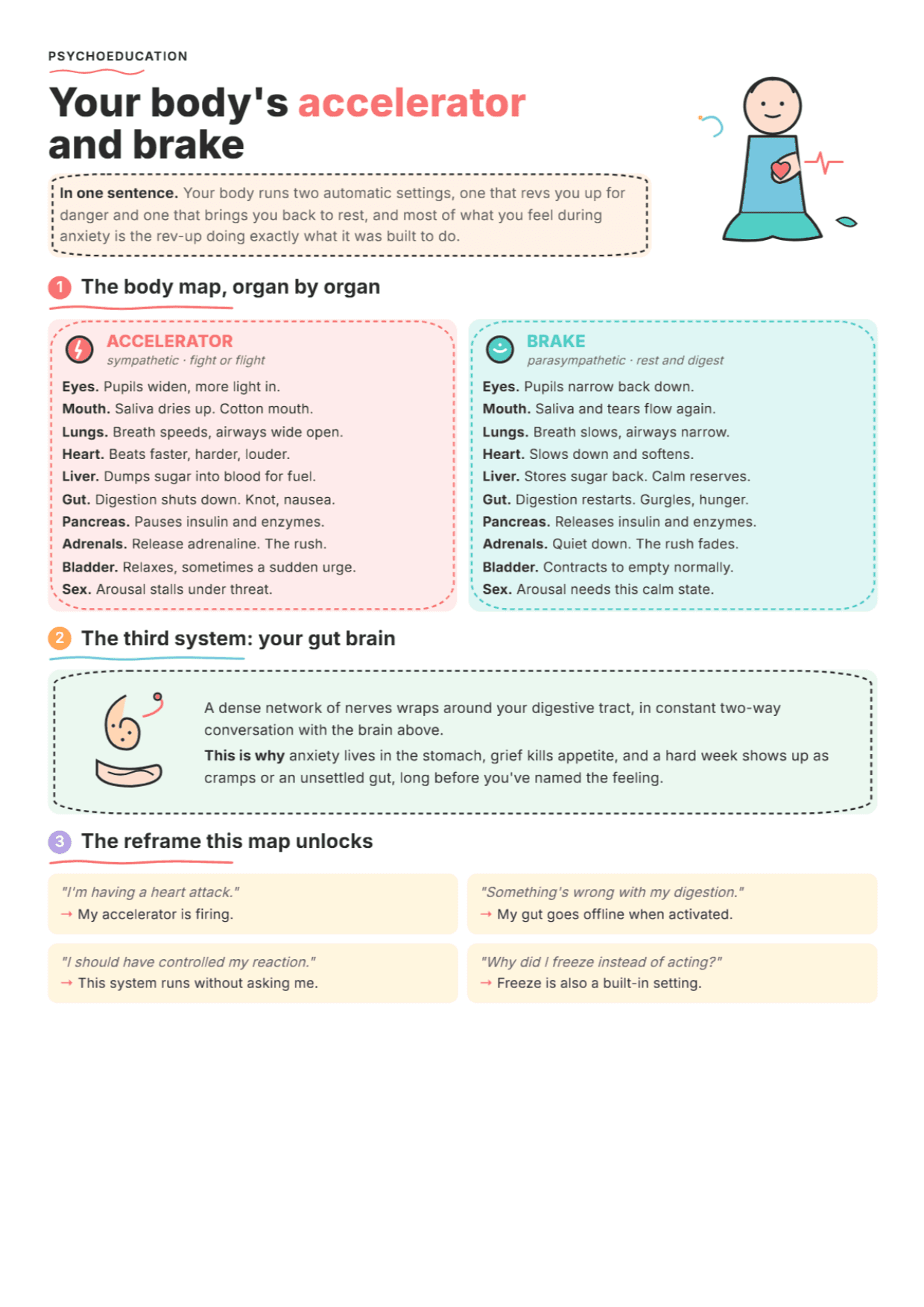
Handout
Autonomic Nervous System: PDF Worksheet, Tools and Exercises
A visual PDF worksheet, clinical tools, and concrete exercises to explain the body's stress and recovery system to patients in session.
AnxietyTrauma & PTSD
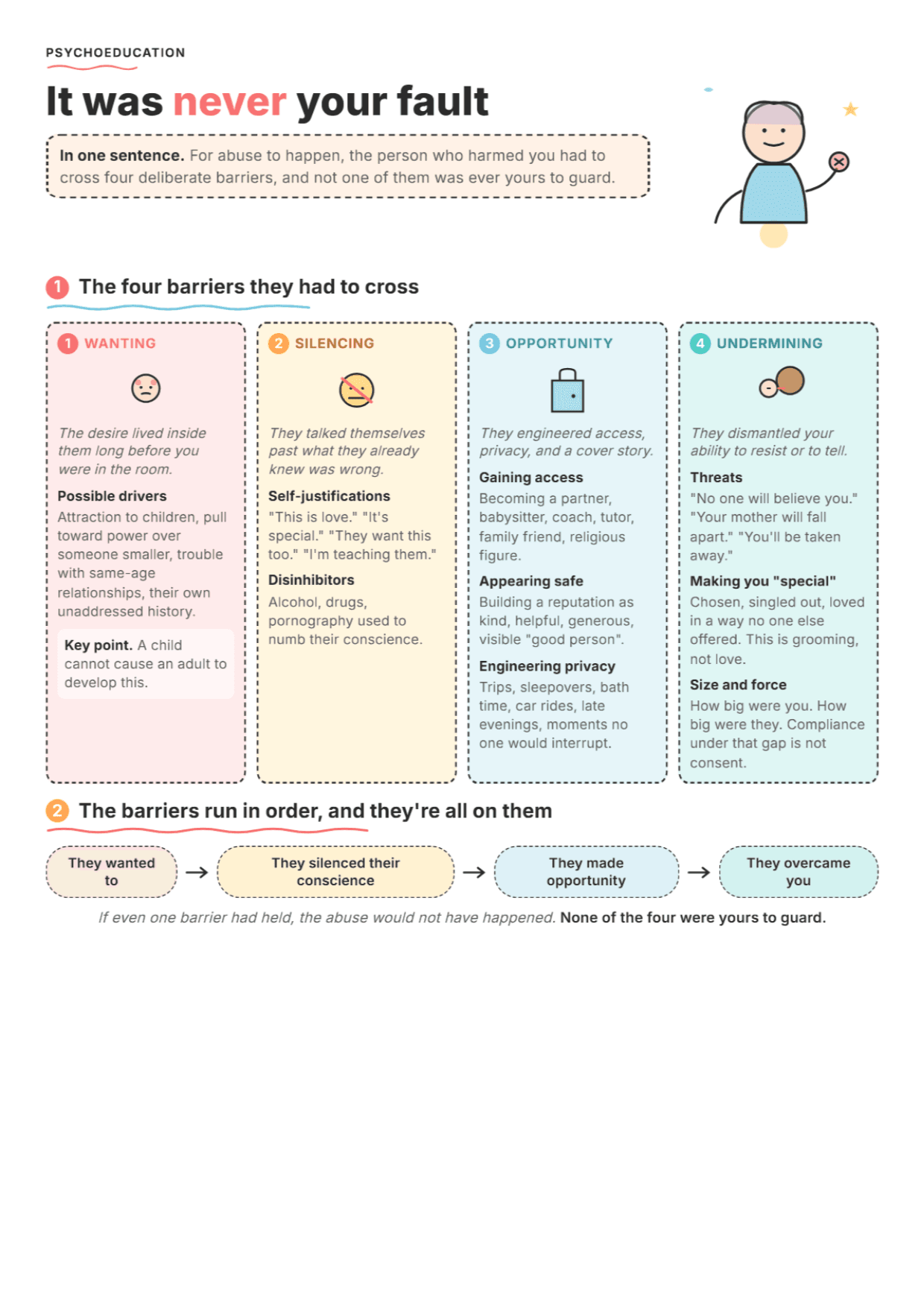
Handout
Barriers Abusers Overcome to Abuse: PDF Worksheet, Tools and Exercises
A clinical PDF worksheet, visual tools, and guided exercises to dismantle survivor self-blame and ground attribution retraining in structured psychoeducation during trauma therapy.
Trauma & PTSDSelf & identity
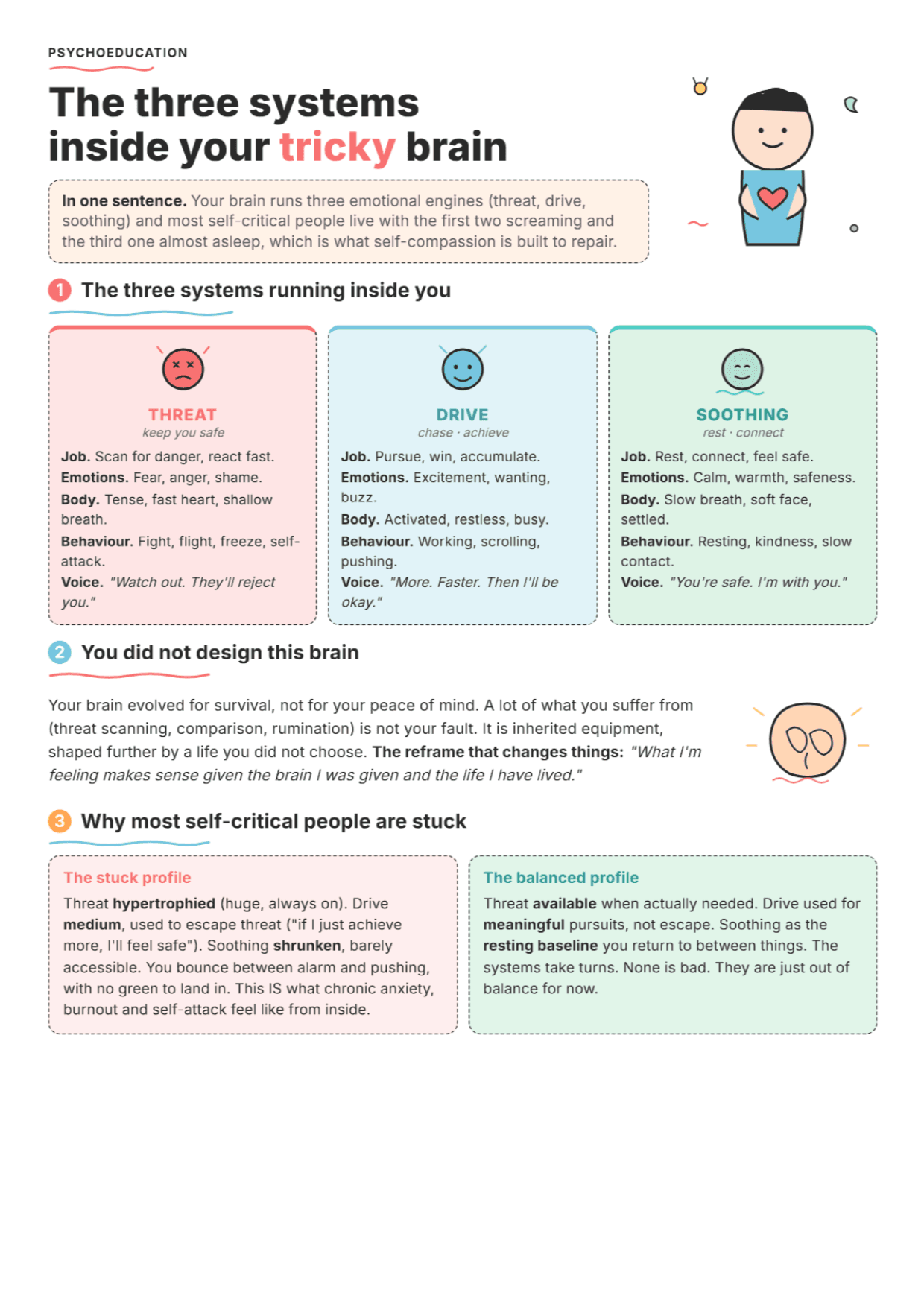
Handout
Compassion Focused Therapy: PDF Worksheet, Tools and Exercises for Clinical Practice
A visual psychoeducation fiche helping clinicians explain Paul Gilbert's three emotional systems, the self-critical stuck profile, and core CFT practices in a single session.
Self & identityMood & depression
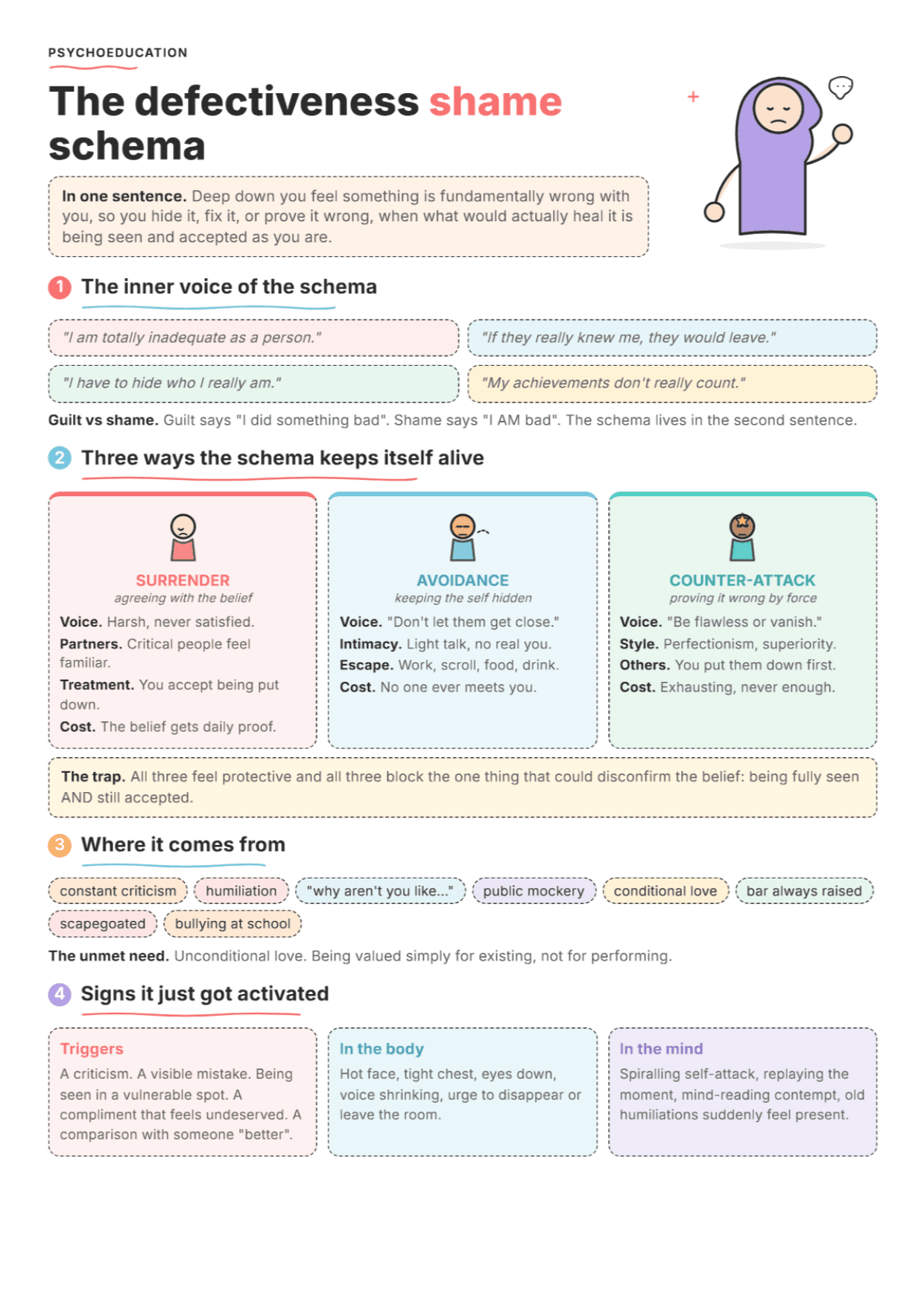
Handout
Defectiveness / Shame Schema: PDF Worksheet, Tools and Exercises
A visual PDF worksheet, clinical tools, and concrete exercises to explain the defectiveness/shame schema in session and support schema therapy work.
Self & identityPersonality
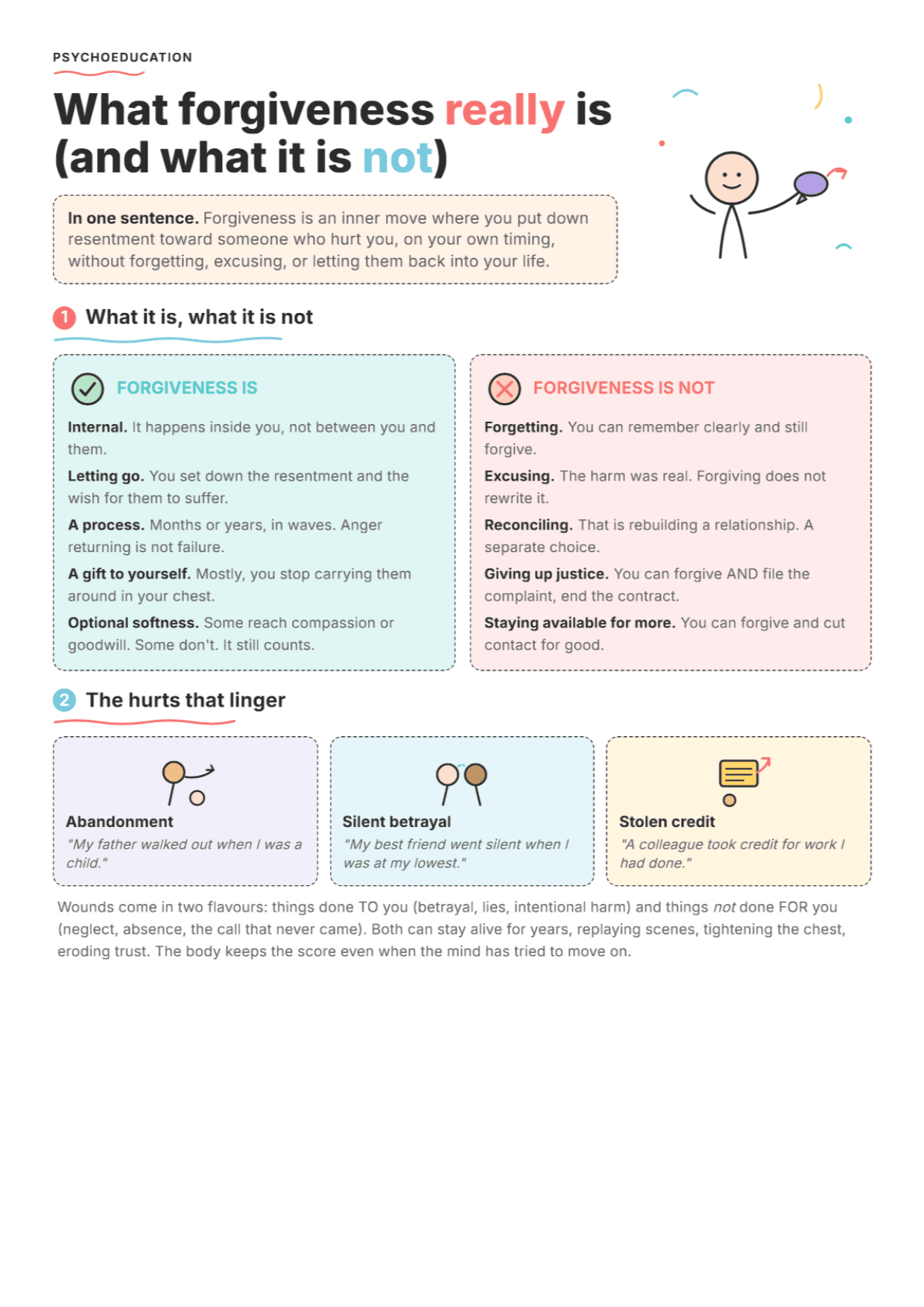
Handout
Forgiveness: PDF Worksheet, Tools and Exercises for Clinical Practice
A structured psychoeducation handout helping clinicians explain forgiveness clearly in session, separate it from reconciliation, and give patients a concrete visual reference to take home.
RelationshipsMood & depression
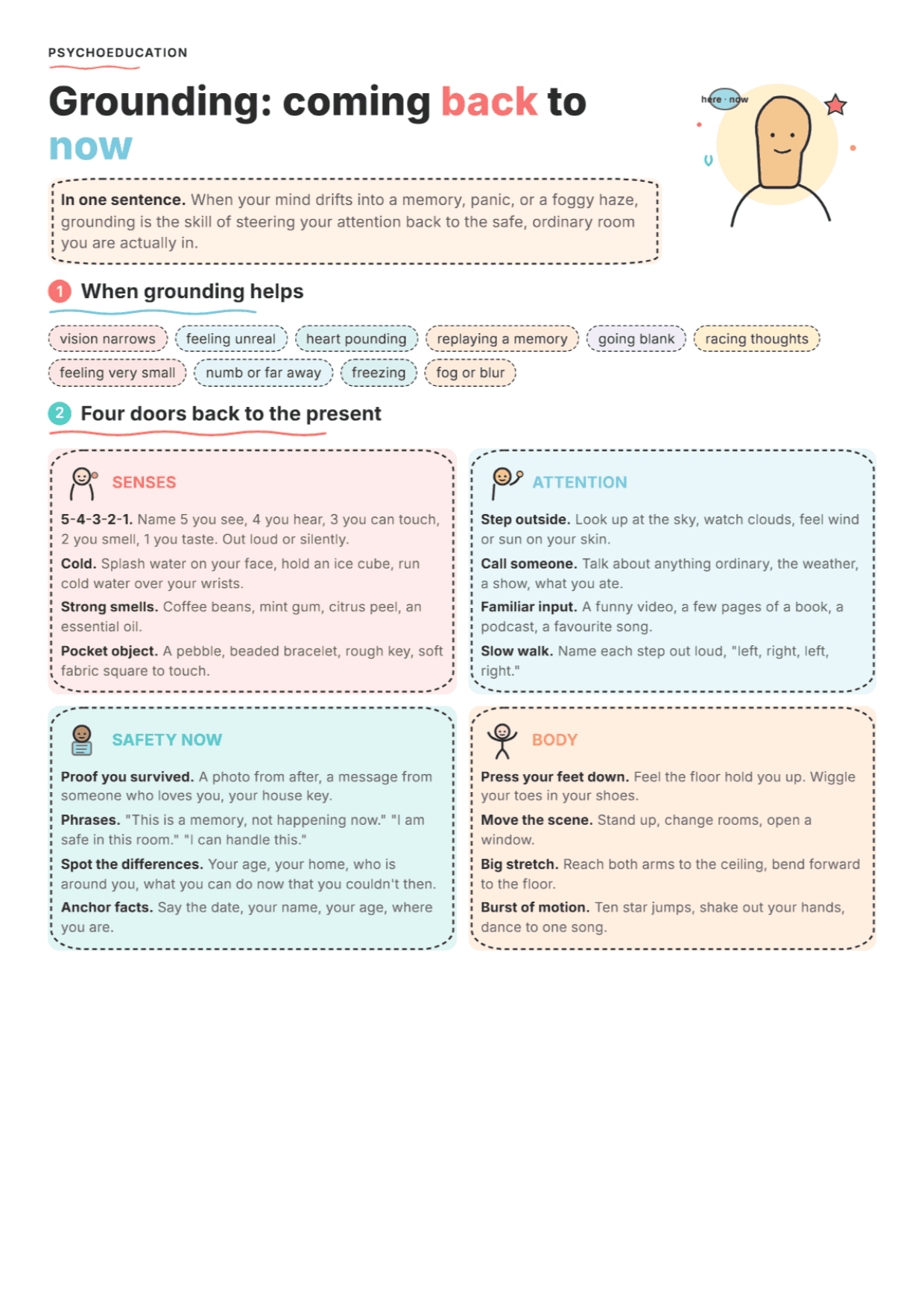
Handout
Grounding Techniques: PDF Worksheet, Tools and Exercises for Clinical Practice
A structured visual menu of grounding exercises clinicians can use in session to help patients with dissociation, flashbacks, and acute distress return to the present moment.
Trauma & PTSDAnxiety
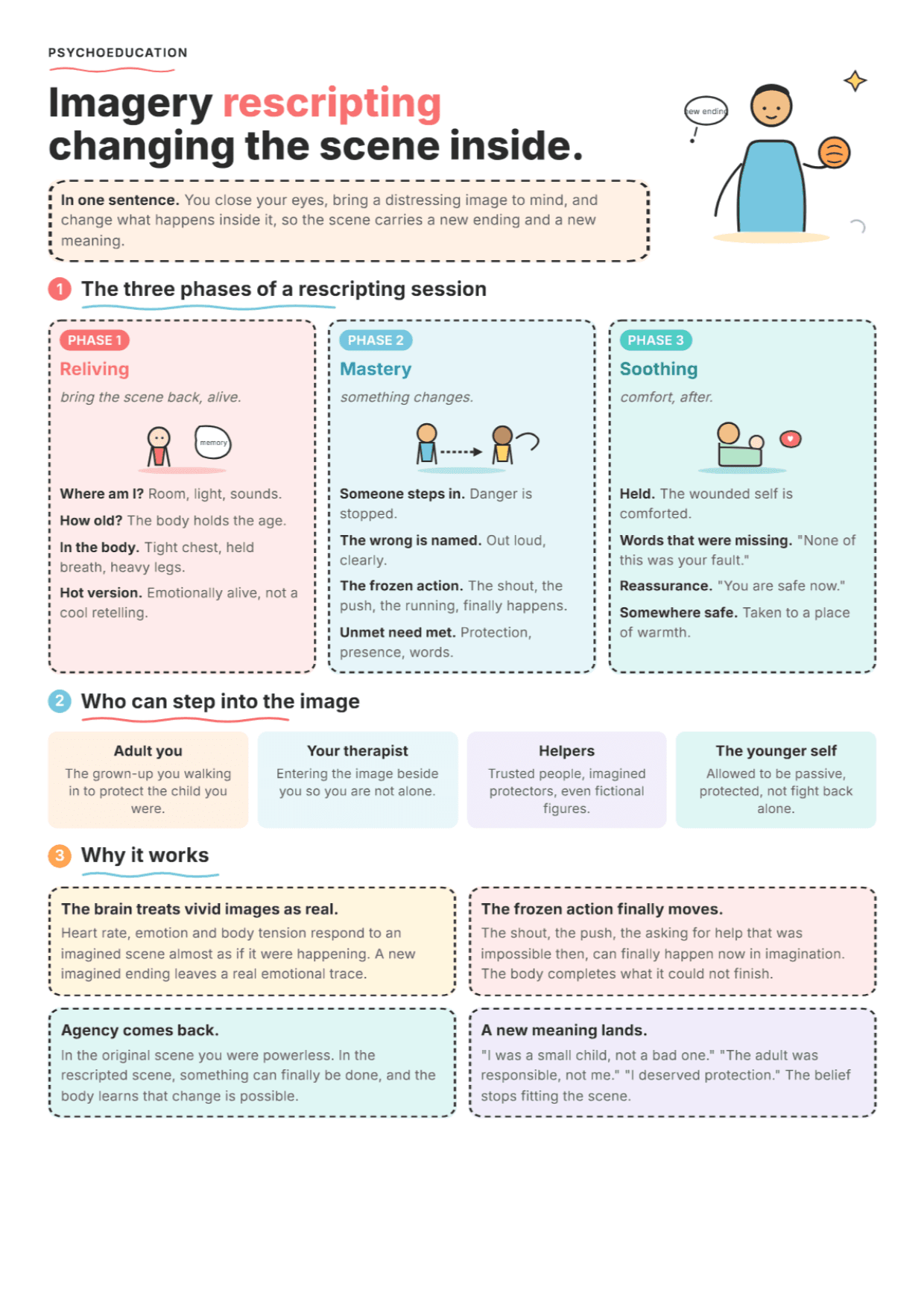
Handout
Imagery Rescripting: PDF Worksheet, Tools and Exercises for Clinical Practice
A visual psychoeducation worksheet clinicians can use in session to explain the three-phase rescripting structure, ground the procedure in mechanism, and prepare patients for imagery work.
Trauma & PTSDMood & depression
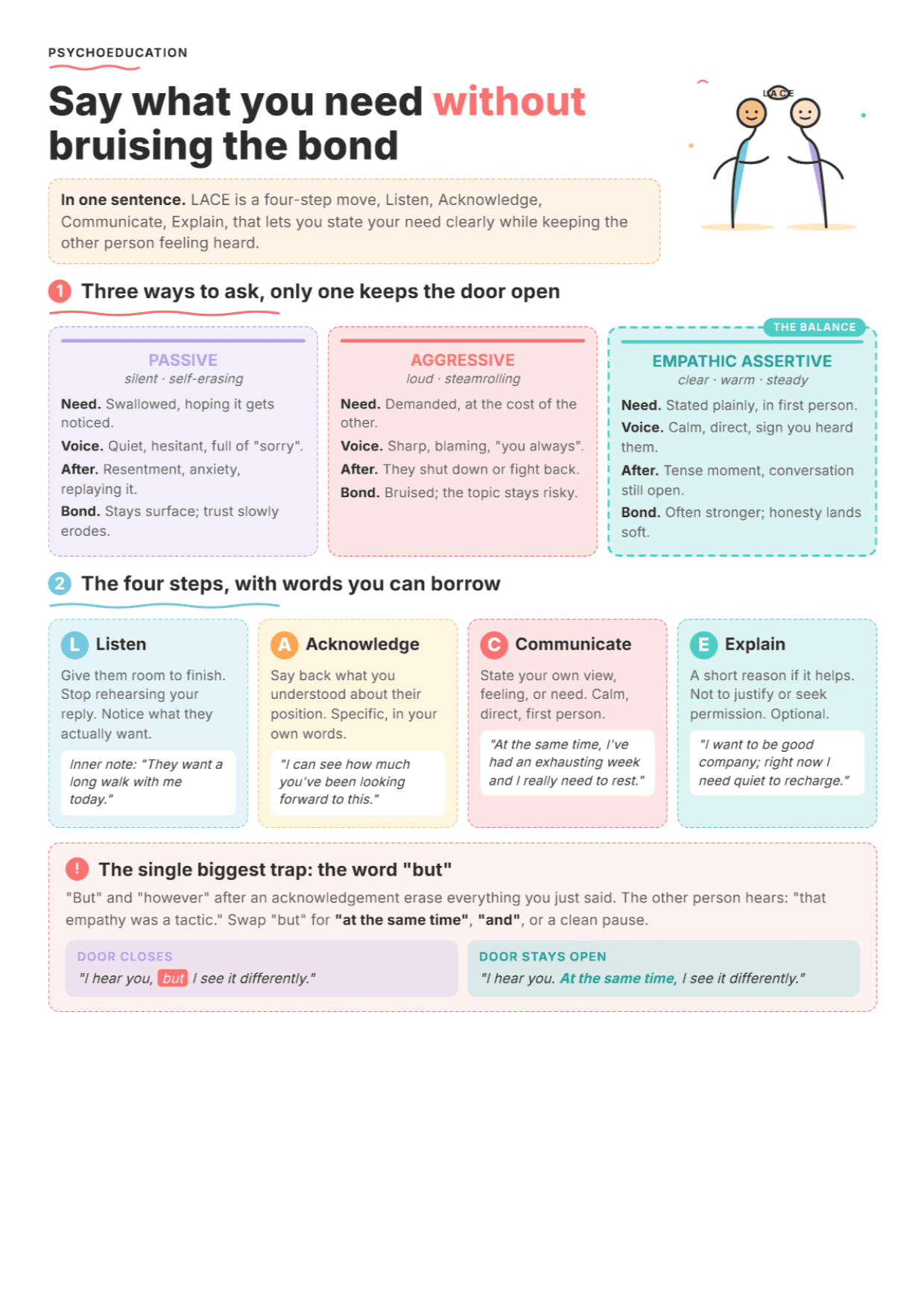
Handout
LACE Empathic Assertion: PDF Worksheet, Tools and Exercises
A printable visual support clinicians can use in session to teach patients the four-step LACE method for stating needs clearly while preserving the relational bond.
Self & identityRelationships
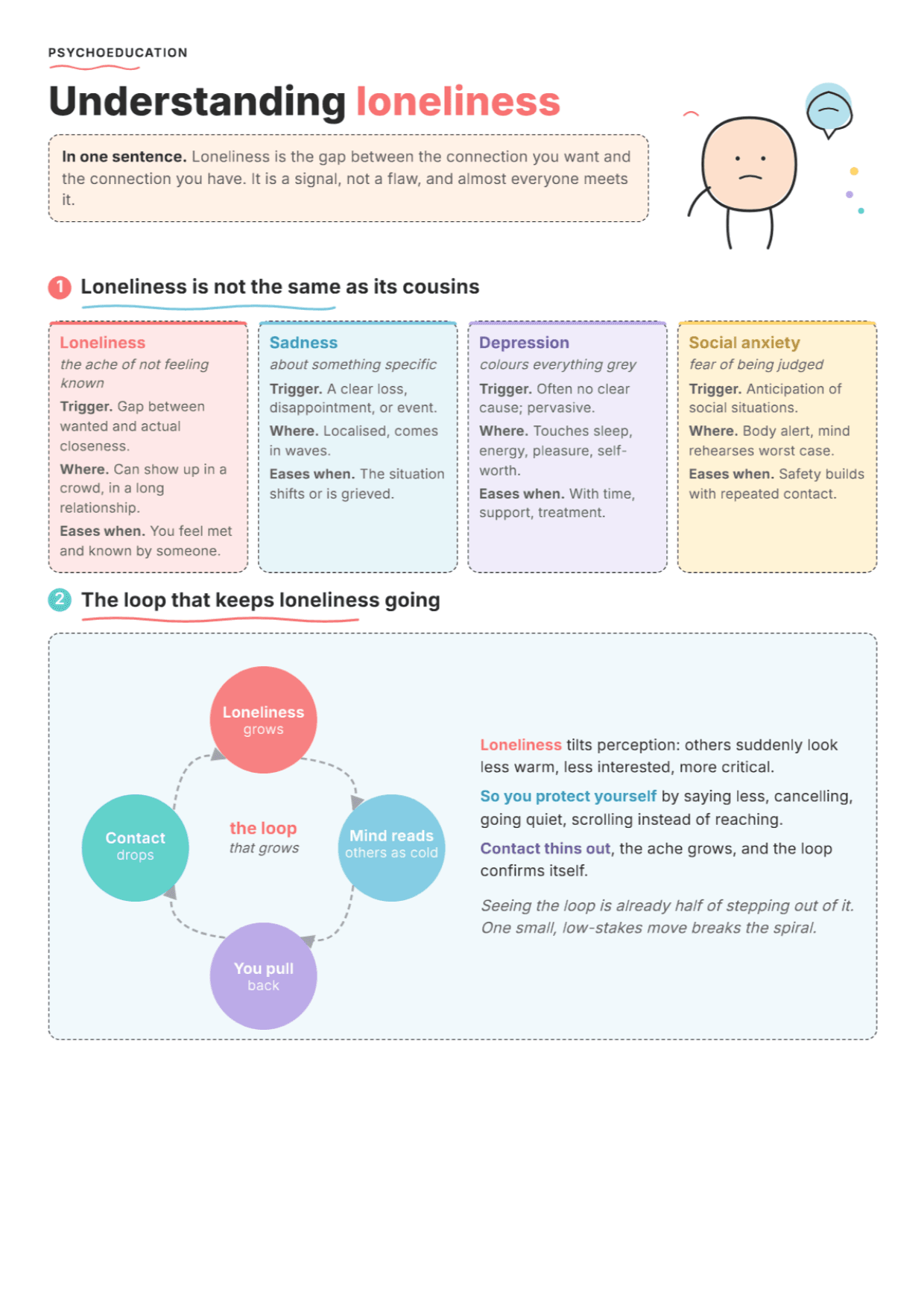
Handout
Loneliness: PDF Worksheet, Tools and Exercises for Clinical Practice
A printable PDF worksheet, tools and exercises to explain loneliness in session, map its self-reinforcing loop, and open the work on shame and reconnection.
Mood & depressionRelationships