
Clinical picture. A., a woman in her early forties, presented with occupational burnout and persistent self-criticism; she described working longer hours whenever anxiety spiked, convinced that one more deliverable would finally bring relief. During a psychoeducation session, the clinician introduced the three-system model using a simple diagram, inviting A. to locate herself on it. She identified immediately with the "stuck profile": threat running constantly, drive used as an escape route, and the soothing system described by her as "something I genuinely cannot access." Naming this pattern as a predictable consequence of an evolved brain rather than a personal failing produced a visible shift; A. reported that for the first time she felt "less broken" and agreed to try a short soothing-focused breathing exercise before the next session.
Compassion Focused Therapy: PDF Worksheet, Tools and Exercises for Clinical Practice
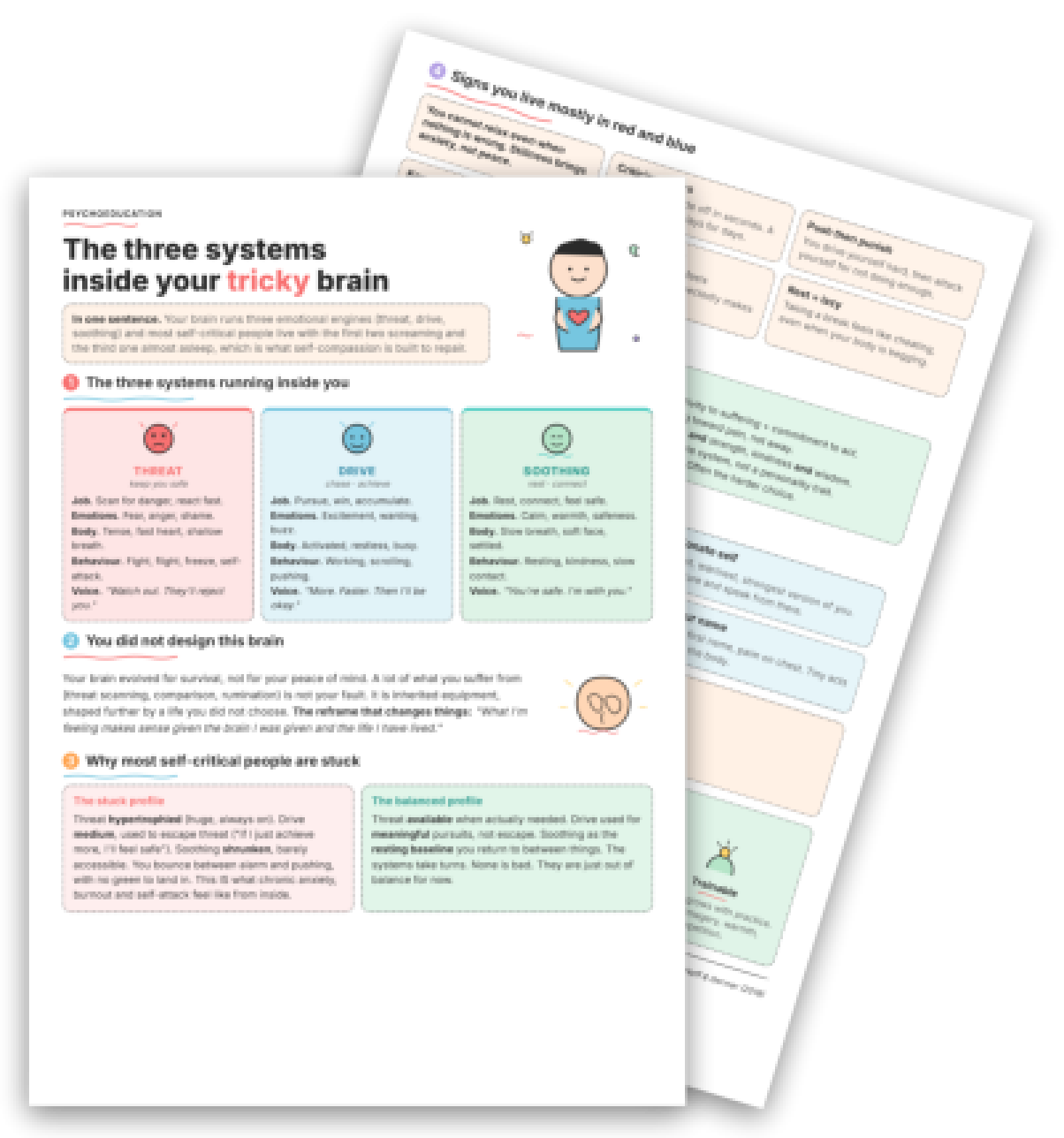
A visual psychoeducation fiche helping clinicians explain Paul Gilbert's three emotional systems, the self-critical stuck profile, and core CFT practices in a single session.
Clinical vignettes
Naming the Threat System in Burnout
Rebalancing Drive and Soothing in Chronic Anxiety
Clinical picture. M., a man in his late twenties with a long history of generalised anxiety, had already tried several CBT-based interventions with partial benefit; residual shame and a harsh internal voice remained prominent. The clinician introduced the CFT framework by asking M. to describe what each system sounded like in his own words, which he did with little prompting, noting that his drive voice and threat voice were "basically the same person." The soothing system was unfamiliar to him, and he initially dismissed it as passivity. Over two sessions working with the informational sheet, M. began to distinguish soothing from disengagement and practised brief grounding exercises; he reported reduced morning rumination, though the clinician noted that consolidating access to the soothing system would require sustained work across the coming weeks.
Most patients presenting with chronic self-criticism, burnout, or shame-based patterns have never heard of Compassion Focused Therapy (CFT). When you introduce it verbally, the word "compassion" itself creates immediate resistance: patients hear softness, avoidance of accountability, or positive thinking. This fiche PDF gives you a concrete, structured visual to get past that resistance in the first fifteen minutes.
Use this resource with your patients
Handout, exercises and materials ready to use, right inside SessionFuel.
Why the three-system model is hard to explain at the board
Paul Gilbert's model rests on a simple but counterintuitive premise: suffering is not a character flaw, it is a design problem. That reframe lands very differently when patients can see the three systems laid out visually rather than hear them described. The verbal version almost always collapses into "I need to calm down more," which misses the point entirely.
The second difficulty is the stuck profile. Patients with burnout, perfectionism patterns, or punitiveness schemas present with threat and drive both overactivated, and a soothing system that is functionally dormant. Saying "your threat system is hypertrophied" in session is clinically accurate and completely abstract. A diagram showing an enlarged red zone, a medium blue zone, and a shrunken green one makes the same point in three seconds, and patients recognise themselves immediately.
A third sticking point: compassion is not what they think it is. The conflation with self-pity, weakness, or "letting yourself off the hook" blocks engagement before any practice is attempted. Addressing that conflation clearly, visually, and early saves several sessions of alliance repair.
What the fiche contains: a visual support for explaining CFT in session
The fiche is structured across six panels, each serving a distinct psychoeducation function. The first presents the three systems side by side, with job, emotions, body state, behaviour, and inner voice listed for each (threat, drive, soothing). Seeing the "More. Faster. Then I'll be okay." drive voice next to the "You're safe. I'm with you." soothing voice is more arresting on paper than any description you give verbally.
The second panel reframes causality: "Your brain evolved for survival, not for your peace of mind," followed by the pivotal line "What I'm feeling makes sense given the brain I was given and the life I have lived." This is the de-shaming pivot that CFT depends on, and it arrives before you have asked the patient to do anything.
The third and fourth panels contrast the stuck profile (threat hypertrophied, soothing shrunken) with the balanced profile, and list six behavioural signs of living predominantly in threat and drive: inability to relax when nothing is wrong, compliments sliding off while criticism replays for days, and rest experienced as laziness. You can use this list as a brief in-session check-in alongside the Autonomic Nervous System fiche if somatic literacy is limited.
The fifth panel addresses the compassion misconceptions directly, with a clean is/isn't layout. The sixth panel names four soothing practices: soothing rhythm breathing, the compassionate self, compassionate imagery, and the hand-on-heart gesture. Each maps directly onto between-session homework you can assign, including dedicated audio resources such as the Self-Compassion for Emotions meditation or the Self-Compassion Bandage audio.
> Key takeaway: This fiche is a visual support that facilitates the explanation of CFT in session. It is not a self-administered questionnaire. The clinician uses it to carry the psychoeducation, then leaves it with the patient as a concrete reference between appointments.
750+ clinical tools
A library built with and for clinicians, ready to use in session and extend between appointments.
Access all the toolsWhen and how to introduce it
The fiche works best from the second or third session onward, once the formulation is sketched and the patient has shown some capacity for self-reflection. It is particularly well-suited to patients presenting with burnout, shame-based presentations (Defectiveness schema, shame psychoeducation needs), chronic self-criticism, or perfectionism. It also integrates naturally when working the Transforming Self-Critical Thoughts worksheet or the Nervous System Regulation fiche earlier in the same sequence.
A low-threshold introduction: "I'd like to show you a diagram that explains where a lot of what you're describing actually comes from, biologically. It takes about five minutes and it tends to make a lot of things click." Avoid framing it as a "compassion exercise" before the misconceptions panel has been read together.
Debrief by asking which of the six "signs of living in red and blue" the patient recognises most, and which soothing practice feels least alien to start with. For patients in whom warmth from others triggers grief or suspicion (a common CFT response), the fiche flags this explicitly under "To discuss in session," which gives you the opening to address it directly rather than waiting for it to surface as resistance.
The fiche does not replace Practicing Self-Compassion exercises or a Three Motivational Systems deeper dive. It is the entry point: the clearest way to establish the model, name the patient's pattern without pathologising it, and open the door to the practices that follow.
Use it with your patients
Share this tool in the mobile app and follow the work between sessions.
Sources
- Gilbert, P. (2009). The Compassionate Mind: A New Approach to Life's Challenges. Constable and Robinson.
- Gilbert, P. (2010). Compassion Focused Therapy: Distinctive Features. Routledge.
- Gilbert, P. (2009). Introducing compassion-focused therapy.
- Kolts, R. L. (2016). CFT Made Simple: A Clinician's Guide to Practicing Compassion-Focused Therapy. New Harbinger Publications.
Your session continues in your patients' pocket
Use with a patientYour resources, available everywhere
The handouts, exercises, programs and audios above: you choose which ones to make available to your patients, in the mobile app dedicated to them.
And far more than a library
The app goes well beyond resources, to support your patients every day:
Related categories
Explore other clinical resources by category.

Anxiety
Clinical hub for anxiety disorders: CBT and ACT worksheets, psychoeducation sheets, and exercises for assessment and treatment across the anxiety spectrum.

Trauma
Clinical hub on trauma and PTSD: assessment, differential diagnosis, treatment phases, and printable resources for practitioners. 155 chars.

Mood
Evidence-based worksheets and clinical tools for mood disorders: CBT, ACT, and positive psychology resources for psychologists and therapists.

Identity
Clinical resources for self-identity work in therapy: CBT, ACT, schema tools for clinicians addressing self-concept, core beliefs, and identity disruption.

Understand
Clinical hub for the therapeutic aim 'Understand': worksheets and tools to build patient insight across CBT, ACT, schema therapy and more.

Repair & soothe
Clinical resources for the repair and soothe therapeutic aim: worksheets, exercises and tools to build self-compassion, reduce shame and restore emotional safety.