
Clinical picture. M., a woman in her mid-thirties, presented with chronic shame and self-blame following years in a coercive relationship. She described repeatedly apologising, making herself small, and going silent during confrontations, and could not understand why she had never "just left or fought back." The clinician introduced the four-response framework as a psychoeducational worksheet, walking through appease and freeze in particular, and named both as automatic nervous-system outputs rather than conscious choices. M. sat quietly for a moment, then said that for the first time the word coward felt less accurate. Over subsequent sessions this reframe reduced self-critical rumination enough to allow more direct work on trauma processing.
Threat Responses (Freeze, Appease, Flight, Fight): PDF Worksheet, Tools and Exercises
A printable PDF fiche and clinical tools to explain the four automatic survival responses in session, supporting trauma psychoeducation, shame reduction, and formulation work.
Clinical vignettes
Appease and Freeze After Relational Violence
Flight and Fight in Workplace Anxiety
Clinical picture. R., a man in his late forties, sought help for what he called "losing control" at work: he would either leave meetings abruptly or snap at colleagues when challenged by his line manager. He described both reactions as baffling and embarrassing. Using the informational sheet, the clinician mapped flight and fight onto the physiological sequence R. had already noticed, the adrenaline surge, the narrowed attention, the speed of it all, and explained that both responses draw on the same arousal state redirected differently. R. found it useful to recognise the shared early-body signal as a cue for grounding rather than a point of no return. He began pausing at that cue, which reduced the frequency of abrupt exits without eliminating the underlying anxiety that remained the focus of ongoing work.
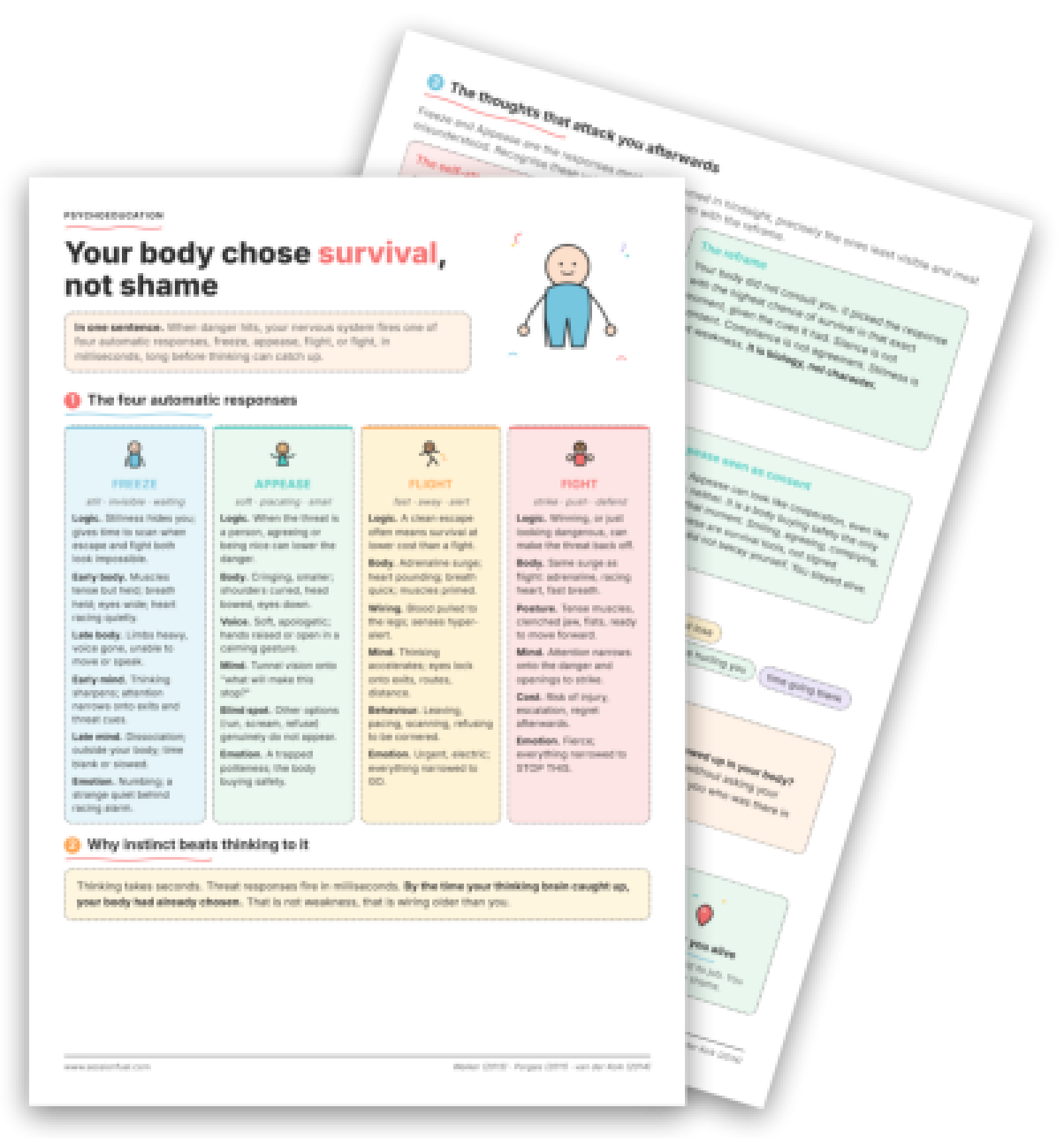
When a patient describes freezing during an assault or going quiet in front of an abusive partner, the self-blame they bring into the room is dense and fast-moving. Oral psychoeducation, however carefully delivered, rarely shifts it in one pass. This fiche PDF functions as a visual support to explain the four automatic threat responses during the session itself, giving both clinician and patient a shared structure to work with, and something the patient can take away.
Use this resource with your patients
Handout, exercises and materials ready to use, right inside SessionFuel.
Why Freeze and Appease are so hard to explain without a visual anchor
The clinical difficulty here is not conceptual, it's affective. By the time a patient is describing a freeze response or a fawn/appease reaction, shame has already rewritten the event as a character verdict: "I'm a coward," "I must have wanted it," "Why didn't I just run?" These attributions are remarkably resistant to verbal correction, precisely because the patient experiences their own silence as evidence.
Fight-or-flight psychoeducation addresses part of this, but appease sits outside most patients' intuitive threat model entirely. They know about running and fighting. Freezing is familiar from cultural shorthand. Appease, the softening, the apologising, the smiling at the aggressor, is the response most likely to be retroactively read as consent or complicity. Without a visual structure that names it explicitly as survival biology, the explanation slides off.
The same applies to freeze into dissociation: patients who report not remembering most of an event, or feeling outside their body, often interpret that as pathology or moral failure. Understanding the autonomic nervous system helps, but a fiche that shows the full progression from early freeze to late dissociation anchors the explanation in something the patient can read, re-read, and point to.
> Key clinical point: The fiche is a visual support that facilitates the explanation in session, not a self-assessment form. It shifts the locus of authority from the clinician's voice to a shared written structure, which is particularly useful when shame or hypervigilance is making direct eye contact with the therapist hard to hold.
What the fiche contains: six structured panels
The fiche is organised into six sections, each serving a distinct psychoeducational function. Sections 1 and 2 form the explanatory core. Section 1 presents all four responses side by side, each with its own survival logic, somatic signature, cognitive profile, and emotional texture. The layout makes the four-way structure immediately visible, something an oral explanation cannot replicate. A patient can see at a glance that "Appease: the body buying safety the only way it can" sits alongside the three responses they already consider legitimate, not outside them.
Section 2 addresses the timing gap between threat and cognition: "Thinking takes seconds. Threat responses fire in milliseconds." Brief, but structurally important for patients who keep asking why they didn't choose differently.
Section 3 is where the fiche becomes clinically specific for trauma and PTSD work: it lists the self-attacking thoughts that follow freeze and appease ("I just stood there," "I was nice to them, I went along with it") and provides a direct reframe ("Silence is not consent. Compliance is not agreement."). Reading these sentences off a printed page carries a different weight than hearing them spoken.
Sections 4 and 5 expand on freeze-into-dissociation and on appease as distinct from consent, with concrete behavioural examples for each. For patients who have complex PTSD presentations or longstanding shame and defectiveness schemas, having both the mechanism and the reframe on one page is more efficient than building the argument piece by piece across multiple sessions.
Section 6 closes with four short reminders: Wired, not weak / No shame / Mix and shift / It kept you alive. Compact enough to photograph and keep.
750+ clinical tools
A library built with and for clinicians, ready to use in session and extend between appointments.
Access all the toolsWhen and how to introduce the fiche in your practice
This fiche fits naturally after the initial anamnesis, once you have enough of the trauma history to know which response or combination the patient is most ashamed of. Introducing it before the patient has told their story risks making it feel prescriptive. Afterwards, it reframes what they've just shared.
A useful framing: "Before we go any further, I want to show you something about how the nervous system works under threat, because I think it speaks directly to what you've described." Turn the fiche toward the patient and walk through it together. The common trauma reactions fiche and nervous system regulation tools pair well as follow-up reading, and grounding exercises address the regulatory work that often becomes the next clinical focus.
For patients doing EMDR work, the fiche supports the negative cognition identification phase: many patients carry "I am weak" or "I should have fought back" as target cognitions, and the fiche provides the psychoeducational scaffold before you install the positive alternative. For those in self-compassion work, Section 3's reframe ("It kept you alive") feeds directly into the compassion-focused rationale.
One limit to flag: patients in acute dissociative states or very early stabilisation may find the dissociation content in Section 4 activating. In those cases, introduce Sections 1 and 2 only in the first pass, and return to the full fiche once the window of tolerance is wider.
The fiche does not replace the relational repair this material requires. It makes that repair faster.
Use it with your patients
Share this tool in the mobile app and follow the work between sessions.
Sources
- Walker, P. (2013). Complex PTSD: From Surviving to Thriving. A Guide and Map for Recovering from Childhood Trauma. Azure Coyote Publishing.
- Porges, S. W. (2011). The Polyvagal Theory: Neurophysiological Foundations of Emotions, Attachment, Communication, and Self-regulation. W. W. Norton and Company.
- van der Kolk, B. A. (2014). The Body Keeps the Score: Brain, Mind, and Body in the Healing of Trauma. Viking Penguin.
- Bracha, H. S. (2004). Freeze, Flight, Fight, Fright, Faint: Adaptationist Perspectives on the Acute Stress Response Spectrum. CNS Spectrums, 9(9), 679-685.
Your session continues in your patients' pocket
Use with a patientYour resources, available everywhere
The handouts, exercises, programs and audios above: you choose which ones to make available to your patients, in the mobile app dedicated to them.
And far more than a library
The app goes well beyond resources, to support your patients every day:
Related categories
Explore other clinical resources by category.

Trauma
Clinical hub on trauma and PTSD: assessment, differential diagnosis, treatment phases, and printable resources for practitioners. 155 chars.

Understand
Clinical hub for the therapeutic aim 'Understand': worksheets and tools to build patient insight across CBT, ACT, schema therapy and more.
Repair & soothe
Clinical resources for the repair and soothe therapeutic aim: worksheets, exercises and tools to build self-compassion, reduce shame and restore emotional safety.

CBT
CBT worksheets, cognitive restructuring exercises & behavioral tools for clinicians. Evidence-based resources for every phase of cognitive behavioral therapy.

Compassion-focused
CFT clinical tools for practioners: exercises, programs and guided audio on shame, self-criticism, guilt and self-compassion. Ready to use in session.

Anxiety
Clinical hub for anxiety disorders: CBT and ACT worksheets, psychoeducation sheets, and exercises for assessment and treatment across the anxiety spectrum.