
Clinical picture. T., a man in his mid-thirties, was referred following a workplace conflict in which he had said nothing during a confrontation with his manager and later described feeling "blank and far away." His partner interpreted his silence as not caring, and he himself worried it meant something was wrong with him. During a session focused on the informational sheet, the clinician walked T. through the freeze branch, including the descriptions of going still, holding the breath, and the shift toward shutdown. T. recognized the physical pattern immediately and was visibly relieved to have a physiological frame for what had happened. He left with the sheet and returned the following week reporting that naming the response aloud during a tense phone call had allowed him to stay present rather than dissociate.
Fight-Flight-Freeze Response: PDF Worksheet, Tools and Exercises
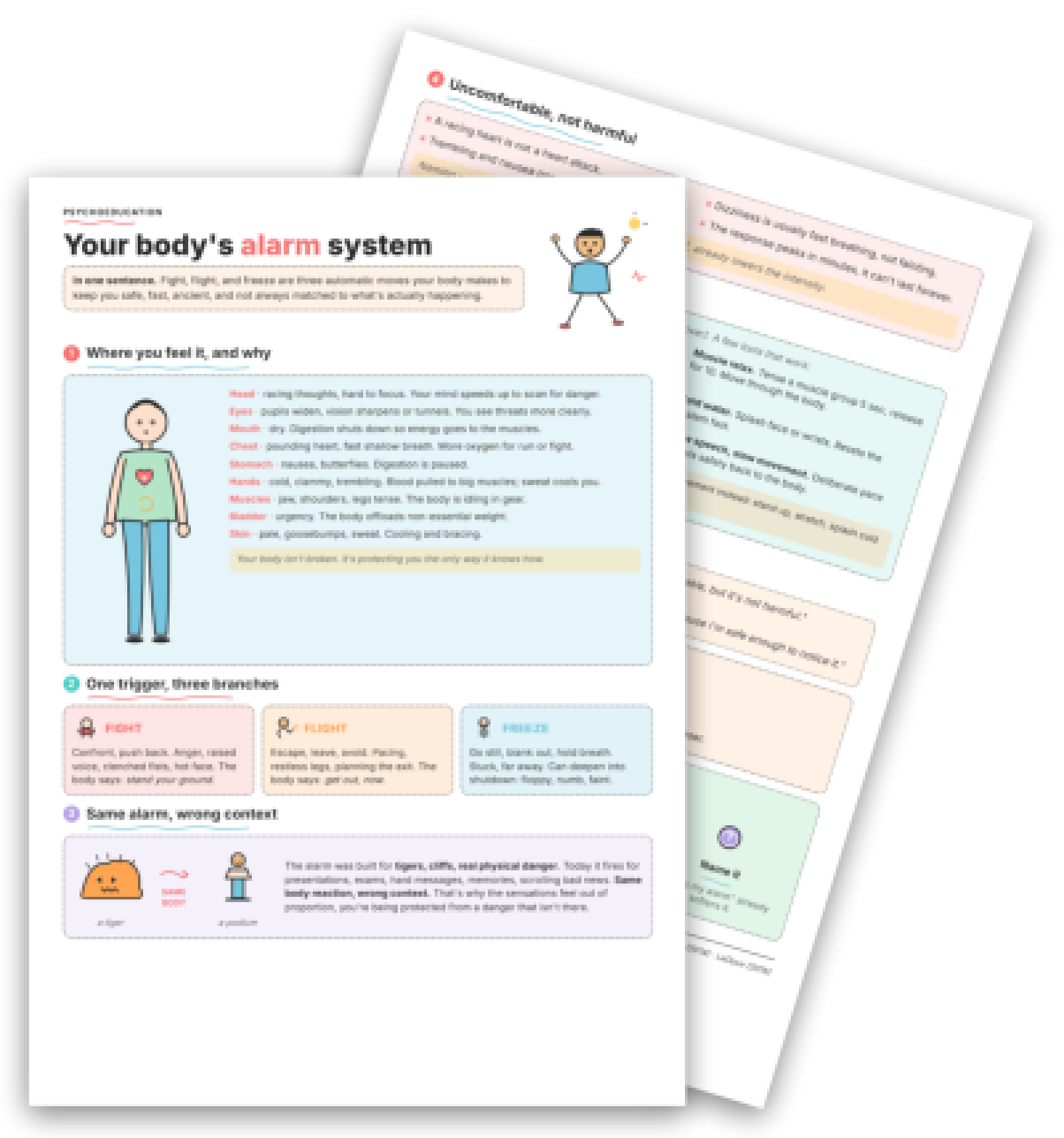
A visual psychoeducation fiche helping clinicians explain the body's alarm system in session, from somatic symptoms to concrete regulation tools.
Clinical vignettes
Freeze Response Mistaken for Indifference
Flight Activation Before Medical Appointments
Clinical picture. A., a woman in her late forties with a history of health anxiety, described an escalating pattern of cancelling GP appointments at the last minute, always accompanied by restlessness, pacing, and an urgent need to leave the waiting room. The clinician introduced the fight-flight-freeze sheet as a shared reference point, drawing her attention to the flight column and the body-map section on chest tightening and cold hands. A. noted that her symptoms matched the sheet closely, which shifted her framing from "I am weak" to "my alarm is firing in the wrong context." Over the following weeks she used the phrase "same body, wrong context" as a brief self-prompt; appointment avoidance decreased, though residual anticipatory anxiety remained and continued to be addressed in sessions.
Explaining the fight-flight-freeze response verbally in session often produces polite nodding without genuine conceptual uptake. Patients who catastrophise palpitations, freeze during conflict, or dissociate under pressure rarely connect those experiences to an evolutionarily conserved alarm circuit, until they can see the map. This fiche PDF is a structured visual support for that explanation: not a take-home questionnaire, but a clinician-guided psychoeducation tool you work through with the patient to make the alarm system concrete, named, and less threatening.
Use this resource with your patients
Handout, exercises and materials ready to use, right inside SessionFuel.
Why This Concept Resists Verbal Explanation in Session
The clinical challenge is specific. Patients arrive with somatic symptoms they have already labelled pathologically: the racing heart is a cardiac event, the nausea signals illness, the frozen dissociative blankness is a sign of mental fragility. Correcting those appraisals in words alone runs into the emotional reasoning that sustains them. Telling a patient their body is functioning normally does not feel convincing when that body currently feels broken.
The second difficulty is granularity. Three branches (fight, flight, freeze) share one activating mechanism but produce radically different presentations. Patients who predominantly freeze are often misread, and they frequently misread themselves, as lazy or weak rather than as maximally defended. Without a visual that places freeze alongside the other two branches on the same arc, the explanation rarely lands. For patients presenting with panic attacks or PTSD symptoms, the mismatch between alarm intensity and actual danger is a core maintenance mechanism; naming it precisely accelerates the recadrage cognitif that follows.
What the Fiche Contains: A Body-by-Body Visual Map
The fiche PDF organises its content across six numbered panels, each addressing one layer of the alarm response.
The first panel maps nine body areas (head, eyes, mouth, chest, stomach, hands, muscles, bladder, skin) with a brief explanatory phrase for each. "A pounding heart, fast shallow breath, more oxygen for run or fight." Patients who have experienced hyperventilation, cold extremities, or an urgent need to urinate during anxiety immediately recognise themselves. The visual layout does what oral explanation cannot: it shows everything happening simultaneously, and frames each sensation as functional, not pathological.
The second panel separates FIGHT, FLIGHT, and FREEZE as three distinct branches of one trigger, each with its signature behavioural markers. Freeze is distinguished further into full shutdown, "floppy, numb, faint," which is clinically important for patients working on trauma reactions or dissociative presentations.
Panel three carries the conceptual pivot the fiche is built around: a tiger on one side, a podium on the other, with the caption "same body, wrong context." This image compresses in two seconds what takes five minutes to convey verbally. It is directly useful for patients with generalised anxiety, social anxiety, or health anxiety whose alarm system fires for evaluative rather than physical threats.
Panels four through six move from explanation to regulation: a set of myth-busters ("a racing heart is not a heart attack"), then six concrete down-regulation tools (extended exhale breathing, progressive muscle relaxation, 5-4-3-2-1 sensory grounding, cold water, deliberate movement, slowed speech), and finally four self-talk phrases calibrated to interrupt catastrophic appraisal mid-activation. A specific note distinguishes regulation for freeze from regulation for fight/flight, gentle movement rather than relaxation, which can deepen shutdown.
> Key point: the fiche is a visual support that facilitates the explanation of the fight-flight-freeze response in session, not an independent homework task. Its value is in the shared looking: pointing at a body diagram changes the register from self-report to observation.
750+ clinical tools
A library built with and for clinicians, ready to use in session and extend between appointments.
Access all the toolsWhen and How to Introduce It in Session
The fiche fits naturally in the psychoeducation phase, typically sessions two to four, once the initial formulation is sketched and the alliance is sufficient for normalisation work. It is particularly indicated for patients whose somatic hypervigilance is sustaining avoidance (panic, health anxiety, PTSD), and for those who are confused or ashamed by their freeze response.
A low-stigma introduction: "I want to show you a diagram that maps what your body is actually doing when this kicks in, most people find it clarifying." Walk through panels one and two together, pausing on any body area the patient recognises. Let the tiger-versus-podium image (panel three) do its own work before you comment.
Debrief by asking which branch they identify with most, and whether the freeze note applies. This feeds directly into case formulation and guides the selection of next-step tools: coping skills for anxiety, an autonomic nervous system overview, or a structured anxiety psychoeducation programme for between-session consolidation. For adolescent or paediatric presentations, pairing it with age-appropriate coping strategies maintains coherence across the care plan.
The fiche does not replace the therapeutic frame. What it does is give patients a working vocabulary for what is happening in their body, reduce shame around symptoms that feel out of control, and leave a concrete reference they can return to between sessions.
Use it with your patients
Share this tool in the mobile app and follow the work between sessions.
Sources
- Cannon, W. B. (1915). Bodily Changes in Pain, Hunger, Fear and Rage: An Account of Recent Researches into the Function of Emotional Excitement. D. Appleton and Company.
- Levine, P. A. (1997). Waking the Tiger: Healing Trauma. North Atlantic Books.
Your session continues in your patients' pocket
Use with a patientYour resources, available everywhere
The handouts, exercises, programs and audios above: you choose which ones to make available to your patients, in the mobile app dedicated to them.
And far more than a library
The app goes well beyond resources, to support your patients every day:
Related categories
Explore other clinical resources by category.
Anxiety
Clinical hub for anxiety disorders: CBT and ACT worksheets, psychoeducation sheets, and exercises for assessment and treatment across the anxiety spectrum.

Trauma
Clinical hub on trauma and PTSD: assessment, differential diagnosis, treatment phases, and printable resources for practitioners. 155 chars.

Emotions
Clinical resources on emotion regulation: worksheets, coping tools, CBT, REBT, and ACT exercises for therapists working across diagnoses and age groups.

Understand
Clinical hub for the therapeutic aim 'Understand': worksheets and tools to build patient insight across CBT, ACT, schema therapy and more.

Regulate
Clinical resources for emotion regulation: worksheets, ACT exercises, and psychoeducation tools for affect regulation across diagnoses. For clinicians.

CBT
CBT worksheets, cognitive restructuring exercises & behavioral tools for clinicians. Evidence-based resources for every phase of cognitive behavioral therapy.