
Clinical picture. T., a woman in her early 30s, presented with recurrent episodes of chest tightness, tingling in her hands, and a sensation of unreality that she attributed to cardiac pathology; cardiology had found nothing abnormal. In session, the clinician introduced the informational sheet on breathing and feelings, walking through the three breathing modes and the mechanism of respiratory alkalosis. T. had not previously connected her habit of shallow, rapid breathing during stressful meetings to the sensations she feared. She practised the 4-2-4 paced breathing sequence during the session and noticed the tingling subside within two minutes. At follow-up she reported that naming the physiology had reduced her tendency to catastrophise the sensations, though she continued to find slow-breathing effortful under acute stress.
How Breathing Affects Feelings: PDF Worksheet, Tools and Exercises
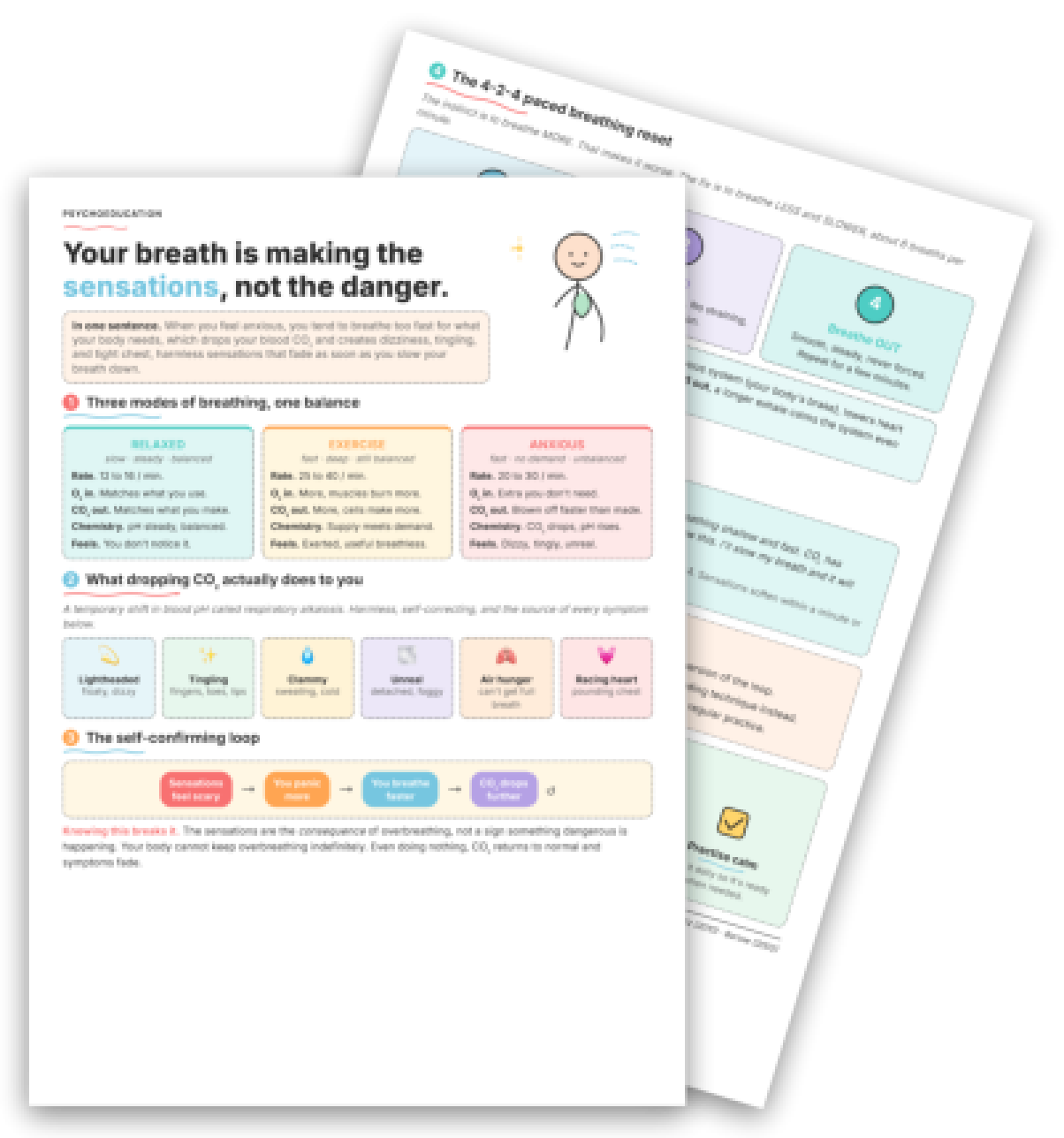
A printable psychoeducation fiche mapping the CO₂-anxiety loop, the 4-2-4 breathing reset, and a cognitive reframe, a visual tool clinicians use in session to make the physiology of panic immediately clear.
Clinical vignettes
Psychoeducation Reframes Chest Tightness
Breaking the Self-Confirming Loop
Clinical picture. M., a man in his mid-40s with a long history of panic disorder, described a pattern in which noticing any breathlessness immediately escalated into full panic; he understood intellectually that his attacks were not dangerous but could not act on that knowledge in the moment. The clinician used the sheet's loop diagram to map M.'s specific sequence: sensations felt scary, he breathed faster, CO₂ dropped further, symptoms intensified. Seeing the cycle drawn out shifted his explanatory frame from 'something is wrong with my heart' to 'I am overbreathing and the chemistry will self-correct.' Over three weeks of practising the 4-2-4 reset between sessions, M. reported two episodes in which he slowed his breath before the panic peaked. He described the outcome as unremarkable rather than triumphant, which the clinician noted as a clinically useful sign of desensitisation.
Most patients intellectually accept that anxiety is "just in their head," then go home and still interpret a tingling hand as a sign of imminent collapse. The gap between conceptual understanding and somatic reassurance is exactly where psychoeducation on breath physiology tends to break down when delivered verbally. This fiche PDF closes that gap by giving you a visual architecture to walk through together in session, leaving the patient with something concrete to hold onto between appointments.
Use this resource with your patients
Handout, exercises and materials ready to use, right inside SessionFuel.
Why the Breathing-Anxiety Connection Resists a Simple Verbal Explanation
The mechanism is elegant but counterintuitive. Anxious hyperventilation does not produce a shortage of oxygen; it produces a surplus of it, while blowing off CO₂ faster than the body generates it. The resulting respiratory alkalosis (a transient shift in blood pH, harmless and self-correcting) generates precisely the dizziness, tingling, chest tightness, and derealisation that patients read as confirming danger. Explaining this orally almost always fails for one reason: the patient's interpretive bias is already activated. They have experienced these sensations as threatening many times, and a verbal reframe rarely competes with that somatic memory.
The second problem is the self-confirming loop. The sensations feel dangerous, breathing accelerates, CO₂ drops further, symptoms intensify. Describing a feedback loop in words is abstract; showing it as a visual cycle is structurally different. Patients who struggle with understanding anxiety's physical dimension or whose profile overlaps with panic disorder are particularly likely to need that visual anchor to interrupt catastrophic appraisal.
What the Fiche Contains: A Visual Map from Physiology to Reframe
The fiche is organised across five structured panels, each serving a distinct psychoeducation function. You are not handing the patient a questionnaire to fill in; you are using a support visuel to guide a shared explanation, pointing to diagrams as you speak.
- Panel 1 (Three breathing modes): A side-by-side comparison of relaxed, exercise, and anxious breathing, showing rate, O₂/CO₂ balance, and subjective feel for each. The column for anxious breathing reads "fast · no demand · unbalanced", which many patients find unexpectedly validating: their body is not broken, it is running a mismatched program.
- Panel 2 (CO₂ effects): Six labelled somatic symptoms of respiratory alkalosis, iconically presented, from lightheadedness and tingling to air hunger and depersonalisation. This panel is where most patients say "that is exactly what I feel."
- Panel 3 (The self-confirming loop): A circular diagram illustrating the escalation from sensation to panic to faster breathing and back.
- Panel 4 (The 4-2-4 reset): Step-by-step paced breathing at roughly six breaths per minute, with a rationale grounded in parasympathetic activation: "Slow breathing engages the parasympathetic nervous system (your body's brake), lowers heart rate, and lets CO₂ rebuild to normal."
- Panel 5 (Cognitive reframe): An "old story / new story" contrast set in a concrete scene (tingling hands in a meeting), bridging the physiological explanation to cognitive restructuring work.
> Key point: this fiche is a visual support that facilitates the explanation of breath physiology in session; it is not a self-monitoring form. The clinician reads and points, the patient follows and responds. The printable stays with the patient as a reference between consultations, not as homework to complete.
The closing "To discuss in session" section prompts the patient to flag if 4-2-4 increases dissociation (a relevant caution for depersonalisation-prone presentations), which gives you an opening to shift toward grounding techniques or DBT TIPP skills instead.
750+ clinical tools
A library built with and for clinicians, ready to use in session and extend between appointments.
Access all the toolsWhen and How to Introduce the Fiche in Session
The fiche fits naturally in early-to-mid treatment, once initial case formulation is in place and the patient has described at least one clear episode of anxious physical symptoms. It works across diagnoses: GAD, panic disorder, health anxiety, social anxiety with prominent somatic features, and presentations involving dissociation or derealisation.
A low-stigma introduction: "I want to show you something about what your body is actually doing in those moments. There is a very specific chemistry behind what you are feeling, and once you see it drawn out, the sensations start to make a different kind of sense." Open the fiche and move through it panel by panel, pausing on the loop diagram. Most patients need a full minute at Panel 2 to match the symptom list to their own experience.
Debrief by asking which panel surprised them most. Patients who fixate on the loop diagram often have strong safety behaviors to address next; those drawn to the old/new story panel are ready to work on challenging anxious automatic thoughts. For younger patients or adolescents, consider pairing it with the fight-flight-freeze explanation for a fuller picture of the autonomic nervous system.
The fiche does not replace exposure work or deeper cognitive restructuring; it gives the patient an accurate map of what is happening so that subsequent interventions, whether interoceptive exposure or anxiety-focused coping work, rest on a shared physiological vocabulary rather than on vague reassurance.
Use it with your patients
Share this tool in the mobile app and follow the work between sessions.
Sources
- Merck & Co. (2025). Respiratory Alkalosis. Merck Manual Professional Edition.
- (2025) The effect of slow breathing in regulating anxiety. Scientific Reports.
- (2024) The effect of slow-paced breathing on cardiovascular and emotion functions: a meta-analysis and systematic review. Mindfulness.
Your session continues in your patients' pocket
Use with a patientYour resources, available everywhere
The handouts, exercises, programs and audios above: you choose which ones to make available to your patients, in the mobile app dedicated to them.
And far more than a library
The app goes well beyond resources, to support your patients every day:
Related categories
Explore other clinical resources by category.
Anxiety
Clinical hub for anxiety disorders: CBT and ACT worksheets, psychoeducation sheets, and exercises for assessment and treatment across the anxiety spectrum.

Emotions
Clinical resources on emotion regulation: worksheets, coping tools, CBT, REBT, and ACT exercises for therapists working across diagnoses and age groups.

Understand
Clinical hub for the therapeutic aim 'Understand': worksheets and tools to build patient insight across CBT, ACT, schema therapy and more.

Regulate
Clinical resources for emotion regulation: worksheets, ACT exercises, and psychoeducation tools for affect regulation across diagnoses. For clinicians.

CBT
CBT worksheets, cognitive restructuring exercises & behavioral tools for clinicians. Evidence-based resources for every phase of cognitive behavioral therapy.
Trauma
Clinical hub on trauma and PTSD: assessment, differential diagnosis, treatment phases, and printable resources for practitioners. 155 chars.