
Clinical picture. R., a man in his late thirties, presented with recurrent episodes of rapid heartbeat, dry mouth, and a conviction that he was about to lose consciousness, which had led to two emergency department visits with no cardiac findings. During the session, the clinician introduced the autonomic nervous system worksheet and walked through the sympathetic column organ by organ. R. paused at the cardiac row and said, quietly, that he had never considered his heart simply responding to a signal rather than malfunctioning. By the following session he reported one episode in which he applied the reframe in the moment; he did not leave the situation, and the episode resolved within minutes rather than escalating.
Autonomic Nervous System: PDF Worksheet, Tools and Exercises
A visual PDF worksheet, clinical tools, and concrete exercises to explain the body's stress and recovery system to patients in session.
Clinical vignettes
Reframing Palpitations in Panic
Gut Symptoms and Named Anxiety
Clinical picture. M., a woman in her mid-twenties with generalised anxiety, described persistent nausea and cramping that her gastroenterologist had attributed to a functional disorder, a diagnosis she found unsatisfying and somewhat dismissive. The clinician used the informational sheet to explain the enteric nervous system and its two-way connection with the central nervous system, noting that digestive shutdown under sympathetic activation is a structural feature, not a character flaw or imagined complaint. M. responded with visible relief, commenting that having a named mechanism made the symptoms feel less threatening. She began tracking the timing of gut symptoms alongside mood and stress ratings, which subsequently supported the formulation and improved her engagement with behavioural interventions.
Patients who present with somatic anxiety, panic, or health anxiety regularly misattribute their physiology to pathology. The racing heart is a cardiac event, the gut knot is a digestive illness. Explaining the autonomic nervous system verbally rarely shifts that conviction. This PDF worksheet gives you a visual anchor for the conversation, organ by organ, so the patient can see the mechanism rather than simply being asked to trust it.
Use this resource with your patients
Handout, exercises and materials ready to use, right inside SessionFuel.
Why Autonomic Nervous System Psychoeducation Resists Verbal Explanation
The central clinical problem is that the somatic cascade feels chaotic from the inside. Words like "sympathetic activation" carry no experiential weight for most patients, and the standard "fight or flight" summary leaves them with no usable map of their own body. Patients with panic disorder need to see why a dry mouth and tunnel vision arrive together. Patients with GAD who hypervigilate on physical cues need a reference that names and normalizes each sensation specifically, not a generic reassurance.
There is also the layer of self-blame. Many patients believe they should have been able to "control their reaction." Dismantling that belief in spoken language is slow work. A printed schematic that externalizes the system, showing it as bilateral, automatic, and purposefully engineered, does that dismantling faster. The patient can point to it, carry it home, and come back to it when the conviction of pathology returns between sessions.
What the Fiche Contains: A Visual Support Built for Session Use
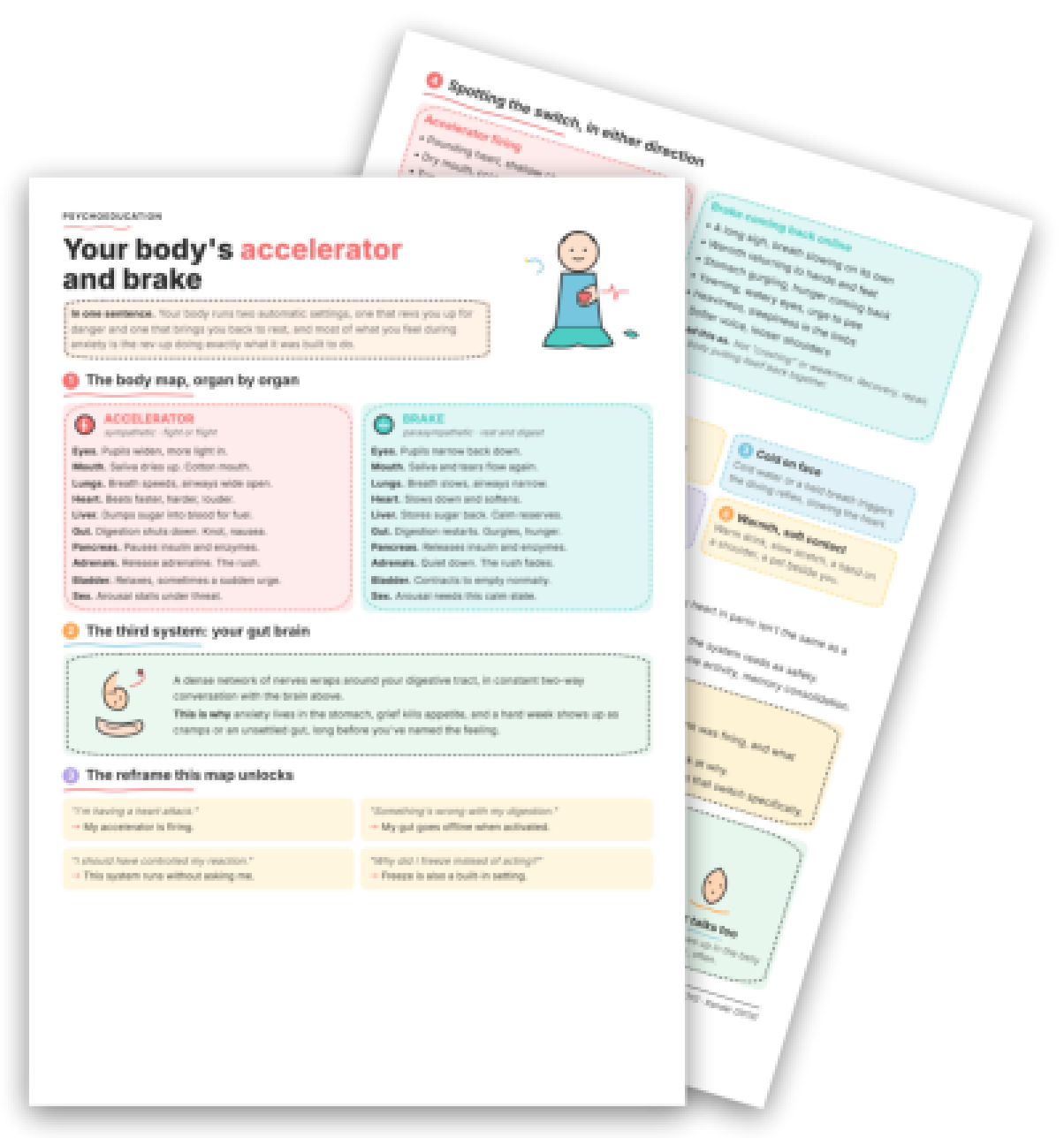
The worksheet is structured across six labeled panels, all grounded in plain language.
- A bilateral body map, organ by organ, listing each structure twice: once under "Accelerator, sympathetic / fight or flight" and once under "Brake, parasympathetic / rest and digest." Each entry is one or two sentences. "Gut. Digestion shuts down. Knot, nausea." on the accelerator side; "Gut. Digestion restarts. Gurgles, hunger." on the brake side. The layout makes the system legible without requiring anatomical vocabulary.
- A short section on the enteric nervous system, framed as "your gut brain," explaining the bidirectional conversation between the digestive tract and the brain. This lands well with patients who carry shame around GI symptoms or who present like those screened with the anxiety physical sensations exercise.
- A cognitive reframe panel that converts catastrophic interpretations into physiological descriptions. "I'm having a heart attack." becomes "My accelerator is firing." Having this in print lets you work through each reframe collaboratively rather than dictating reformulations.
- Symptom checklists for both directions: accelerator firing (pounding heart, dry mouth, tunnel vision, trembling legs) and brake coming back online (warmth returning to hands, stomach gurgling, yawning, heaviness). The brake-return list is particularly useful for patients who interpret recovery symptoms as a new wave of distress.
- Six brake-nudging techniques, each described mechanistically: extended exhale, audible sigh, cold water on the face, humming or singing, environmental naming, and warm contact. The mechanistic framing (the exhale is "the brake's lever"; humming "stimulate[s] the vagus nerve") preserves credibility for patients who are skeptical of relaxation tools.
- A common confusions block addressing three persistent clinical obstacles: misattributed symptoms, the limits of voluntary control, and the active, restorative nature of calm.
> Key takeaway: The fiche is a visual support that facilitates explanation in session. The bilateral layout, reframe panel, and symptom checklists do work that spoken description alone cannot: they externalize a system the patient currently experiences as random and threatening, and leave a concrete reference to consult between appointments.
Clinical library
750+ clinical tools
A library built with and for clinicians, ready to use in session and extend between appointments.
Access all the toolsSeveral resource types
Psychoeducation handouts
Understand at a glance
Interactive exercises
To do and fill in
Interactive programs
A structured path
Audios
Meditation and relaxation
Psychometric tests
Automatic scoring
When and How to Introduce the Worksheet
This resource fits naturally in the second or third session, once the presenting problem is established and before graded exposure or deeper cognitive work begins. It is especially well suited for:
- Patients with panic attacks or panic disorder who remain convinced their symptoms indicate physical pathology
- Patients with PTSD whose freeze response confuses or shames them (the fiche explicitly names freeze as "also a built-in setting")
- Patients carrying body-shame around GI symptoms, sweating, or disrupted sexual function under stress
- Any patient where fear psychoeducation is the next clinical step, alongside resources like the Fear Psychoeducation program or the anxiety psychoeducation curriculum
A low-labeling introduction works well: "I'd like to show you a map of what happens in your body when you're under pressure. It's a reference we'll build on over the next few sessions." Walk through the body map together, asking the patient to identify which sensations are familiar. The reframe panel works as a collaborative exercise rather than a reading task.
Debrief the brake-nudging section by asking which technique feels immediately accessible and which feels impossible. The worksheet itself frames this as a session discussion point. That contrast is clinically informative and opens the door to the relaxation response work that naturally follows.
For between-session use, the symptom checklist pairs well with the anxiety physical sensations monitoring exercise. With patients in acute dissociative presentations, establish basic somatic grounding first (the sensory grounding exercise is a useful precursor) before introducing the body map. The fiche does not replace the therapeutic frame; it makes the explanation more precise and leaves the patient something concrete to hold onto.
Use it with your patients
Share this tool in the mobile app and follow the work between sessions.
Sources
- Porges, S. W. (2011). The Polyvagal Theory: Neurophysiological Foundations of Emotions, Attachment, Communication, and Self-regulation. W. W. Norton and Company.
- Jänig, W. (2006). Integrative Action of the Autonomic Nervous System: Neurobiology of Homeostasis. Cambridge University Press.
- Dana, D. (2018). The Polyvagal Theory in Therapy: Engaging the Rhythm of Regulation. W. W. Norton and Company.
- Jänig, W. (2022). The Integrative Action of the Autonomic Nervous System: Neurobiology of Homeostasis (2nd ed.). Cambridge University Press.
Patient mobile app
Your session continues in your patients' pocket
Use with a patientYour resources, available everywhere
The handouts, exercises, programs and audios above: you choose which ones to make available to your patients, in the mobile app dedicated to them.
Psychoeducation handoutsInteractive exercisesInteractive programsAudiosPsychometric tests
And far more than a library
The app goes well beyond resources, to support your patients every day:
Standardized tests
Therapy journal
Gamification
Wellbeing challenges
Introspection prompts
Therapist homework
Related categories
Explore other clinical resources by category.

Anxiety
Clinical hub for anxiety disorders: CBT and ACT worksheets, psychoeducation sheets, and exercises for assessment and treatment across the anxiety spectrum.

Trauma
Clinical hub on trauma and PTSD: assessment, differential diagnosis, treatment phases, and printable resources for practitioners. 155 chars.

Emotions
Clinical resources on emotion regulation: worksheets, coping tools, CBT, REBT, and ACT exercises for therapists working across diagnoses and age groups.

Health
Somatic health clinical resources for practitioners: worksheets, psychoeducation, and exercises for somatic symptom disorder, chronic pain, and more.

Understand
Clinical hub for the therapeutic aim 'Understand': worksheets and tools to build patient insight across CBT, ACT, schema therapy and more.

Regulate
Clinical resources for emotion regulation: worksheets, ACT exercises, and psychoeducation tools for affect regulation across diagnoses. For clinicians.