
Clinical picture. A., a woman in her early 40s, presented with a longstanding pattern of social withdrawal and vague somatic complaints that she struggled to articulate in session. Her clinician introduced the fear psychoeducation program as between-session work, starting with Lesson 1, which asks patients to name two or three personal fears and consider how realistic each one is. A. returned the following week having written that her fears centered on emotional closeness and on being judged as incompetent, and she noted, with some surprise, that she had rated both as partly unrealistic. This small act of labeling created enough distance for her to begin discussing avoidance behaviors she had never previously named as fear-driven.
Fear Psychoeducation: A Structured 5-Lesson Clinical Program
Help patients map fear's protective, motivating, and limiting functions through an autonomous step-by-step homework program.
Clinical vignettes
Naming Fear Before Avoiding It
Recognizing a Freeze Response in Anxiety
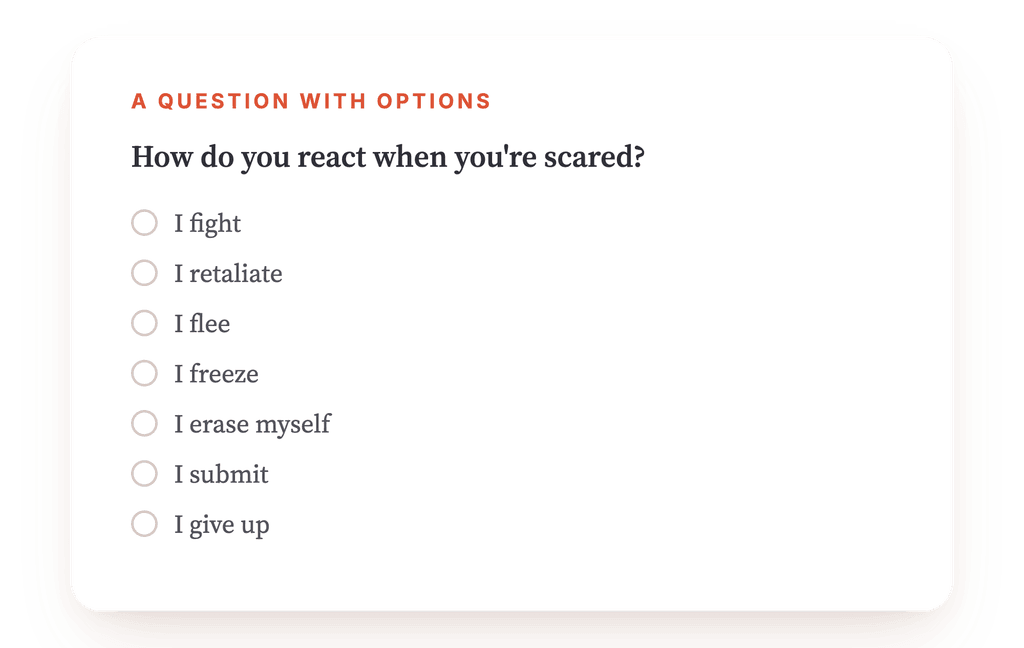
Clinical picture. M., a man in his late 20s referred for generalized anxiety, described feeling "blank and paralyzed" in situations of uncertainty at work, without understanding why. His clinician assigned Lesson 1 of the fear program as independent work between appointments, drawing his attention to the section on defense mechanisms and the multiple-choice item asking how he responds when afraid. M. selected "freeze" and "submit," then brought those answers into the next session as a concrete starting point. Reframing his paralysis as a recognizable, functional fear response reduced some of his self-critical rumination and allowed the clinician to begin mapping the specific triggers that activated it.

Use this resource with your patients
Handout, exercises and materials ready to use, right inside SessionFuel.
The Clinical Challenge: What Makes Fear Hard to Address
Fear is universal and adaptive, yet patients rarely arrive with a working map of how it operates in their own lives. The core difficulty is not a lack of information: it is that fear hijacks the very cognitive resources needed to reflect on it. In the grip of an activated amygdala, verbal psychoeducation has limited reach, and a well-intentioned explanation during a consultation is often forgotten before the next appointment.
Several dimensions compound the clinical picture. Fear's protective, motivating, and limiting functions coexist and overlap, and patients frequently conflate them, either dismissing every alarm as irrational or treating every signal as a genuine threat. The fight-flight-freeze response is well documented, yet its personal somatic expression varies widely and rarely gets made explicit. The role of cortisol and adrenaline, the illusion of control in the face of potential loss, and the slow work of building courage all resist a single oral explanation. This is where a structured between-session program earns its clinical value.
Clinical library
750+ clinical tools
A library built with and for clinicians, ready to use in session and extend between appointments.
Access all the toolsSeveral resource types
Psychoeducation handouts
Understand at a glance
Interactive exercises
To do and fill in
Interactive programs
A structured path
Audios
Meditation and relaxation
Psychometric tests
Automatic scoring
What This Five-Lesson Program Contains
The program moves patients through a progressive arc of five lessons, each building directly on the previous one.
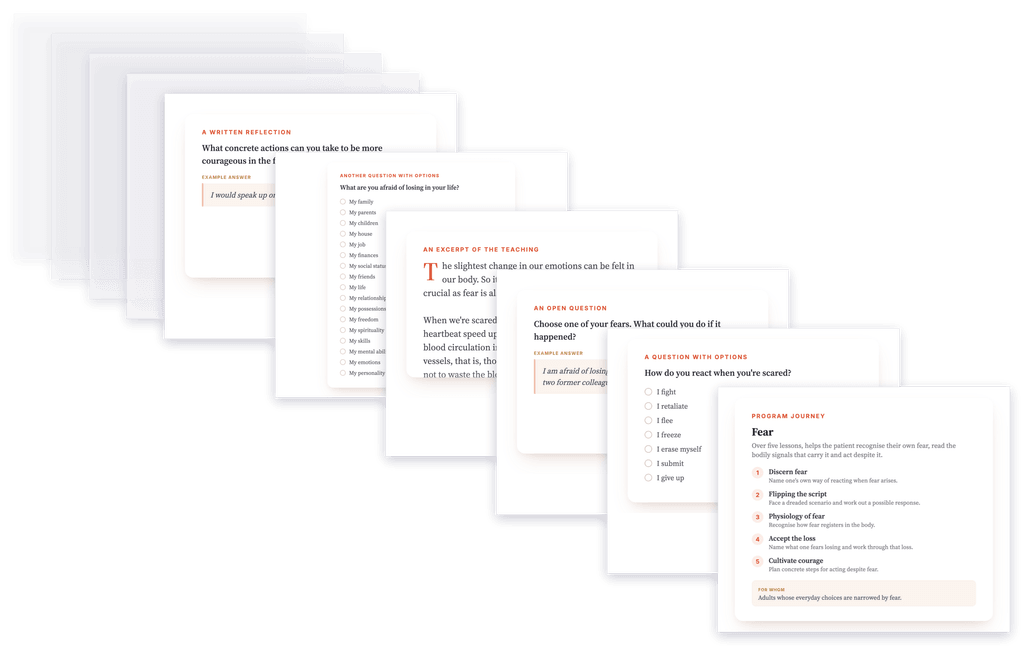
Lesson 1 (Discerning Fear) lays the conceptual ground: the amygdala's role, the four primary defense responses, and fear's three distinct functions. Patients name their own fears, rate their realism, and identify their personal reaction patterns through guided prompts and multiple-choice questions. This kind of systematic self-inquiry complements tools like the What Keeps Fears and Phobias Going fiche by situating the clinical theory inside the patient's lived experience.
Lesson 2 (Flipping the Script) shifts to anticipatory work. When fear is not actively felt, patients explore how they could protect, motivate, and free themselves from limitation if the feared situation became real. Fear is reframed as a guide rather than a verdict, a move that resonates naturally with psychological flexibility work and with the Control, Influence, Accept framework.
Lesson 3 (The Physiology of Fear) maps the bodily experience: where fear is felt, how adrenaline and cortisol operate, and which somatic regulation strategies the patient can realistically adopt. Clinicians who already use the Nervous System Regulation fiche or the How Your Body Responds to Stress worksheet will find this lesson a direct extension of that psychoeducation.
Lesson 4 (Accepting Loss) addresses the fear-of-loss mechanism explicitly. Most fear, the lesson proposes, is rooted in the threat of losing something: a person, a status, control, certainty. Patients examine specific feared losses, challenge the illusion of control, practice sitting with uncertainty, and explore how loss can become a catalyst for growth. This pairs naturally with the Intolerance of Uncertainty program and with work on active acceptance.
Lesson 5 (Cultivating Courage) closes the arc with a focus on action. Courage is framed not as a fixed trait but as a practice built step by step: patients identify domains where they already act courageously, domains where they want more, and concrete next actions calibrated to their pace. The Comfort, Stretch and Panic Zones fiche makes a useful companion resource at this stage.
These preview images show only a small aperçu of the program; the full curriculum contains far more lessons, steps, guided prompts, and multiple-choice questions than what is visible in the excerpts here.
Key insight: Fear's three functions, protection, motivation, and limitation, rarely operate in isolation. A program that maps all three and connects them to physiology, loss, and courage gives patients a working model they can actually use between appointments.
This program is available to your patients through the patient mobile application of SessionFuel, the dedicated companion app reserved for patients of clinicians who use SessionFuel: you assign it directly from your account, and your patient completes each lesson autonomously on their phone, on their own time between consultations.
Use it with your patients
Share this tool in the mobile app and follow the work between sessions.
Integrating This Program Into Your Practice
Which patients benefit most. The program suits patients with generalized anxiety, specific fears, avoidance patterns, difficulty tolerating uncertainty, or those navigating a significant life transition where loss is a live theme. It also works well for patients who intellectually understand their fear but have never mapped its somatic or functional dimensions with any precision. Given the loss-centered fourth lesson, it can be particularly valuable alongside grief work or major change processes. Clinicians working with the Cycle of Avoidance or Safety Behaviors fiche will find the program reinforces that clinical thread without duplicating it.
How to introduce it. Frame the assignment clearly: between this consultation and the next, the patient will work through the first one or two lessons at their own pace. There is no performance pressure; the prompts and multiple-choice questions invite reflection, not correct answers. Reassure patients that the program asks nothing about confronting feared situations, only mapping them with more precision.
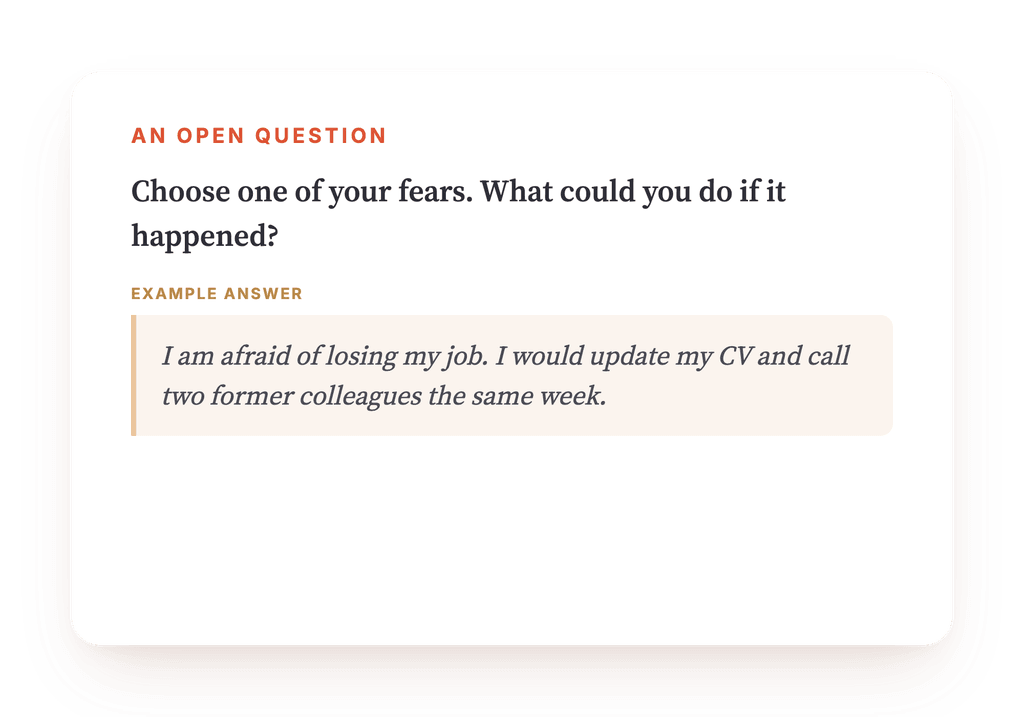
How to use what they bring back. The written prompt responses, such as describing a situation where fear limited them or naming a feared loss already present in their life, become direct clinical material at the next session. For patients where courage-building emerges as the central focus, the Resilience Psychoeducation program can serve as a natural follow-on assignment.

Patient mobile app
Your session continues in your patients' pocket
Use with a patientYour resources, available everywhere
The handouts, exercises, programs and audios above: you choose which ones to make available to your patients, in the mobile app dedicated to them.
Psychoeducation handoutsInteractive exercisesInteractive programsAudiosPsychometric tests
And far more than a library
The app goes well beyond resources, to support your patients every day:
Standardized tests
Therapy journal
Gamification
Wellbeing challenges
Introspection prompts
Therapist homework
Related categories
Explore other clinical resources by category.

Anxiety
Clinical hub for anxiety disorders: CBT and ACT worksheets, psychoeducation sheets, and exercises for assessment and treatment across the anxiety spectrum.

Emotions
Clinical resources on emotion regulation: worksheets, coping tools, CBT, REBT, and ACT exercises for therapists working across diagnoses and age groups.

Understand
Clinical hub for the therapeutic aim 'Understand': worksheets and tools to build patient insight across CBT, ACT, schema therapy and more.

Build awareness
Clinical worksheets and tools to build awareness in therapy: cognitive distortions, schemas, emotions, ACT and CBT resources for practitioners.

ACT
Clinical hub for Acceptance and Commitment Therapy (ACT): worksheets, exercises, programs and audio resources for practitioners using the ACT model.

Integrative
Integrative therapy clinical resources: worksheets, psychoeducation programs, and exercises for eclectic, multimodal practice across orientations.