
Clinical picture. M., a woman in her early forties, presents with persistent low mood and longstanding occupational avoidance, organised around the fused belief "I am incompetent" following a redundancy two years prior. In session, the clinician introduces the dual-hexagon framework from the psychological flexibility informational sheet, pointing out the distinction between fusion and defusion without asking M. to challenge the content of the thought. M. practises adding the frame "I am having the thought that I am incompetent" aloud, then sits quietly for a moment and notes, with some surprise, that the sentence felt "further away." She does not report the belief as gone, but agrees to bring the defusion phrase into one avoided work task before the next session. At follow-up she had sent a job application, describing the process as uncomfortable but possible.
Psychological Flexibility: PDF Worksheet, Tools and Exercises
A printable PDF worksheet, practical tools, and concrete exercises to explain and apply psychological flexibility in ACT-informed clinical practice.
Clinical vignettes
Unhooking from a Rigid Self-Story
Values Clarity Prompting Committed Action
Clinical picture. R., a man in his late twenties with generalised anxiety and a pattern of social withdrawal, describes his life as "on hold" while waiting to feel less anxious before re-engaging with friends. The clinician uses the informational sheet to map R.'s current position on the stuck hexagon, identifying experiential avoidance and unclear values as the dominant processes maintaining his withdrawal. Together they clarify that connection and reliability matter to him as a friend, which the sheet frames as values rather than goals. The clinician proposes one committed action aligned with those values, attending a brief social event without the precondition of feeling calm. R. reported post-session that the anxiety was present throughout the evening and that he stayed anyway, marking a shift in how he related to the feeling rather than its intensity.
Explaining psychological flexibility orally in session tends to produce polite nodding, not genuine uptake. Patients absorb the words but leave without a usable map of where they are stuck and what to do next. This PDF worksheet gives you a visual scaffold that makes the hexaflex architecture concrete, session-ready, and something the patient can take home.
Use this resource with your patients
Handout, exercises and materials ready to use, right inside SessionFuel.
Why Psychological Flexibility Resists Verbal Explanation
The construct sits at the intersection of six interacting processes. Naming them sequentially (fusion, experiential avoidance, cognitive rigidity, unclear values, temporal displacement, committed action) is accurate but overwhelms working memory. Patients tend to latch onto one piece, usually avoidance, and lose the relational logic between the others.
A second problem is that the therapeutic goal itself is counterintuitive. Patients arrive expecting symptom reduction; ACT asks them to reorient entirely. Without a clear visual contrast, phrases like "make room for your anxiety" sound like resignation. The same applies to the values-versus-goals distinction: clinicians who work regularly with the ACT hexaflex model know how often patients conflate the two, and how much time gets spent untangling them verbally when a diagram would have landed it in thirty seconds.
Defusion is perhaps the hardest piece. ACT cognitive defusion techniques require patients to experience a new relationship with thought rather than just understand one. Describing that shift without an anchor makes it abstract and slippery.
750+ clinical tools
A library built with and for clinicians, ready to use in session and extend between appointments.
Access all the toolsWhat the Fiche Contains: A Visual Tool for ACT Psychoeducation
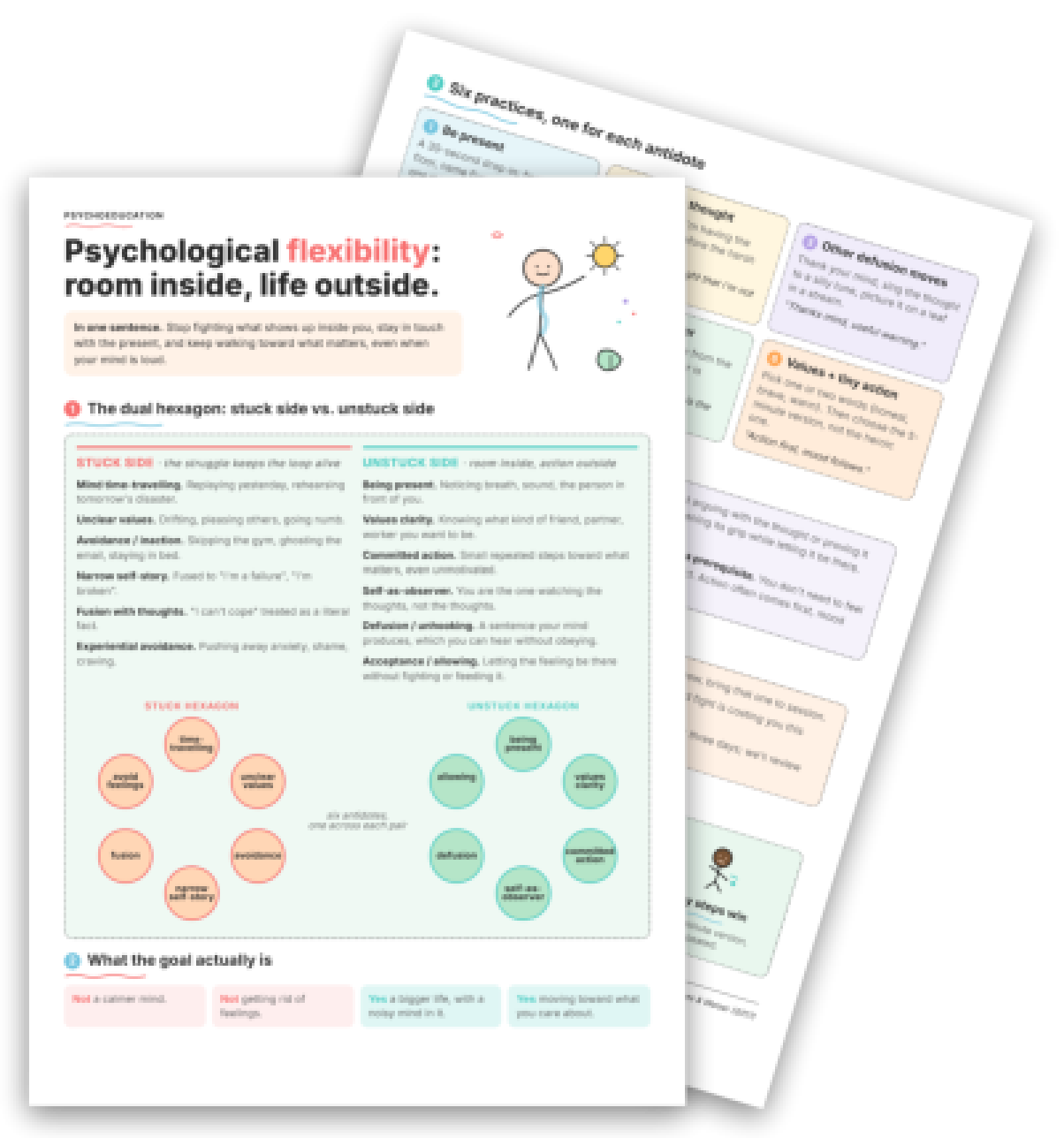
The fiche PDF is built around a dual hexagon: one side labeled STUCK, one labeled UNSTUCK, with six matched pairs set across the two faces. Each stuck process (fusion, experiential avoidance, time-travelling, unclear values, narrow self-story, avoidance or inaction) maps directly onto its antidote on the unstuck side. The layout does something a verbal explanation cannot: it shows all six pairs simultaneously, so the patient sees the system rather than a list.
A second panel clarifies the actual goal of the work with deliberate brevity: "not a calmer mind, not getting rid of feelings" but "a bigger life, with a noisy mind in it." This reframe, visible on the page, tends to land harder than when said aloud, precisely because the patient can sit with it.
The third panel describes six concrete practices, one per antidote: a 30-second grounding drop-in, the defusion phrase "I'm having the thought that...", body-based allowing, the self-as-observer distinction, and a values-plus-tiny-action sequence. Each practice comes with a one-line prompt designed to stick between sessions.
A common confusions panel addresses the four most frequent misreadings: acceptance is not resignation, defusion is not arguing with the thought, values are not goals, and motivation is not a prerequisite for action. For clinicians already using the Choice Point worksheet or working through committed action exercises, this section reinforces consistent language across tools.
Finally, three "to discuss in session" prompts are printed directly on the fiche, turning it into a debrief structure you can use at the following appointment.
> Key point: the fiche is a visual support that facilitates the explanation of psychological flexibility in session. It is not a self-administered questionnaire; it is a psychoeducation tool the clinician uses alongside the patient to make a complex model tangible, set shared vocabulary, and leave a concrete reference in the patient's hands.
Use it with your patients
Share this tool in the mobile app and follow the work between sessions.
When and How to Introduce the Fiche
The fiche fits naturally after the initial formulation, once the therapeutic contract is established and avoidance patterns have been identified. For patients presenting with generalised avoidance cycles, it pairs well with a behavioral avoidance map completed the same week.
Introduce it without diagnostic labeling: "I'd like to show you a map of two ways our minds can operate. We'll go through it together and see which parts feel familiar." Walk through the dual hexagon with the patient, asking them to point to whichever stuck process feels most active right now. That single question, grounded in what they can see on the page, replaces five minutes of abstract questioning.
For patients engaged in an ACT-based depression program or working through values clarification exercises, the fiche serves as an ongoing orientation document, something they can return to when a stuck process resurfaces between appointments.
One note of caution: with patients in acute crisis or with very limited mentalizing capacity, the hexagon may feel overwhelming on first contact. In those cases, introduce a single pair from the diagram and expand gradually.
The fiche does not replace the relational work of ACT; it makes the conceptual architecture visible so that the relational work can go deeper, faster.
Your session continues in your patients' pocket
Use with a patientYour resources, available everywhere
The handouts, exercises, programs and audios above: you choose which ones to make available to your patients, in the mobile app dedicated to them.
And far more than a library
The app goes well beyond resources, to support your patients every day:
Related categories
Explore other clinical resources by category.

Anxiety
Clinical hub for anxiety disorders: CBT and ACT worksheets, psychoeducation sheets, and exercises for assessment and treatment across the anxiety spectrum.

Mood
Evidence-based worksheets and clinical tools for mood disorders: CBT, ACT, and positive psychology resources for psychologists and therapists.

Identity
Clinical resources for self-identity work in therapy: CBT, ACT, schema tools for clinicians addressing self-concept, core beliefs, and identity disruption.

Emotions
Clinical resources on emotion regulation: worksheets, coping tools, CBT, REBT, and ACT exercises for therapists working across diagnoses and age groups.

Cognition
Printable cognitive therapy worksheets and clinical tools for therapists: CBT, ACT, schema work, defusion, distortions, and belief restructuring.

Understand
Clinical hub for the therapeutic aim 'Understand': worksheets and tools to build patient insight across CBT, ACT, schema therapy and more.