
Clinical picture. P., a 34-year-old with generalised anxiety disorder, reported abandoning two previous attempts at mindfulness practice because he "kept getting distracted" and concluded he was doing it wrong. His therapist used the anchor-drift-notice-return loop from the psychoeducational sheet to reframe what he had experienced. Rather than treating mind-wandering as a sign of incompetence, the clinician explained that each drift and return constitutes one repetition of the actual skill being trained. P. was asked to sit for eight minutes that evening, labelling thoughts softly as "thinking" or "planning" and returning to the breath without self-correction. At the following session he reported completing three consecutive days, noting that the absence of a pass-or-fail standard made continuation feel manageable.
Mindfulness Meditation: PDF Worksheet, Tools and Exercises for Clinical Practice
A printable fiche and visual tools to explain mindfulness meditation clearly in session, install a shared vocabulary, and give patients a durable practice anchor they can actually use.
Clinical vignettes
Reframing Drift as Practice, Not Failure
Adjusting the Anchor Under High Arousal
Clinical picture. M., a 51-year-old in treatment for recurrent depression, described becoming overwhelmed during a home practice session when somatic tightness in her chest drew her attention away from the breath and escalated into rumination. Her therapist reviewed the sheet's guidance on alternative anchors and suggested that on days of high physiological arousal she shift her focus to auditory stimuli in the room or to the physical sensation of her feet on the floor. M. trialled this in a brief in-session exercise, finding that sounds provided a sufficiently neutral anchor without amplifying the chest sensation. She incorporated the strategy into her daily ten-minute sessions and reported fewer aborted practices over the following fortnight.
When you introduce mindfulness in session, patients nod, and then return the following week reporting that they "failed because their mind wouldn't stop." That one misconception, the belief that a wandering mind is an error rather than the mechanism itself, quietly kills the practice before it takes hold. This fiche PDF is a visual support you can place in front of a patient during session to correct it immediately, before the misreading has time to calcify.
Use this resource with your patients
Handout, exercises and materials ready to use, right inside SessionFuel.
Why mindfulness meditation resists verbal explanation in session
The core problem is conceptual, not motivational. Patients overwhelmingly interpret attention training as attention control, and then experience each drift as a personal failure. Verbal reassurance that "it's normal" rarely shifts this frame, because the patient has no alternative mental model to replace it with.
A second friction point: the instruction "return gently" sounds deceptively simple. Without a concrete image of what that return looks like, many patients oscillate between punitive self-correction and giving up on the anchor entirely. This is especially pronounced in patients with perfectionism) or rigid self-evaluation schemas, where the tolerance for perceived incompetence is low. Patients prone to rumination) also tend to turn the wandering mind into a meta-problem, layering self-judgment onto the already activated content.
The fiche addresses both failure points at once, visually, so the clinician's explanation has something to point to rather than only something to say.
What the fiche contains: a visual loop that reframes the practice
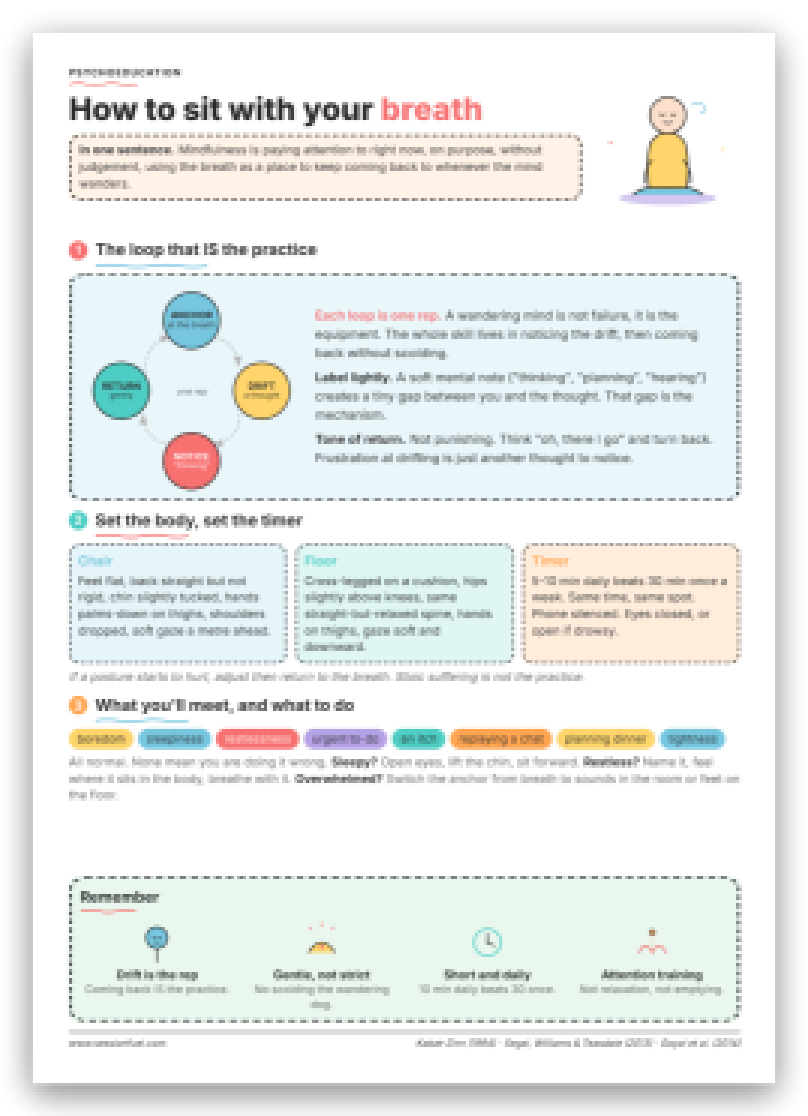
The structural centrepiece of the fiche is a four-step cycle: ANCHOR at the breath → DRIFT (a thought) → NOTICE ("thinking") → RETURN gently, labelled explicitly as "one rep." That single reframe, made visible on paper, does more clinical work than several minutes of verbal explanation. The patient can see that drift is not an interruption of the practice; it is the practice.
> Key takeaway: this fiche is a visual support that facilitates the explanation of mindfulness meditation in session. It is not a self-administered questionnaire; the clinician uses it as a psychoeducation anchor, points to the loop diagram while speaking, and hands it to the patient as a concrete reference to take home.
The fiche also frames light labelling ("thinking", "planning", "hearing") as the mechanism that creates "a tiny gap between you and the thought." This is directly compatible with the cognitive defusion) vocabulary from ACT, and with the decentering work described in distancing and decentering tools). For clinicians working within the ACT Hexaflex) framework, pointing to the fiche's loop during session allows you to name the present-moment awareness pillar concretely and immediately.
The posture section (chair and floor variations) and timer guidance (five to ten minutes daily beats thirty minutes once a week) reduce the two commonest practical barriers without requiring the clinician to address them separately. A short section on "what you'll meet" normalises boredom, sleepiness, restlessness, and somatic sensations as expected content, with brief redirects for each (lift the chin for drowsiness; name the sensation and breathe with it for restlessness; shift the anchor to sounds or foot contact if overwhelmed). The DBT mindfulness skills) framework maps neatly onto this section for clinicians who want to name the what and how skills explicitly.
Four "Remember" panels close the fiche: Drift is the rep / Gentle, not strict / Short and daily / Attention training, not relaxation. That last distinction is clinically significant and frequently misunderstood. Naming it visually prevents patients from abandoning the practice when it fails to produce immediate calm.
750+ clinical tools
A library built with and for clinicians, ready to use in session and extend between appointments.
Access all the toolsWhen and how to introduce the fiche in session
The fiche fits naturally in the second or third session, once a formal mindfulness component has been agreed upon, and before the patient attempts solo practice. Propose it with something like: "Before you try this at home, I want to show you a map of what you'll actually be doing, because the thing most people get wrong is thinking that a wandering mind means they've failed."
Point to the loop diagram while you explain the rep concept. Patients with generalised anxiety), panic disorder), or high interoceptive sensitivity may need the posture and troubleshooting sections covered explicitly before they leave. For these profiles, pair the fiche with a short body scan audio) or a present-moment grounding audio) as an initial structured exposure to anchored attention.
Debrief at the next session by asking what the patient noticed most, and which of the "what you'll meet" items showed up. This debrief naturally opens discussion of avoidance, non-judgment), and the patient's relationship with imperfection, without requiring the clinician to impose a thematic frame. For patients building broader mental health foundations), the fiche integrates well into a first lesson on present-moment living.
The fiche does not replace clinical formulation or protocol; it makes one specific explanation faster, clearer, and leaves the patient with a reference they can return to between sessions.
Use it with your patients
Share this tool in the mobile app and follow the work between sessions.
Sources
- Kabat-Zinn, J. (1994). Wherever You Go, There You Are: Mindfulness Meditation in Everyday Life. Hyperion.
- Kabat-Zinn, J. (2013). Full Catastrophe Living: Using the Wisdom of Your Body and Mind to Face Stress, Pain, and Illness (2nd ed., revised and updated). Bantam Books / Random House.
- Segal, Z. V., Williams, J. M. G., & Teasdale, J. D. (2013). Mindfulness-Based Cognitive Therapy for Depression (2nd ed.). The Guilford Press.
Your session continues in your patients' pocket
Use with a patientYour resources, available everywhere
The handouts, exercises, programs and audios above: you choose which ones to make available to your patients, in the mobile app dedicated to them.
And far more than a library
The app goes well beyond resources, to support your patients every day:
Related categories
Explore other clinical resources by category.

Anxiety
Clinical hub for anxiety disorders: CBT and ACT worksheets, psychoeducation sheets, and exercises for assessment and treatment across the anxiety spectrum.

Mood
Evidence-based worksheets and clinical tools for mood disorders: CBT, ACT, and positive psychology resources for psychologists and therapists.

Emotions
Clinical resources on emotion regulation: worksheets, coping tools, CBT, REBT, and ACT exercises for therapists working across diagnoses and age groups.

Cognition
Printable cognitive therapy worksheets and clinical tools for therapists: CBT, ACT, schema work, defusion, distortions, and belief restructuring.

Build awareness
Clinical worksheets and tools to build awareness in therapy: cognitive distortions, schemas, emotions, ACT and CBT resources for practitioners.

Regulate
Clinical resources for emotion regulation: worksheets, ACT exercises, and psychoeducation tools for affect regulation across diagnoses. For clinicians.