
Clinical picture. M., a 34-year-old accountant, presents with generalised anxiety and a pattern of protracted rumination following perceived errors at work. A recurrent thought, "I will ruin everything," occupies much of his attentional bandwidth and he reports spending hours each evening rehearsing counter-arguments that provide no lasting relief. The clinician introduces the labelling move from a psychoeducational sheet on distancing, asking M. to name the thought type rather than engage with its content: "That's a catastrophising thought" rather than "Is it true?" Over two weeks M. practises this shift at home and reports that the thought still arises but feels less like a verdict and more like a known visitor he can note and set aside. He does not describe the change as dramatic; he describes it as "a bit of room to breathe."
Distancing and Decentering: PDF Worksheet, Tools and Exercises
A visual PDF worksheet with six concrete defusion moves and exercises to help patients step back from fused thoughts, a practical psychoeducation tool for ACT and CBT clinicians.
Clinical vignettes
Labelling Breaks a Rumination Loop
Vocalising Reduces a Self-Critical Fused Thought
Clinical picture. A., a 28-year-old graduate student, describes a loud inner critic whose appraisals, particularly "You are not intelligent enough to be here," feel indistinguishable from factual statements. She has tried to challenge the thought cognitively but finds debate with it exhausting and inconclusive. Working from the decentering fiche, the clinician invites her to say the thought aloud in a slow cartoon voice during session; A. laughs briefly and notes, unprompted, "It sounds less like the truth when it's squeaky." The vocalising technique does not eliminate the thought, and the clinician frames this explicitly, but it creates enough distance for A. to notice she is having the thought rather than being it. She begins using the same move independently when the critic is loudest before seminars.
Cognitive defusion is notoriously difficult to convey verbally. Patients nod when you explain the difference between being a thought and observing one, then leave the session still fully fused with the content. This fiche PDF gives the concept a visual spine so the distinction actually lands in session, rather than dissolving the moment the patient walks out the door.
Use this resource with your patients
Handout, exercises and materials ready to use, right inside SessionFuel.
Why Decentering Resists Verbal Explanation
Decentering sits at the intersection of metacognitive awareness and ACT-style defusion: the patient must grasp that a thought is a mental event with its own phenomenology, not a factual report about reality. Explained orally, that distinction collapses quickly. The patient processes the explanation through the very fusion mechanism you are trying to address. Believability gets conflated with accuracy, and the conversation drifts toward debating whether the thought is true rather than shifting the patient's relationship to it.
This is also where standard automatic thought work reaches its ceiling. Patients who can already catch their thoughts and fill in a cognitive triangle still struggle when the thought is too hot to dispute, or when the same thought has been operating for decades. What they need is not a better counter-argument but a different stance altogether. The fiche targets precisely that gap.
What the Fiche Contains
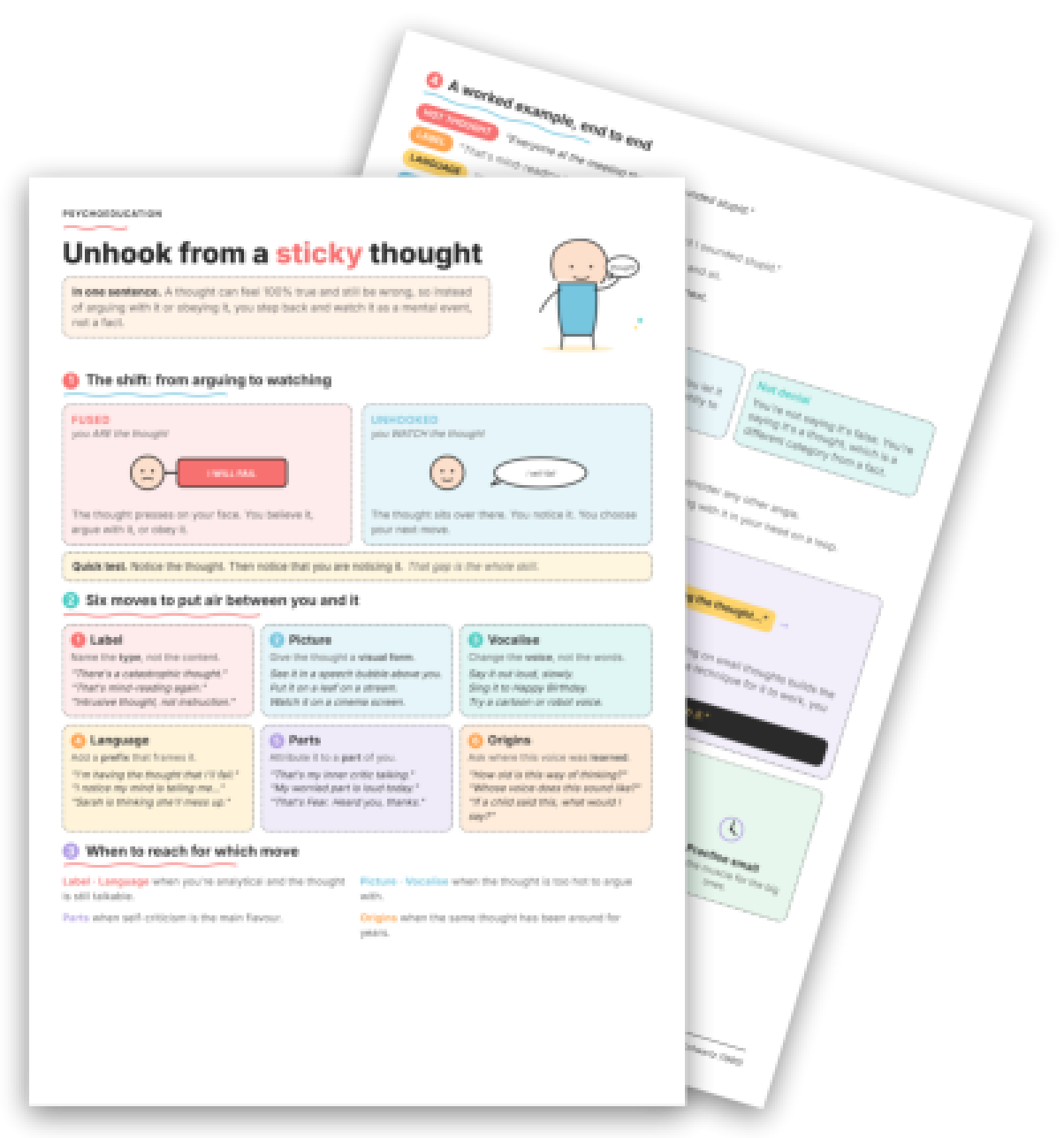
The fiche PDF opens with a two-column visual contrasting two positions: fused ("you ARE the thought"; the thought "presses on your face") versus unhooked ("you WATCH the thought"; it sits at a distance and you choose your next move). A quick self-test follows immediately: "Notice the thought. Then notice that you are noticing it. That gap is the whole skill." That single diagram does more work than five minutes of oral explanation.
The core of the sheet is a structured table of six defusion moves:
- Label: naming the type, not the content ("That's mind-reading again" / "Intrusive thought, not instruction")
- Picture: giving the thought a visual form (speech bubble, leaf on a stream, cinema screen)
- Vocalise: changing the voice, singing the thought to Happy Birthday, trying a cartoon voice
- Language: adding a framing prefix ("I'm having the thought that I'll fail")
- Parts: attributing the thought to an inner part ("My worried part is loud today")
- Origins: tracing where the voice was learned ("Whose voice does this sound like?")
A decision matrix maps which move fits which clinical presentation: Language and Label when the patient is analytical and the thought is still discussable; Picture and Vocalise when arousal is too high for rational dispute; Parts when self-criticism is the dominant flavour; Origins when the same thought has been circling for years. This maps cleanly onto ACT-specific defusion work and can be integrated into any ACT Hexaflex framework already in use.
A worked example walks one hot thought from label through language to imagery, ending with a "~30% less sting" rating and a prompt to choose what to do next. A 60-second daily practice (catch, label, rewrite with "I'm having the thought that...", rate belief before and after) closes the sheet as structured between-session work. A compact panel titled "What this is NOT" addresses the three most predictable patient misconceptions: positive replacement, suppression, and denial. That section alone saves several clarification minutes per session.
> Key takeaway: The fiche is a visual support that makes decentering teachable in a single session. The patient leaves with a concrete scaffold, not just a memory of an analogy you described once.
750+ clinical tools
A library built with and for clinicians, ready to use in session and extend between appointments.
Access all the toolsWhen and How to Introduce the Fiche
The sheet fits naturally once the cognitive triangle is in place and the patient has begun catching automatic thoughts, but before defusion has been formally introduced. A clean framing: "Now that you can spot the thoughts, here is how to get some distance from them without needing to win the argument."
For patients carrying high rumination or social anxiety, where fusion is body-driven and the loop is already loud, open directly on Picture or Vocalise rather than Language. For schema-level material, the Origins move connects naturally into core belief work and complements evaluating whether a thought is worth the mental energy at all. The Choice Point fiche pairs well as a next step, once the patient can reliably unhook and then choose a values-consistent action.
Debrief the chosen move in the following session: which thoughts were labelled, whether belief ratings shifted, and which technique felt least absurd to actually try. If the patient reports that sillier methods worked better (the fiche states this explicitly), they have understood the principle at the right level. Pair with confronting avoidance when the fused thought has been driving behavioural withdrawal.
One clinical limit worth naming: the fiche presupposes enough psychological flexibility to tolerate a thought being present without immediately acting on it. With severely fused content in acute presentations, introduce the moves gradually and within session first rather than as autonomous homework.
The fiche does not replace the therapeutic frame. It makes an opaque construct visible and leaves the patient with a precise, portable set of exercises to practise between sessions.
Use it with your patients
Share this tool in the mobile app and follow the work between sessions.
Sources
- Hayes, S. C., Strosahl, K. D., Wilson, K. G. (2012). Acceptance and Commitment Therapy: The Process and Practice of Mindful Change (2nd ed.). Guilford Press.
- Harris, R. (2019). ACT Made Simple: An Easy-to-Read Primer on Acceptance and Commitment Therapy (2nd ed.). New Harbinger Publications.
Your session continues in your patients' pocket
Use with a patientYour resources, available everywhere
The handouts, exercises, programs and audios above: you choose which ones to make available to your patients, in the mobile app dedicated to them.
And far more than a library
The app goes well beyond resources, to support your patients every day:
Related categories
Explore other clinical resources by category.

Anxiety
Clinical hub for anxiety disorders: CBT and ACT worksheets, psychoeducation sheets, and exercises for assessment and treatment across the anxiety spectrum.

Mood
Evidence-based worksheets and clinical tools for mood disorders: CBT, ACT, and positive psychology resources for psychologists and therapists.

Cognition
Printable cognitive therapy worksheets and clinical tools for therapists: CBT, ACT, schema work, defusion, distortions, and belief restructuring.

Build awareness
Clinical worksheets and tools to build awareness in therapy: cognitive distortions, schemas, emotions, ACT and CBT resources for practitioners.

Restructure
Clinical hub for cognitive restructuring worksheets: distortion identification, belief disputation, ABC model, and schema work for evidence-based practice.

ACT
Clinical hub for Acceptance and Commitment Therapy (ACT): worksheets, exercises, programs and audio resources for practitioners using the ACT model.