
Clinical picture. M., a 34-year-old woman with generalized anxiety disorder, presented with pervasive intrusive worries throughout the working day, which she had previously managed by seeking reassurance from colleagues. The clinician introduced worry postponement, asking her to catch each worry, classify it as hypothetical, note it in one line on her phone, and defer it to a fixed 20-minute window at 18:30. After five days, M. reported that roughly two thirds of her noted worries felt either resolved or trivial by the time she sat down with them. This shift was used in session to challenge her belief that immediate mental engagement with worries was necessary to prevent bad outcomes.
HandoutAnxietyEmotions & stressThoughts & cognitionBuild awarenessRegulateRestructureCBTMetacognitiveMindfulness (MBSR/MBCT)
Worry Postponement: PDF Worksheet, Tools and Exercises
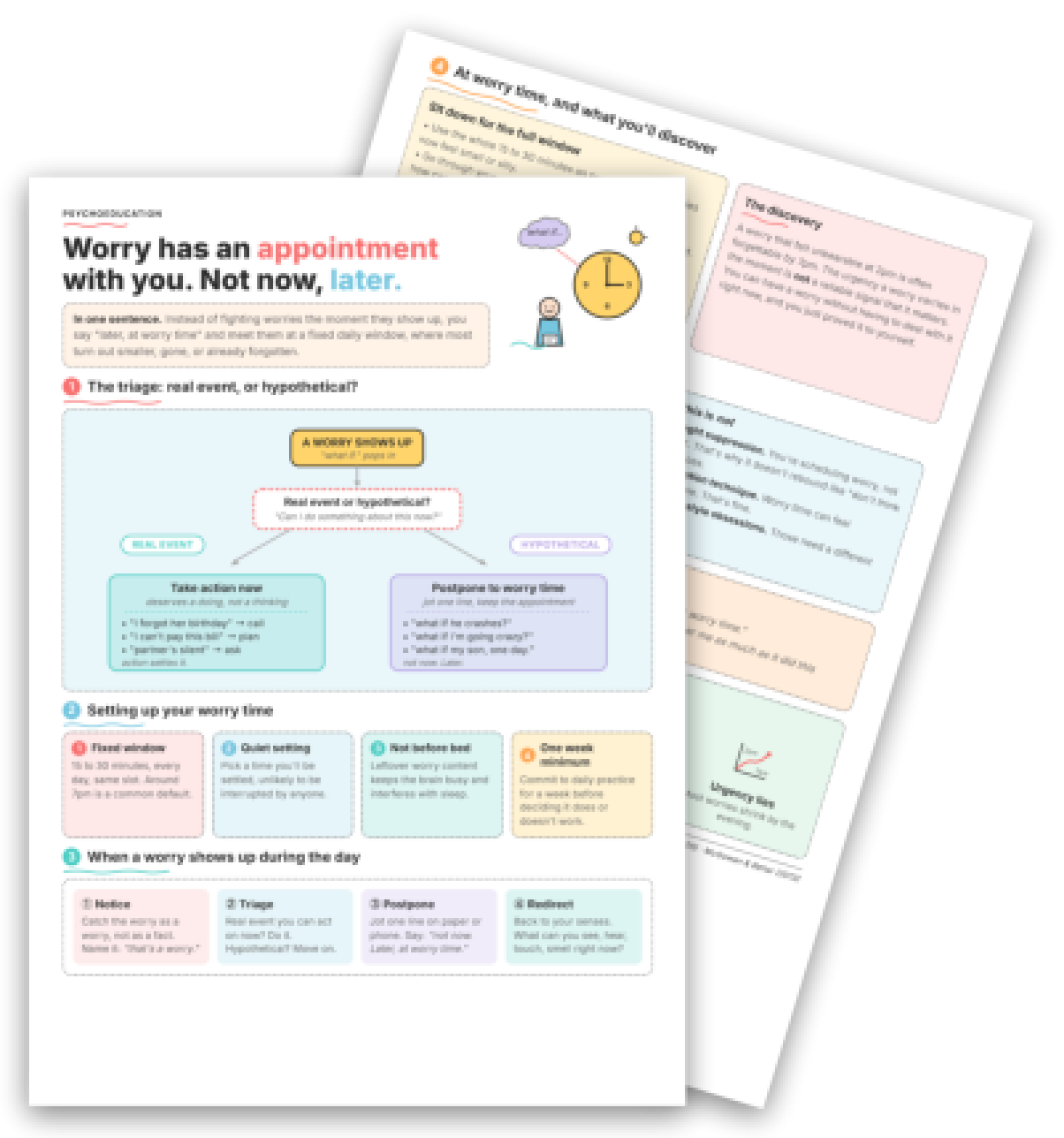
A visual PDF worksheet to explain and introduce the worry postponement technique in session, with a triage protocol, worry time setup, and pitfall guidance.
Clinical vignettes
Postponement Reveals Worry Decay
Triage Step Prompts Behavioral Action
Clinical picture. T., a 51-year-old man referred for health anxiety following a cardiac investigation with inconclusive findings, had developed a pattern of repetitive mental checking throughout the day. When the clinician introduced the real-event versus hypothetical triage, T. identified one worry, a postponed follow-up call to his GP, that qualified as a real, actionable problem rather than a hypothetical. He made the call that afternoon, which reduced that specific worry substantially. The remaining hypothetical worries were scheduled for his designated worry window, and he began to notice a modest but consistent drop in their rated intensity between the moment they arose and his evening review.
Explaining worry postponement verbally in session almost always runs into the same wall: patients hear "schedule your worry" and immediately interpret it as thought suppression, the rebound-prone "don't think about it" strategy they've already tried and abandoned. Without a visual anchor, the distinction evaporates as soon as they leave the room. This fiche PDF gives you a concrete support to make the mechanism visible, the protocol learnable in one read, and the rationale genuinely memorable.
Use this resource with your patients
Handout, exercises and materials ready to use, right inside SessionFuel.
Why Worry Postponement Is Hard to Explain at the Oral Level
Rooted in Borkovec's original protocol (1983) and refined through Leahy's clinical work, worry postponement is one of the most efficient first-line interventions for GAD and chronic rumination. Its logic is tight: containing worry within a bounded window disrupts the diffuse, day-long hypervigilance that characterises pathological worry, without asking patients to suppress content or challenge cognitions head-on.
The clinical difficulty isn't conceptual, it's perceptual. Patients confuse postponement with avoidance, or with the kind of futile thought-stopping they associate with prior failed attempts. They also miss the triage step: not all worries qualify for postponement. A real, actionable problem should be acted on, not parked. Explaining this distinction orally, without a shared map, tends to produce confused nodding rather than genuine procedural understanding.
A second obstacle is the urgency bias built into worry itself. The fiche names it plainly: "the urgency a worry carries in the moment is not a reliable signal that it matters." That reframe needs to land visually, not just be spoken once.
What the Fiche Contains, and Why the Visual Format Earns Its Place
The fiche PDF unfolds across five clearly segmented panels, each handling a distinct procedural step.
Panel 1 presents the core triage question: "Real event, or hypothetical?", a decision fork that separates actionable problems (respond with direct action, not with thinking) from hypothetical "what if" spirals (postponed to worry time). Laid out as a visual branching structure, the fork gives patients something to retrieve between sessions without needing to reconstruct the reasoning from memory.
Panel 2 covers worry time setup: a fixed 15-to-30-minute daily window, same slot each day, with explicit guidance against scheduling it near bedtime to avoid sleep interference. Four concrete parameters are listed, fixed window, quiet setting, not before bed, one-week minimum commitment, which prevents the vague "I'll try to do it" implementation that derails self-monitoring tasks.
Panel 3 walks through the four in-the-moment steps: notice, triage, postpone (jot one line), redirect via sensory grounding. The redirect instruction, "Back to your senses. What can you see, hear, touch, smell right now?", bridges naturally into any somatic or mindfulness work already in progress in the therapy.
Panel 4 addresses what happens at worry time itself: rating each noted worry from 0 to 10 on current concern versus how it felt when it arrived, then identifying recurring themes and converting real problems into a single concrete next step. This is where the intervention's clinical payoff becomes observable to the patient.
Panel 5 handles pitfalls and misattributions directly. The fiche distinguishes postponement from thought suppression, explicitly disavows the relaxation framing ("worry time can feel uncomfortable, that's fine"), and flags OCD-style obsessions as a contraindication requiring a different approach.
> To remember: the fiche is a visual support that facilitates the explanation of worry postponement in session, not a self-help checklist to hand out without context. The branching triage structure and the 0-to-10 rating prompts do the explanatory work that an oral description alone rarely achieves.
Clinical library
750+ clinical tools
A library built with and for clinicians, ready to use in session and extend between appointments.
Access all the toolsSeveral resource types
Psychoeducation handouts
Understand at a glance
Interactive exercises
To do and fill in
Interactive programs
A structured path
Audios
Meditation and relaxation
Psychometric tests
Automatic scoring
When and How to Introduce the Fiche
Best moment: second or third session, once the formulation is sketched and the patient's worry pattern is named. If you're working within a GAD cognitive-behavioral model or addressing intolerance of uncertainty, worry postponement fits as the first behavioural experiment before any cognitive restructuring begins.
A natural introduction: "I'd like to show you a technique that doesn't ask you to stop worrying or challenge your thoughts, it just changes when you do it." Then walk Panel 1 together in session, asking the patient to generate one recent worry and run it through the triage fork aloud. This active rehearsal is more durable than reading alone.
Profiles: especially indicated for patients with pervasive free-floating worry, chronic sleep disruption linked to evening rumination, and those who have found thought suppression counterproductive. It integrates cleanly alongside grounding techniques, stop overthinking work, or any intolerance-of-uncertainty program.
Contraindication: as the fiche itself notes, OCD-driven obsessions, where postponement can temporarily relieve compulsive pressure and inadvertently reinforce the cycle. For those presentations, what keeps OCD going and an ERP framework are more appropriate entry points.
Debrief at the next session: ask the patient to bring their written worry list and compare their 0-to-10 ratings at arrival versus at 7pm. The empirical observation, "most worries shrank by evening", does more persuasive clinical work than any psychoeducation paragraph. It gives the patient direct, self-generated evidence that urgency and importance are separable.
The fiche doesn't replace the therapeutic frame. It makes the explanation precise, leaves the patient with a retrievable procedure, and gives you a shared vocabulary to return to when the technique needs troubleshooting.
Use it with your patients
Share this tool in the mobile app and follow the work between sessions.
Sources
- Dippel, A., Brosschot, J. F., & Verkuil, B. (2024). Effects of worry postponement on daily worry: A meta-analysis. International Journal of Cognitive Behavioral Therapy, 17, 160-178.
- Krzikalla, C., Buhlmann, U., Schug, J., Kopei, I., Gerlach, A. L., Doebler, P., Morina, N., & Andor, T. (2024). Worry postponement from the metacognitive perspective: A randomized waitlist-controlled trial. Clinical Psychology in Europe, 6(2), Article e12741.
- Wells, A. (2009). Metacognitive therapy for anxiety and depression. Guilford Press.
Patient mobile app
Your session continues in your patients' pocket
Use with a patientYour resources, available everywhere
The handouts, exercises, programs and audios above: you choose which ones to make available to your patients, in the mobile app dedicated to them.
Psychoeducation handoutsInteractive exercisesInteractive programsAudiosPsychometric tests
And far more than a library
The app goes well beyond resources, to support your patients every day:
Standardized tests
Therapy journal
Gamification
Wellbeing challenges
Introspection prompts
Therapist homework
Related categories
Explore other clinical resources by category.

Anxiety
Clinical hub for anxiety disorders: CBT and ACT worksheets, psychoeducation sheets, and exercises for assessment and treatment across the anxiety spectrum.

Emotions
Clinical resources on emotion regulation: worksheets, coping tools, CBT, REBT, and ACT exercises for therapists working across diagnoses and age groups.

Cognition
Printable cognitive therapy worksheets and clinical tools for therapists: CBT, ACT, schema work, defusion, distortions, and belief restructuring.

Build awareness
Clinical worksheets and tools to build awareness in therapy: cognitive distortions, schemas, emotions, ACT and CBT resources for practitioners.

Regulate
Clinical resources for emotion regulation: worksheets, ACT exercises, and psychoeducation tools for affect regulation across diagnoses. For clinicians.

Restructure
Clinical hub for cognitive restructuring worksheets: distortion identification, belief disputation, ABC model, and schema work for evidence-based practice.