
Clinical picture. A., a woman in her mid-thirties, was referred for persistent fatigue and poor sleep; she described herself as "a chronic overthinker" and had not previously considered psychological input. During a first psychoeducation session, the clinician used the CBT model of GAD to walk through the four-engine loop, asking A. to map a recent worry chain onto the diagram. A. quickly identified intolerance of uncertainty as her dominant engine, recognising her pattern of re-reading sent emails and rehearsing worst-case conversations before meetings. By the end of the session she could distinguish her worry behaviour from actual problem-solving, which she found less shaming than her prior self-label. She agreed to one small behavioural experiment: sending a routine message without re-reading it, as a first step toward tolerating the discomfort of uncertainty.
Cognitive Behavioral Model of GAD: PDF Worksheet, Tools and Exercises
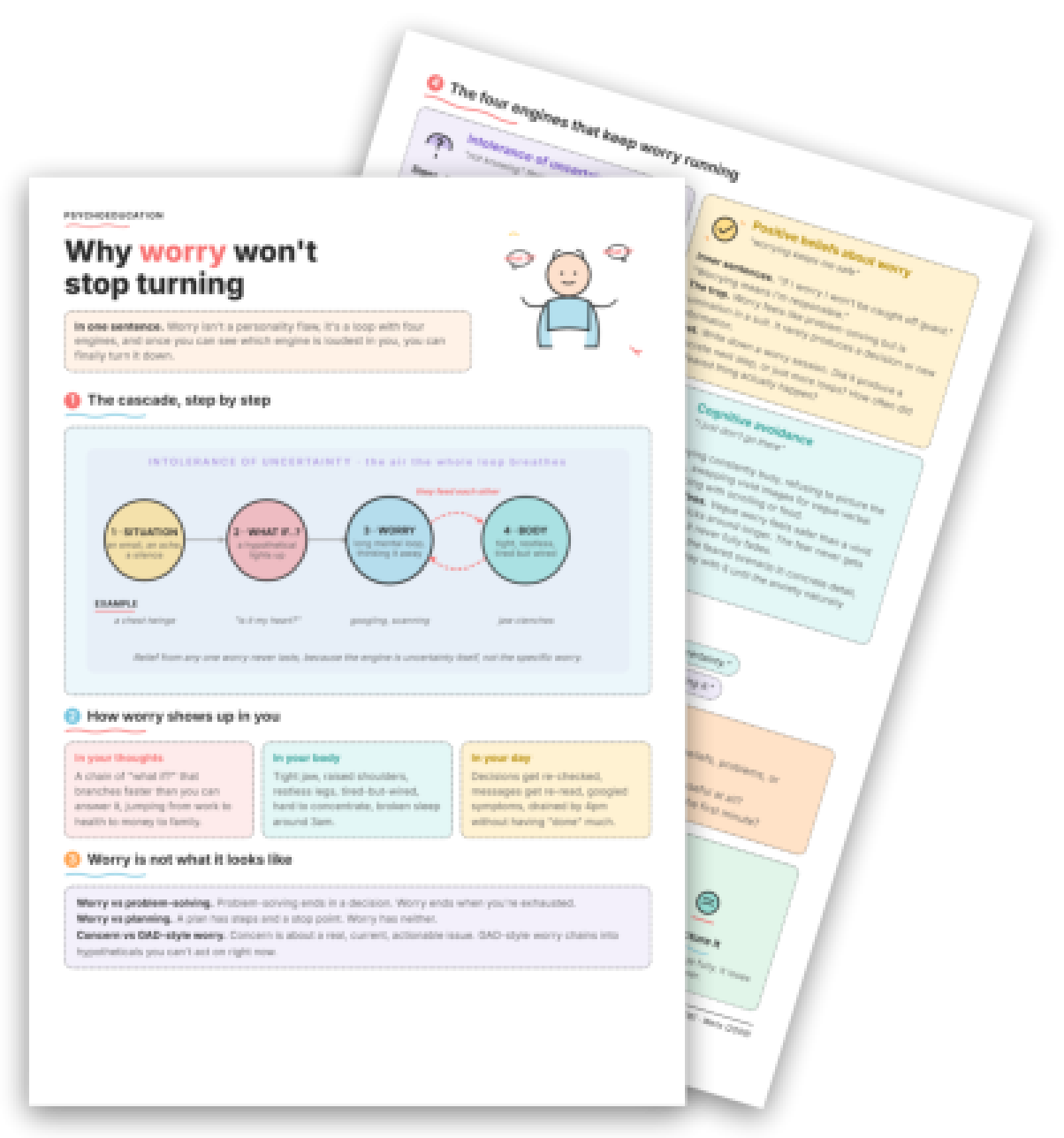
A visual PDF worksheet to explain the four-engine worry loop in session, build a shared clinical vocabulary, and give patients with GAD a concrete reference they can keep.
Clinical vignettes
Naming the Loop in a First Session
Psychoeducation Shifting Positive Worry Beliefs
Clinical picture. T., a man in his late forties with a longstanding history of health anxiety and occupational stress, entered therapy believing that his constant vigilance protected his family from harm. The clinician introduced the informational sheet during session two, focusing on the distinction between concern and GAD-style worry and on the engine labelled positive beliefs about worry. T. initially pushed back, arguing that his worry had "caught real problems" in the past; the clinician acknowledged this without disputing it, then invited him to track over one week whether his worry chains ended in a decision or in exhaustion. He returned reporting that none had ended in a concrete action, which shifted his framing from "worry as protection" toward "worry as a loop I can learn to exit." This opened space for subsequent work on graduated uncertainty tolerance.
Explaining the CBT model of GAD verbally rarely lands the first time. Patients with chronic worry tend to agree with everything you say and then leave the session still convinced that worry is either a personality trait or a form of responsible planning. This fiche PDF externalizes the model as a visual map, so the loop becomes something to look at together rather than something to absorb from spoken description alone.
Use this resource with your patients
Handout, exercises and materials ready to use, right inside SessionFuel.
Why the GAD Model Resists Oral Explanation
The core difficulty is that intolerance of uncertainty is both the central mechanism and the one patients are most invested in defending. When you describe the four-engine model verbally, patients often hear a critique of their character rather than a description of a learnable loop. They also struggle to hold the structural distinction between worry and problem-solving in working memory: the idea that worry produces no decision and has no natural stop point is clinically precise but easy to dismiss as abstract.
The other consistent sticking point is cognitive avoidance. Patients using verbal worry as a substitute for imagery-based processing rarely recognize it as avoidance at all; it feels like engagement. Oral explanation competes with the very mechanism it is trying to name. A visual support that places cognitive avoidance alongside the other three engines, on the same diagram, makes the equivalence visible rather than argued.
What the Fiche Contains: A Visual Engine Map for GAD
The fiche opens with a one-sentence framing drawn directly from the Dugas and Robichaud model: "Worry isn't a personality flaw, it's a loop with four engines." That sentence alone reframes the patient's self-attribution before you say anything.
The five-panel structure covers exactly what you need for a psychoeducation session on GAD:
- Panel 1 shows the cascade step by step: Situation, "What if?", Worry, Body, each feeding the next, with intolerance of uncertainty named as "the air the whole loop breathes." The accompanying example (a chest twinge triggering googling and jaw clenching) makes the cycle concrete without requiring the patient to self-disclose first.
- Panel 2 maps how worry shows up across thoughts, body, and daily behavior, which is useful for patients who compartmentalize somatic symptoms and mental activity as separate problems.
- Panel 3 draws the clinical distinctions directly: "Problem-solving ends in a decision. Worry ends when you're exhausted." This panel does the heavy lifting for the worry and attention capture exercise you may assign afterward.
- Panel 4 develops each of the four engines (intolerance of uncertainty, positive beliefs about worry, poor problem orientation, cognitive avoidance) with signs, reframes, and a behavioral practice. The cognitive avoidance section includes the key instruction to write the feared scenario in concrete detail and stay with it, a direct bridge toward graduated exposure work and the exposure hierarchy tool.
- Panel 5 gives the patient phrases to borrow ("This is a What if, not a fact"; "Worrying is not preparing"), plus three session-discussion questions that you can use to open the debrief.
> Key point: this fiche is a visual support for in-session explanation, not a self-report form. The engine diagram gives you something to point to while you talk; patients follow the arrows rather than trying to hold an abstract model in mind. They leave with a reference they can return to between sessions.
750+ clinical tools
A library built with and for clinicians, ready to use in session and extend between appointments.
Access all the toolsWhen and How to Introduce the Fiche
This fiche fits naturally at the psychoeducation phase, typically sessions two or three, once you have completed the functional assessment and established basic alliance. It is well suited to patients who intellectualize their worry, who present with significant reassurance-seeking (see the reassurance-seeking exercise), or who describe themselves as "overthinkers" without connecting that to generalized anxiety disorder symptoms.
A useful introduction: "I want to show you a map of how worry tends to maintain itself. This isn't a test; I'd like us to look at it together and see which parts fit your experience." That framing keeps the patient in collaborative mode and avoids activating the positive beliefs about worry before you have named them together.
Debrief around the Panel 5 discussion questions: which engine felt loudest, what would change if worry were not useful at all, and what happened to anxiety when the patient pictured the feared scenario fully. Those three questions move the session from psychoeducation into case formulation, and connect directly to the intolerance of uncertainty program and the intolerance of uncertainty exercise you may introduce in subsequent sessions.
One contraindication worth noting: patients in acute crisis or with significant comorbid depression may find the four-engine model cognitively overwhelming at first contact. With those presentations, the anxiety psychoeducation program offers a more gradual entry point before you introduce the full GAD loop. The fiche also pairs well with checking and certainty-seeking work and with avoidance reduction once the patient can name their dominant engine.
The fiche does not replace the therapeutic frame; it makes one difficult explanation land more cleanly, and leaves the patient with a concrete map of their own maintenance cycle.
Use it with your patients
Share this tool in the mobile app and follow the work between sessions.
Sources
- Robichaud, M., Koerner, N., & Dugas, M. J. (2019). Cognitive Behavioral Treatment for Generalized Anxiety Disorder: From Science to Practice (2nd ed.). Routledge.
- Bottesi, G., Ghisi, M., Carraro, E., Barclay, N., Payne, R., & Freeston, M. H. (2016). Revising the intolerance of uncertainty model of generalized anxiety disorder: Evidence from UK and Italian undergraduate samples. Frontiers in Psychology, 7, 1723.
Your session continues in your patients' pocket
Use with a patientYour resources, available everywhere
The handouts, exercises, programs and audios above: you choose which ones to make available to your patients, in the mobile app dedicated to them.
And far more than a library
The app goes well beyond resources, to support your patients every day:
Related categories
Explore other clinical resources by category.
Anxiety
Clinical hub for anxiety disorders: CBT and ACT worksheets, psychoeducation sheets, and exercises for assessment and treatment across the anxiety spectrum.

Cognition
Printable cognitive therapy worksheets and clinical tools for therapists: CBT, ACT, schema work, defusion, distortions, and belief restructuring.

Understand
Clinical hub for the therapeutic aim 'Understand': worksheets and tools to build patient insight across CBT, ACT, schema therapy and more.

CBT
CBT worksheets, cognitive restructuring exercises & behavioral tools for clinicians. Evidence-based resources for every phase of cognitive behavioral therapy.

Trauma
Clinical hub on trauma and PTSD: assessment, differential diagnosis, treatment phases, and printable resources for practitioners. 155 chars.

Mood
Evidence-based worksheets and clinical tools for mood disorders: CBT, ACT, and positive psychology resources for psychologists and therapists.