
Clinical picture. M., a man in his mid-forties, was referred for persistent low mood after a cardiology workup returned normal results. He described avoiding the underground, preferring to drive, and always choosing aisle seats at his son's school events. During the intake, the clinician introduced the informational sheet on agoraphobia and read through the safety-behaviour section with him. M. recognised, with visible surprise, that his water bottle, his exit-scanning, and his insistence on driving were not practical preferences but rituals organised around the fear of being trapped if his heart began to race. This recognition reframed the working formulation from a mood disorder to an anxiety disorder with significant functional restriction, and gave the pair a shared language for treatment planning.
Agoraphobia: PDF Worksheet, Tools and Exercises for Clinical Practice
A structured visual fiche to explain agoraphobia in session, map feared situations, identify safety behaviours, and open the work of graded exposure with your patients.
Clinical vignettes
Safety Behaviours Masking the Diagnosis
Dignity-Driven Avoidance Identified Late
Clinical picture. T., a woman in her early thirties, had been seen for two years with a diagnosis of irritable bowel syndrome and health anxiety. She had gradually stopped attending her book group, reduced her working hours, and no longer used public transport. When the clinician used the sheet to distinguish the two flavours of feared catastrophe, T. immediately pointed to the second: she was not afraid of panic sensations but of losing bowel control in a place she could not leave quickly. Neither she nor her previous clinician had named this as agoraphobia. Recognising the dignity-driven pattern clarified why standard panic psychoeducation had felt irrelevant to her and opened a more targeted conversation about interoceptive exposure and gradual situational work.
Patients referred for agoraphobia rarely arrive with that label. They describe a map with holes in it: the metro they stopped using, the supermarket queue they now avoid, the cinema seat that has to be on the aisle. Translating that lived geography into a clinical framework, one the patient genuinely internalises rather than politely nods at, takes more than a verbal explanation. This fiche PDF provides a ready-to-use visual support for exactly that work, making the psychoeducation concrete, collaborative, and something the patient can take home.
Use this resource with your patients
Handout, exercises and materials ready to use, right inside SessionFuel.
Why agoraphobia resists a purely oral explanation
The core misunderstanding is definitional. Most patients believe agoraphobia means a fear of open spaces. The actual mechanism, fear of being trapped somewhere escape or help would be impossible, lands very differently. Said aloud once, it often triggers a polite "yes, I see" without real integration. The concept needs to be shown, not just named.
A second layer of difficulty is heterogeneity. Some patients fear their own body: pounding heart, dizziness, derealisation, the sense of losing control or going mad. Others fear an incapacitating event: vomiting in public, losing bladder control, collapsing without anyone nearby. These are clinically distinct profiles with different treatment emphases, and patients often cannot articulate which flavour drives them until you give them a framework that separates the two. Without that distinction, exposure hierarchy work can miss its target entirely.
A third obstacle is the safety behaviour blind spot. Patients describe their rituals (gripping the trolley, sipping water, sitting near the exit) as sensible precautions, not as fear-maintenance mechanisms. The cognitive loop that credits the ritual rather than reality is invisible to them until it is drawn.
What the fiche contains: a visual map for a complex disorder
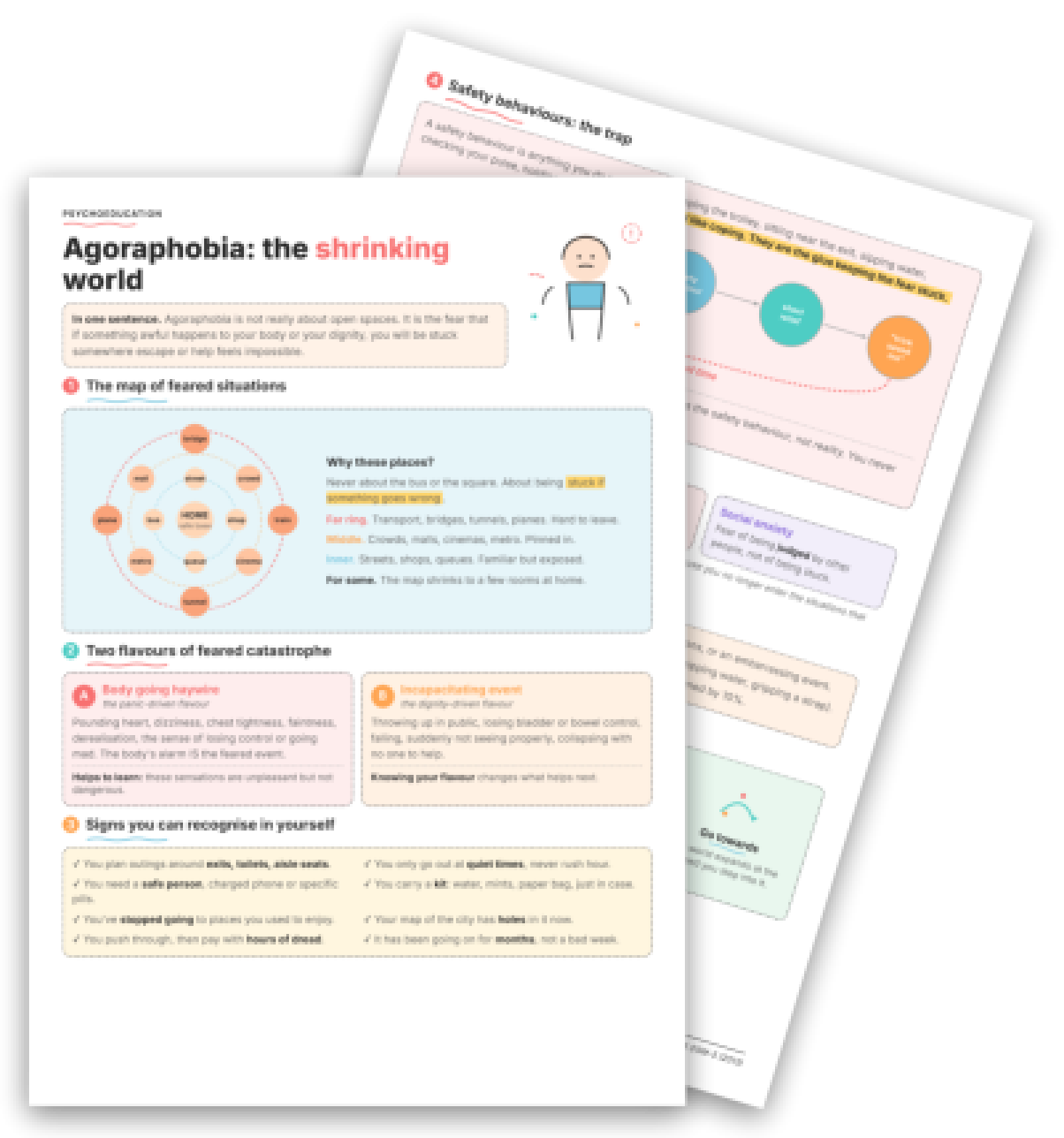
The fiche PDF is organised into seven panels, each doing clinical work that an oral explanation does alone less efficiently.
- Panel 1, "The map of feared situations": a concentric ring diagram placing home at the centre and radiating outward through streets, crowds, transport, and tunnels. Patients immediately locate their own geography on it, which shortens the anamnèse and externalises avoidance without blame.
- Panel 2, "Two flavours of feared catastrophe": a clean A/B distinction between the panic-driven flavour (body sensations as the feared event) and the dignity-driven flavour (incapacitating events in public). The fiche states plainly: "Knowing your flavour changes what helps next", a direct prompt to orient the treatment plan.
- Panel 3: eight observable signs ("You plan outings around exits, toilets, aisle seats"; "You push through, then pay with hours of dread") that patients can verify against their own behaviour without feeling pathologised.
- Panel 4, "Safety behaviours: the trap": a flowchart showing how the loop between feared situation, predicted catastrophe, safety behaviour, and short relief keeps the belief intact. This is the visual representation of the évitement expérientiel maintenance cycle that is notoriously hard to convey verbally.
- Panel 5: a three-column comparison differentiating agoraphobia from panic disorder and social anxiety, genuinely useful when presentations overlap, as they often do.
- Panels 6 and 7: session prompts and a four-point summary the patient reads alone after the appointment.
> Key point: the fiche is not a self-assessment questionnaire the patient fills in alone. It is a visual support that facilitates the explanation in session, the clinician works through each panel together with the patient, building a shared vocabulary and a formulation the patient can see.
750+ clinical tools
A library built with and for clinicians, ready to use in session and extend between appointments.
Access all the toolsWhen and how to introduce the fiche
The fiche fits naturally after the initial anamnèse, once you have a rough picture of the avoided situations and before you begin building an exposure hierarchy. Introducing it early establishes the conceptual frame that makes habituation rationale comprehensible later.
For patients with a long avoidance history, or those who minimise the extent of their restriction, opening on Panel 1, "Let's see which ring of this map feels most familiar to you", anchors the conversation in their own experience rather than a diagnostic checklist. For patients who arrive convinced they have panic disorder but describe situation-specific avoidance, Panel 5 is a precise, non-confrontational way to reframe the presentation.
When debriefing Panel 4, ask the patient to name one safety behaviour they would be willing to drop before the next session. That single commitment is more actionable than a general instruction to "face your fears," and it maps directly onto the cycle of avoidance you will continue to address with tools like psychological safety crutches or the exposure therapy program.
A brief contraindication: in the early sessions of an EMDR protocol for co-occurring trauma, or with patients in acute decompensation, hold back the safety-behaviour panel. The loop diagram requires sufficient observing-ego function to land as insight rather than additional evidence of hopelessness.
The fiche does not replace the therapeutic frame. It makes the explanation clearer and leaves the patient with a concrete reference, one that holds the formulation between sessions.
Use it with your patients
Share this tool in the mobile app and follow the work between sessions.
Sources
- Salkovskis, P. M. (1991). The Importance of Behaviour in the Maintenance of Anxiety and Panic: A Cognitive Account. Behavioural and Cognitive Psychotherapy.
- National Institute for Health and Care Excellence (NICE) (2011). Generalised Anxiety Disorder and Panic Disorder in Adults: Management (Clinical Guideline CG113).
- Barlow, D. H. (2002). Anxiety and Its Disorders: The Nature and Treatment of Anxiety and Panic (2nd ed.). Guilford Press.
- Craske, M. G., Barlow, D. H. (2022). Mastery of Your Anxiety and Panic: Therapist Guide (5th ed.). Oxford University Press.
Your session continues in your patients' pocket
Use with a patientYour resources, available everywhere
The handouts, exercises, programs and audios above: you choose which ones to make available to your patients, in the mobile app dedicated to them.
And far more than a library
The app goes well beyond resources, to support your patients every day:
Related categories
Explore other clinical resources by category.

Anxiety
Clinical hub for anxiety disorders: CBT and ACT worksheets, psychoeducation sheets, and exercises for assessment and treatment across the anxiety spectrum.

Understand
Clinical hub for the therapeutic aim 'Understand': worksheets and tools to build patient insight across CBT, ACT, schema therapy and more.

CBT
CBT worksheets, cognitive restructuring exercises & behavioral tools for clinicians. Evidence-based resources for every phase of cognitive behavioral therapy.

Trauma
Clinical hub on trauma and PTSD: assessment, differential diagnosis, treatment phases, and printable resources for practitioners. 155 chars.

Mood
Evidence-based worksheets and clinical tools for mood disorders: CBT, ACT, and positive psychology resources for psychologists and therapists.

Identity
Clinical resources for self-identity work in therapy: CBT, ACT, schema tools for clinicians addressing self-concept, core beliefs, and identity disruption.