
Clinical picture. T., a woman in her early 40s, presented after six weeks of difficulty falling asleep following a sudden job redundancy. She described lying awake for one to two hours each night despite having a quiet bedroom and no competing obligations. The clinician worked through the five criteria with her: a clear sleep complaint, adequate opportunity, and marked daytime fatigue with concentration lapses that were affecting her job search. No evidence of obstructive sleep apnoea, current depressive episode, or substance use emerged, placing the presentation firmly in the short-term insomnia category. A brief behavioural intervention targeting stimulus control and worry postponement was initiated, with the expectation of reassessing at the three-month mark rather than moving straight to a full CBT-I protocol.
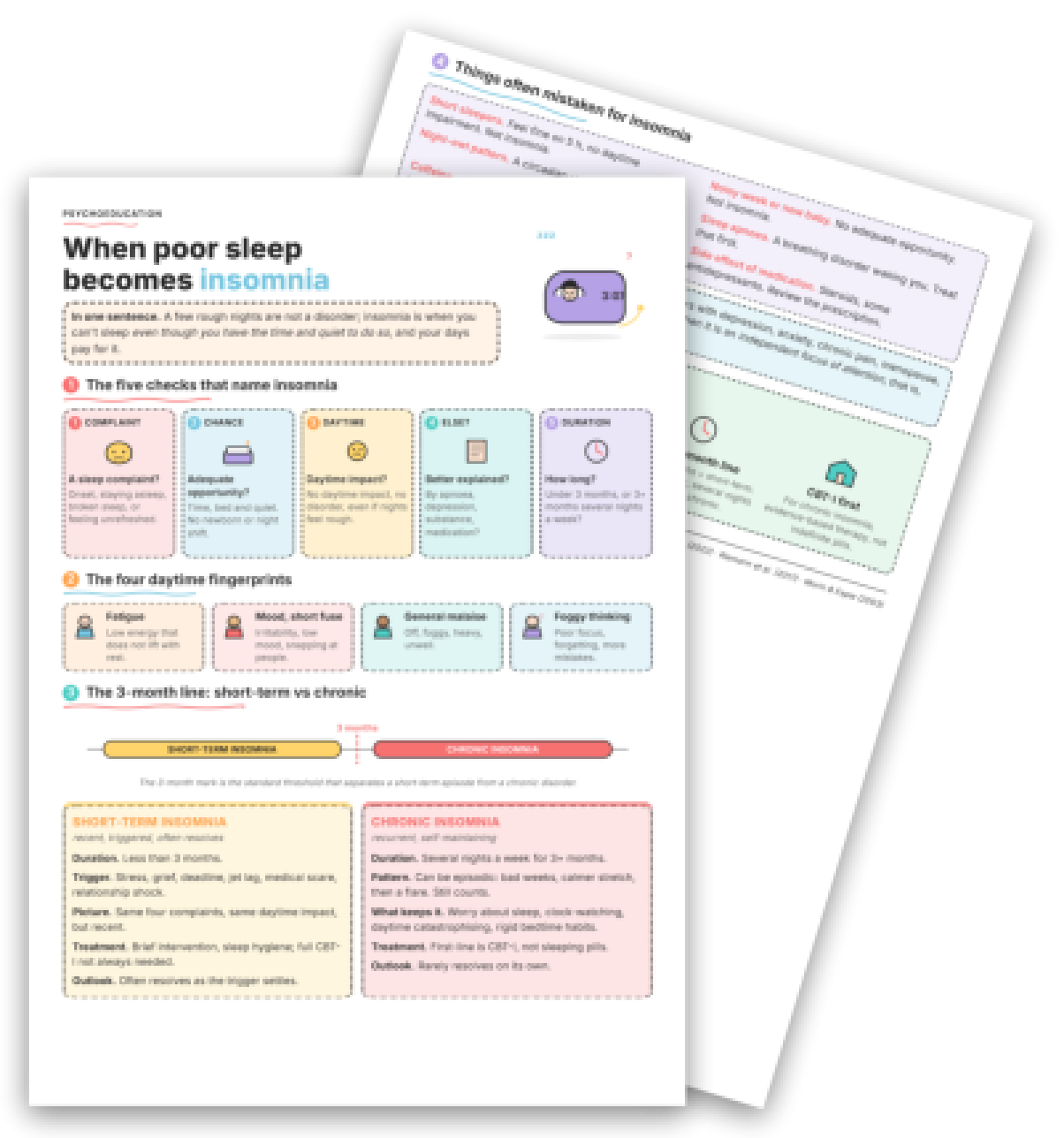
Insomnia Disorders: PDF Worksheet, Tools and Exercises for Clinical Practice
A printable PDF fiche, clinical tools, and structured exercises to recognize insomnia disorders and anchor psychoeducation during the clinical session.
Clinical vignettes
Short-Term Insomnia After Acute Stressor
Chronic Insomnia Misread as Normal Variation
Clinical picture. M., a man in his late 50s, was referred for low mood and had mentioned in passing that he had always been a poor sleeper. On structured inquiry, he described waking repeatedly in the night, clock-watching, and spending long hours in bed to compensate, across most nights for well over a year. He had assumed this was simply his temperament because he occasionally had a calmer week. The clinician used the worksheet framework to clarify that episodic fluctuation does not exclude a chronic disorder, and that his persistent daytime fatigue, irritability, and cognitive fog met the daytime-impact criterion. The presentation was reframed as chronic insomnia maintaining the low mood rather than caused by it, and CBT-I was offered as the first-line approach.
Patients who present with fatigue, irritability, and concentration difficulties rarely arrive having already named their problem as a clinical insomnia disorder. Explaining the diagnostic threshold verbally, five interlocking criteria, a daytime-impact requirement, an "adequate opportunity" condition, tends to produce nodding without genuine conceptual uptake. This fiche PDF serves as a visual support to make that distinction clear during the session itself, not after it.
Use this resource with your patients
Handout, exercises and materials ready to use, right inside SessionFuel.
Why Insomnia Is Hard to Clarify in Session
Two diagnostic errors surface regularly in clinical practice. The first is under-recognition: patients minimise daytime impact, believe they "can't complain," or assume that troubled sleep is normal at their age or stress level. The second is over-attribution: patients self-diagnose insomnia when the actual driver is sleep apnoea, a medication side effect (steroids, certain antidepressants), alcohol rebound, or simply the absence of any genuine sleep opportunity, a newborn, rotating night shifts.
The "adequate opportunity" criterion is the most counterintuitive piece. Unless it is explicitly named and checked, it goes unexamined. Similarly, the three-month threshold separating short-term from chronic insomnia rarely registers when delivered only as a spoken statement. Patients in the early weeks of a stress-triggered episode often catastrophise toward a chronic identity, while those who have been struggling for years sometimes normalise what has long since crossed that line. Rumination and sleep-related worry accelerate that chronification, which is precisely why early conceptual clarity matters.
The fiche addresses these bottlenecks directly as a support visuel, the clinician uses it to walk through the criteria together with the patient, rather than reciting them.
What the Fiche Contains: A Visual Structure for a Five-Criteria Diagnosis
The fiche is organised into four sequential panels, each targeting a distinct layer of the clinical picture.
Panel 1, "The five checks that name insomnia," presents the diagnostic logic as a stepwise visual sequence: complaint → adequate opportunity → daytime impact → better explanation? → duration. Seeing these as five discrete gates, rather than as one fuzzy construct, makes it immediately apparent that a "yes" to all five is required. The layout shows, at a glance, why a patient with disrupted sleep but no daytime impact does not meet criteria, and why a patient whose nights are explained by apnoea requires a different formulation.
Panel 2, "The four daytime fingerprints," names fatigue that does not lift with rest, irritability and mood disruption, general malaise, and cognitive fog. This panel is useful with patients who describe somatic or affective complaints in session without connecting them to sleep. It also facilitates overlap conversations: depression, generalized anxiety, and burnout all share this fingerprint, and the fiche supports a transparent formulation discussion rather than leaving the patient to infer one.
Panel 3 renders the short-term / chronic distinction as a visual timeline bisected at three months, with side-by-side columns specifying trigger patterns, maintenance mechanisms ("worry about sleep, clock-watching, daytime catastrophising"), and treatment implications. The contrast is stark on the page in a way that speech alone cannot achieve: first-line treatment for chronic insomnia is CBT-I, not sleeping pills. You can use this panel to introduce the CBT model of insomnia as a natural next step.
Panel 4 lists the differential diagnoses most commonly confused with insomnia, short sleepers, circadian phase disorders, sleep apnoea, substance-induced waking, and comorbid presentations including PTSD, chronic pain, and menopause. The fiche includes a clinically precise note: insomnia warrants its own diagnostic label only "when it is an independent focus of attention, that is, treating the other condition would not, on its own, fix the sleep." This framing is worth sharing verbatim with patients who are uncertain whether their sleep complaint "counts."
> Key point: the fiche is a visual support that facilitates the explanation of insomnia criteria in session; it is not a self-administered questionnaire. The clinician uses it to anchor a shared vocabulary, prevent diagnostic confusion, and leave the patient with a concrete reference.
750+ clinical tools
A library built with and for clinicians, ready to use in session and extend between appointments.
Access all the toolsWhen and How to Introduce the Fiche
This fiche fits naturally into an initial or second session when sleep disturbance is part of the presenting complaint, or at any point where fatigue, cognitive fog, or mood disruption has been reported without a clear functional hypothesis. It is particularly useful with patients who catastrophise about their anxiety symptoms, reassigning their daytime presentation to a named and treatable disorder often reduces secondary distress considerably.
A simple introductory frame: "Before we talk about what to do about your sleep, I'd like to walk through a short checklist together, it will help us both understand exactly what kind of sleep problem we're dealing with." Work through Panel 1 aloud, checking each criterion as you go. Panel 3 is where most of the clinical conversation happens: patients almost always want to know whether what they have is "serious," and the timeline answers that question visually.
Patients with autonomic hyperarousal as a core feature may also benefit from the differential discussion in Panel 4, which prevents misattribution of physiological activation to insomnia proper.
The fiche does not replace a full clinical formulation, and it is not sufficient on its own where comorbidity (notably depression, GAD, or bipolar disorder) is prominent. In those cases, it supports one layer of a larger psychoeducation arc. Handed to the patient at the end of the session, it gives them a concrete reference point, and a shared clinical language, to carry between appointments.
Use it with your patients
Share this tool in the mobile app and follow the work between sessions.
Sources
- American Academy of Sleep Medicine (AASM) (2023). International Classification of Sleep Disorders, Third Edition, Text Revision (ICSD-3-TR). American Academy of Sleep Medicine.
- Riemann, D., Espie, C. A., Altena, E., Arnardottir, E. S., Baglioni, C., Bassetti, C. L. A., et al. (2023). The European Insomnia Guideline: An update on the diagnosis and treatment of insomnia 2023. Journal of Sleep Research, 32(6), e14035.
- American College of Physicians (ACP) (2016). Management of Chronic Insomnia Disorder in Adults: A Clinical Practice Guideline from the American College of Physicians. Annals of Internal Medicine, 165(2), 125-133.
Your session continues in your patients' pocket
Use with a patientYour resources, available everywhere
The handouts, exercises, programs and audios above: you choose which ones to make available to your patients, in the mobile app dedicated to them.
And far more than a library
The app goes well beyond resources, to support your patients every day:
Related categories
Explore other clinical resources by category.
Health
Somatic health clinical resources for practitioners: worksheets, psychoeducation, and exercises for somatic symptom disorder, chronic pain, and more.

Understand
Clinical hub for the therapeutic aim 'Understand': worksheets and tools to build patient insight across CBT, ACT, schema therapy and more.
CBT
CBT worksheets, cognitive restructuring exercises & behavioral tools for clinicians. Evidence-based resources for every phase of cognitive behavioral therapy.

Anxiety
Clinical hub for anxiety disorders: CBT and ACT worksheets, psychoeducation sheets, and exercises for assessment and treatment across the anxiety spectrum.
Trauma
Clinical hub on trauma and PTSD: assessment, differential diagnosis, treatment phases, and printable resources for practitioners. 155 chars.
Mood
Evidence-based worksheets and clinical tools for mood disorders: CBT, ACT, and positive psychology resources for psychologists and therapists.