
Clinical picture. A., a 34-year-old accountant, is referred for what his GP describes as generalised anxiety and difficulty concentrating at work. During the initial assessment, he mentions spending up to two hours each evening mentally replaying conversations to confirm he said nothing offensive. When the clinician maps the sequence on paper, the obsession-compulsion loop becomes visible: an intrusive doubt, a spike of discomfort, and a covert mental ritual that provides brief relief before the doubt returns. A. had not identified the replaying as a compulsion, assuming only physical rituals counted. Naming the hidden compulsion as the maintaining factor shifts the formulation and opens a clearer path toward ERP.
Recognizing OCD: PDF Worksheet, Tools and Exercises for Clinical Practice
A printable PDF fiche and visual tools to explain the OCD loop, distinguish obsessions from compulsions, and map differential diagnosis in session.
Clinical vignettes
Missed Compulsions in a Busy Professional
Contamination Loop Across Three Months
Clinical picture. M., a woman in her late twenties, presents after three months of progressive hand-washing that now occupies roughly 90 minutes a day and has caused skin breakdown. She describes the trigger as an intrusive image of transmitting illness to her infant, followed by intense disgust and a compulsion to wash until the feeling subsides. Using the four-stage loop from the psychoeducation sheet, the clinician names each step aloud with M. and asks her to track which part causes most distress. This structured recognition allows M. to see that the washing sustains rather than resolves the fear, a prerequisite for engaging with the rationale for exposure and response prevention.
Explaining OCD verbally in a first psychoeducation session routinely runs into the same wall: patients hear the loop described, nod, and still leave convinced their checking is reasonable, their mental rituals invisible, or their diagnosis wrong. This fiche PDF gives you a structured visual anchor to make the obsessive-compulsive mechanism legible in session, not just audible.
Use this resource with your patients
Handout, exercises and materials ready to use, right inside SessionFuel.
Why OCD Resists Verbal Explanation
Three mechanisms make the oral explanation fall flat. First, patients rarely self-identify as having compulsions, because they experience the ritual as the sensible response to a genuine threat. Without a visual that shows relief reinforcing the loop, the maintenance cycle stays abstract. Second, mental compulsions (silent counting, replaying, mental swapping) go undisclosed precisely because patients don't register them as rituals at all. A clinician naming them verbally gets a confused look; a schema showing them alongside visible compulsions makes the equivalence immediately obvious. Third, differential diagnosis is where most confusion lands: a patient treated for GAD who actually presents with ego-dystonic intrusions needs the distinction drawn clearly, and "your worries feel intrusive and unlike you" rarely lands on its own.
The fiche addresses all three gaps in one printable page, structured for use during the session, not as homework to complete alone.
Clinical library
750+ clinical tools
A library built with and for clinicians, ready to use in session and extend between appointments.
Access all the toolsSeveral resource types
Psychoeducation handouts
Understand at a glance
Interactive exercises
To do and fill in
Interactive programs
A structured path
Audios
Meditation and relaxation
Psychometric tests
Automatic scoring
What the Fiche Contains: A Visual Support for the OCD Mechanism
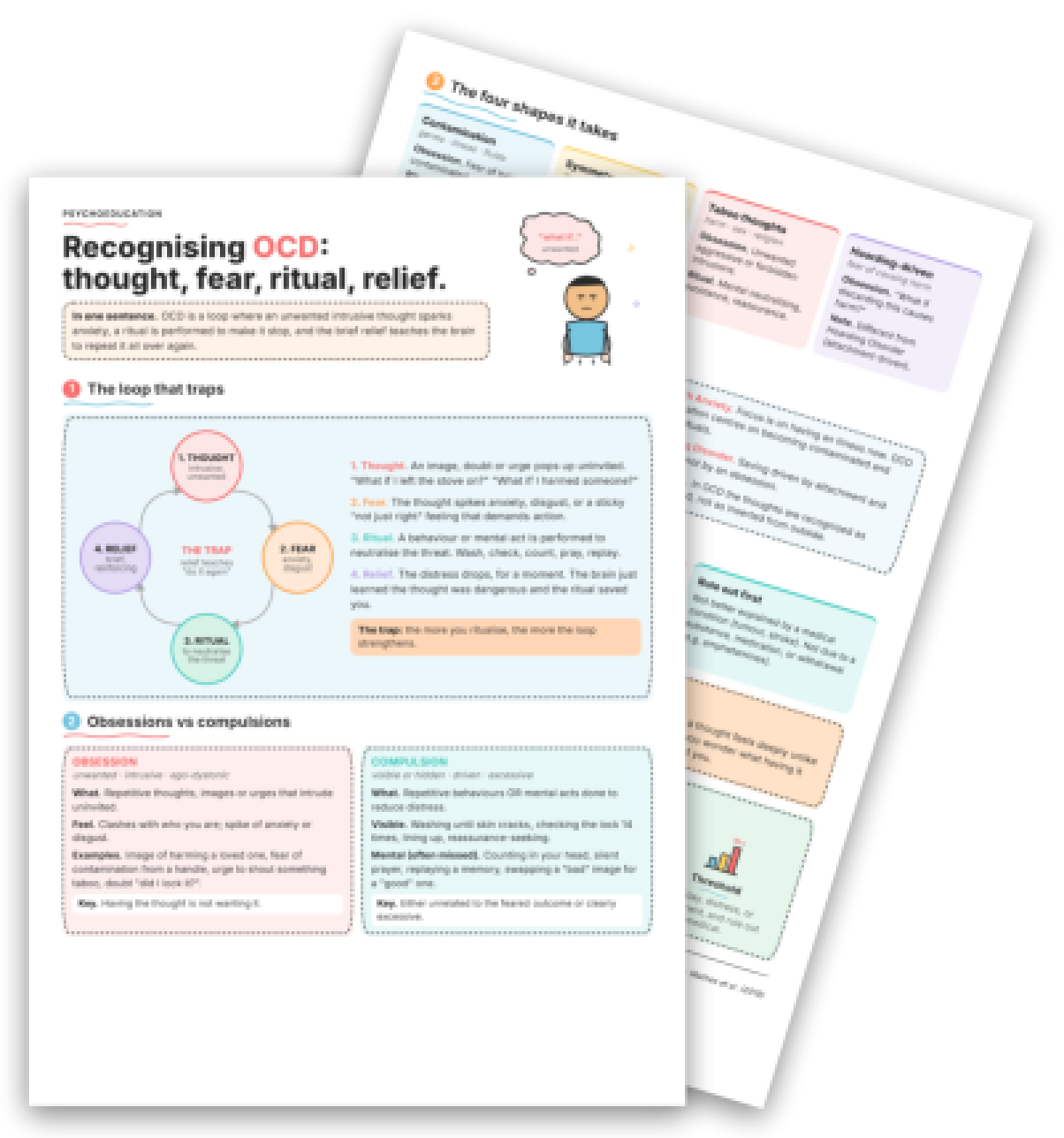
The sheet organizes five numbered panels, each targeting a distinct clinical teaching point.
Panel 1 renders the core loop as a four-step cycle: "intrusive, unwanted thought → anxiety or disgust → ritual to neutralise the threat → brief, reinforcing relief." The panel names the trap explicitly: "relief teaches 'do it again.'" Showing this cycle visually, rather than reciting it, lets you point to the reinforcement arrow the moment a patient says "but checking makes sense."
Panel 2 separates obsessions from compulsions in a side-by-side layout. The obsession column highlights ego-dystonic quality and spike of anxiety; the compulsion column splits visible rituals (washing until skin cracks, checking 14 times) from mental ones (counting, replaying, silent prayer, swapping a "bad" image for a "good" one). This split is the single most useful psychoeducation move for patients who insist they "don't do anything" ritualistically.
Panel 3 maps four clinical presentations: contamination, symmetry, taboo thoughts, and hoarding-driven OCD, each with its characteristic obsession and ritual type. The note under hoarding-driven that distinguishes it from Hoarding Disorder (attachment-driven versus obsession-driven) is directly usable at the differential diagnosis moment.
Panel 4 is a concise differential table covering six look-alikes: GAD, health anxiety, BDD, Hoarding Disorder, tic disorders, and psychosis. The psychosis entry alone ("in OCD the thoughts are recognised as one's own mind, not as inserted from outside") earns its place for any patient who fears their intrusions mean something about their sanity.
Panel 5 covers diagnostic threshold (more than 1 hour per day, or significant distress or impairment), underlying beliefs (inflated responsibility, thought-action fusion, intolerance of uncertainty), and medical/substance rule-outs. It closes with three "to discuss in session" prompts that you can read directly to the patient: "When you notice mental rituals you haven't told anyone about, counting, replaying, silent prayer" is one of them.
> Key takeaway: the fiche is a visual support that facilitates the explanation of OCD in session; it is not a self-administered questionnaire, but a shared reference point you annotate alongside the patient to build a common vocabulary and leave them with a concrete take-home anchor.
Use it with your patients
Share this tool in the mobile app and follow the work between sessions.
When and How to Introduce the Fiche
The optimal moment is after the anamnèse but before the formal treatment rationale, typically session two or three. By then you have enough clinical material to point to the patient's own examples on each panel.
For patients presenting with intrusive thoughts, images, and impulses already acknowledged, the fiche moves quickly to panel 2. For those referred for GAD or health anxiety with a differential still open, panels 4 and 5 do the clinical work. For patients convinced their checking behavior is rational, panel 1's reinforcement arrow is where you linger.
A low-stigma introduction: "I'd like to show you a diagram of how OCD works as a system; tell me what fits and what doesn't." This frames it as collaborative mapping, not labeling. Debrief by asking which panel surprised them most, and whether any of the mental ritual examples apply. Resistance on panel 2 (mental compulsions) is clinically informative.
After the fiche, building an exposure hierarchy and working through the OCD obsessional thought restructuring exercise follow naturally. The OCD compulsion stopping criterion exercise and the OCD compulsion progress review translate the psychoeducation into measurable between-session work. For patients whose reassurance-seeking is silently replacing visible rituals (flagged explicitly in panel 5), that pattern can be named using the exact language they already saw on the sheet. The intolerance of uncertainty dimension and the body dysmorphic disorder and hoarding disorder differential fiche pages can extend the session if needed.
The fiche does not replace formulation or the therapeutic relationship; it makes the conceptual map visible so both clinician and patient are pointing at the same thing.
Patient mobile app
Your session continues in your patients' pocket
Use with a patientYour resources, available everywhere
The handouts, exercises, programs and audios above: you choose which ones to make available to your patients, in the mobile app dedicated to them.
Psychoeducation handoutsInteractive exercisesInteractive programsAudiosPsychometric tests
And far more than a library
The app goes well beyond resources, to support your patients every day:
Standardized tests
Therapy journal
Gamification
Wellbeing challenges
Introspection prompts
Therapist homework
Related categories
Explore other clinical resources by category.
Anxiety
Clinical hub for anxiety disorders: CBT and ACT worksheets, psychoeducation sheets, and exercises for assessment and treatment across the anxiety spectrum.

Understand
Clinical hub for the therapeutic aim 'Understand': worksheets and tools to build patient insight across CBT, ACT, schema therapy and more.

CBT
CBT worksheets, cognitive restructuring exercises & behavioral tools for clinicians. Evidence-based resources for every phase of cognitive behavioral therapy.
Trauma
Clinical hub on trauma and PTSD: assessment, differential diagnosis, treatment phases, and printable resources for practitioners. 155 chars.

Mood
Evidence-based worksheets and clinical tools for mood disorders: CBT, ACT, and positive psychology resources for psychologists and therapists.

Identity
Clinical resources for self-identity work in therapy: CBT, ACT, schema tools for clinicians addressing self-concept, core beliefs, and identity disruption.