
Clinical picture. M., a 34-year-old secondary school teacher, was referred after two emergency department visits in three months, each prompted by chest pain and the conviction she was having a cardiac event; all investigations returned normal. She described the episodes as arriving without warning, once at her desk mid-lesson and once waking her at 3 a.m., lasting roughly fifteen minutes and leaving her exhausted. Using the informational sheet during the session, the clinician walked through the attack-versus-disorder distinction, and M. immediately recognised the anticipatory dread she had been carrying between episodes as significant in its own right. She had already stopped driving on the ring road and was avoiding the staffroom at busy times, a pattern of avoidance she had not previously labelled as related to the attacks. This shared framework opened space to discuss the maintaining cycle and to introduce a rationale for treatment, without requiring M. to accept any particular interpretation of her symptoms before she was ready.
Recognizing Panic Disorder: PDF Worksheet, Tools and Exercises for Clinical Practice
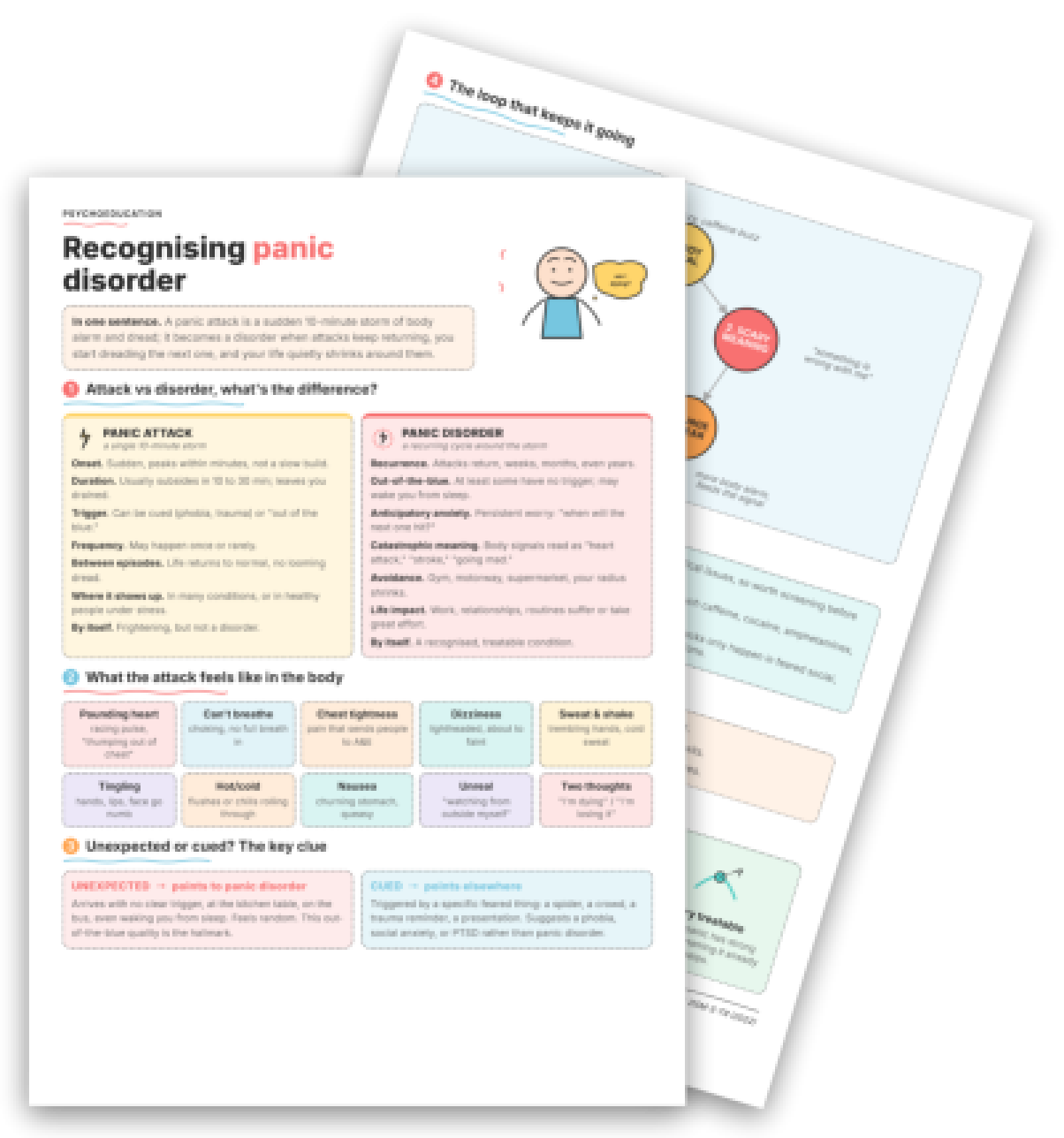
A visual psychoeducation fiche PDF to explain the attack-versus-disorder distinction, the maintenance loop, and differential markers clearly in session.
Clinical vignettes
Unexpected Attacks, Shrinking Radius
Dismissing Recurrence as Stress
Clinical picture. R., a 47-year-old logistics manager, presented describing himself as "not a mental health person" and attributing recurrent episodes of dizziness, tingling, and a sense of unreality to overwork; he had experienced similar episodes intermittently for nearly four years. The clinician used the symptom list from the informational sheet as a neutral checklist, asking R. to indicate which sensations he recognised rather than framing them as psychological from the outset. R. identified eight of the listed physical features, and the out-of-the-blue criterion proved particularly clarifying: he noted that several recent episodes had occurred on quiet Sunday mornings, a detail he had found puzzling. Mapping the frequency and between-episode worry onto the disorder criteria shifted the conversation from "stress management" to a more accurate formulation, and R. agreed to a further assessment session.
Patients who arrive after a first panic episode often leave session still conflating that single event with a chronic condition, then return weeks later more entrenched in anticipatory anxiety and avoidance than when they came. This fiche PDF provides a visual scaffold that makes the attack-versus-disorder distinction immediately legible, names the maintenance loop in plain terms, and gives both clinician and patient a shared model before treatment work begins.
Use this resource with your patients
Handout, exercises and materials ready to use, right inside SessionFuel.
Why the Panic Attack / Panic Disorder Distinction Resists Verbal Explanation
The nosological boundary matters enormously for formulation and treatment planning, yet patients routinely blur it in both directions. Someone who experienced one episode two months ago may now organize their daily life around avoiding a recurrence, meeting every functional criterion for panic disorder without ever having been given the label. Someone who has been cycling through attacks for a year may still believe they have "undiagnosed cardiac problems" or "just bad anxiety," partly because no clinician has explicitly mapped the disorder structure for them.
Describing the catastrophic misattribution cycle verbally rarely produces the insight moment you need. Clark's 1986 cognitive model is precise and elegant on paper, but telling a patient that "the body produces a signal, which is read as dangerous, which amplifies the signal" leaves the linkage between their specific sensations and their conviction that something is medically catastrophic largely intact. The loop needs to be shown, not only described. The unexpected versus cued distinction, equally critical for differentiating panic disorder from social anxiety, specific phobia, or PTSD, is another point where oral explanation alone tends to be insufficient: patients often reach for a plausible trigger retrospectively and miss the diagnostic significance of out-of-the-blue onset.
What the Fiche Contains: A Visual Map for Session Use
The fiche opens with a one-sentence orienting frame: "A panic attack is a sudden 10-minute storm of body alarm and dread; it becomes a disorder when attacks keep returning, you start dreading the next one, and your life quietly shrinks around them." That formulation alone earns its place as a session anchor.
What follows across seven panels:
- Side-by-side comparison of panic attack versus panic disorder across six dimensions: onset, duration, trigger type, frequency, between-episode functioning, and clinical significance. Seeing both columns simultaneously makes the structural difference visible in a way no verbal summary replicates.
- Ten somatic correlates of an attack (pounding heart, chest tightness, derealization, tingling, nausea, and others), giving patients a vocabulary for their body experience before any reframing is attempted.
- Unexpected versus cued panel: a differential hinge you can use to rule in panic disorder while ruling out social anxiety, specific phobia, or PTSD as the primary diagnosis.
- Five-step maintenance loop (body signal, scary meaning, surge of fear, safety move, avoidance), visualized as a cycle. This is Clark's cognitive model of panic in diagram form, making the self-reinforcing structure apparent without requiring a theoretical preamble.
- Medical rule-outs panel covering thyroid pathology, cardiac arrhythmia, vestibular disorders, stimulant use, and benzodiazepine or alcohol withdrawal, before confirming the diagnostic label. Clinically essential when patients arrive self-diagnosed or when somatic presentation warrants re-examination alongside the CBT model of fear of body sensations.
- Three session discussion prompts drawn directly from the fiche: "When you notice your radius shrinking, places you used to go but now quietly avoid" and "When the dread between attacks is starting to weigh as much as the attacks themselves." These function as readiness probes for assessing anticipatory anxiety and agoraphobic avoidance before you move toward treatment planning.
- Four-point summary panel distilling the key clinical messages: the time-limited arc of an attack, the attack-versus-disorder distinction, the role of catastrophic meaning, and treatability.
> Key point: This fiche is a visual psychoeducation support designed to facilitate your in-session explanation. It is not a checklist patients complete independently. Its value is in being shown while you walk through each panel together, building a shared working model before graded exposure work or any other structured intervention begins.
750+ clinical tools
A library built with and for clinicians, ready to use in session and extend between appointments.
Access all the toolsWhen and How to Introduce It
The fiche sits naturally at the close of the first or second appointment, after the initial anamnesis and before you introduce structured tools such as the Panic Attacks psychoeducation program or interoceptive exposure exercises. A straightforward introduction: "I'd like to show you something that maps exactly what you've been describing. Have a look at this with me and tell me what fits your experience."
For patients presenting with chest pain or dizziness who have already been through cardiac investigations, Panel 5 (rule-outs) is a natural first anchor. It validates their concern about physical causes while opening a conversation about functional explanation, without dismissing their medical history.
The maintenance loop panel is particularly productive with patients whose avoidance has already generalized significantly: seeing safety behaviors named explicitly ("sit, grip, leave, check pulse") as steps that feed the loop often shifts something that weeks of verbal explanation has not. For patients whose generalized anxiety runs alongside panic, you can cross-reference the anticipatory anxiety section with your work on intolerance of uncertainty.
One limit worth noting: patients in acute crisis or with active medical comorbidity are not the right audience for the differential panel on a first meeting. In those contexts, delay the disorder-level psychoeducation until the alliance is solid and acute distress has reduced. The fiche does not replace the clinical formulation; it makes it easier to explain.
Use it with your patients
Share this tool in the mobile app and follow the work between sessions.
Sources
- American Psychiatric Association (2013). Diagnostic and Statistical Manual of Mental Disorders, Fifth Edition (DSM-5). American Psychiatric Publishing.
- National Institute for Health and Care Excellence (NICE) (2011). Generalised anxiety disorder and panic disorder in adults: management (Clinical Guideline CG113). NICE.
- Barlow, D. H. (2002). Anxiety and Its Disorders: The Nature and Treatment of Anxiety and Panic (2nd ed.). Guilford Press.
Your session continues in your patients' pocket
Use with a patientYour resources, available everywhere
The handouts, exercises, programs and audios above: you choose which ones to make available to your patients, in the mobile app dedicated to them.
And far more than a library
The app goes well beyond resources, to support your patients every day:
Related categories
Explore other clinical resources by category.

Anxiety
Clinical hub for anxiety disorders: CBT and ACT worksheets, psychoeducation sheets, and exercises for assessment and treatment across the anxiety spectrum.

Understand
Clinical hub for the therapeutic aim 'Understand': worksheets and tools to build patient insight across CBT, ACT, schema therapy and more.

CBT
CBT worksheets, cognitive restructuring exercises & behavioral tools for clinicians. Evidence-based resources for every phase of cognitive behavioral therapy.

Trauma
Clinical hub on trauma and PTSD: assessment, differential diagnosis, treatment phases, and printable resources for practitioners. 155 chars.

Mood
Evidence-based worksheets and clinical tools for mood disorders: CBT, ACT, and positive psychology resources for psychologists and therapists.

Identity
Clinical resources for self-identity work in therapy: CBT, ACT, schema tools for clinicians addressing self-concept, core beliefs, and identity disruption.